

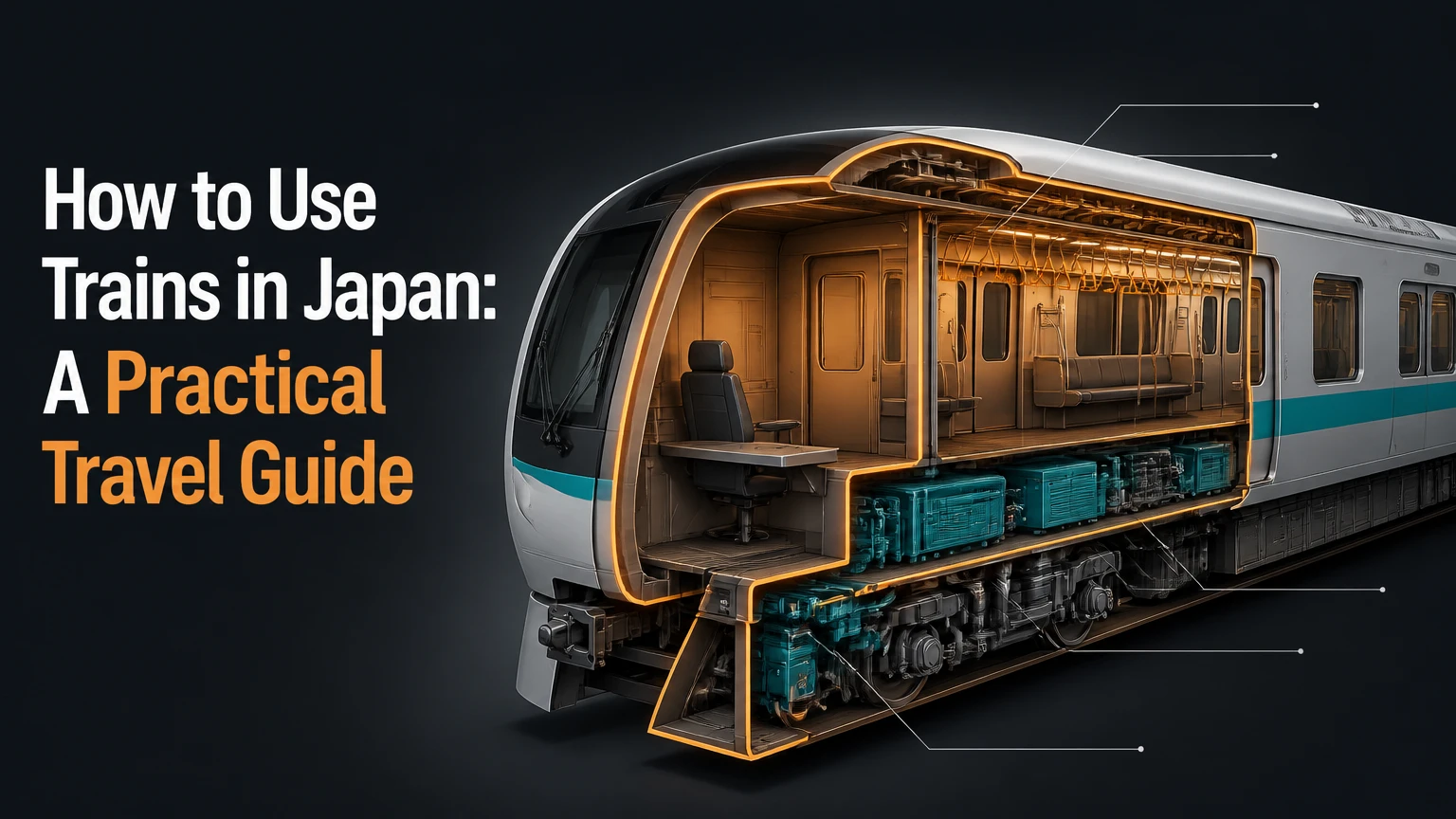
Japan’s train system is a nationwide network of Shinkansen, JR services, private railways, and subways that connects airports, cities, and rural destinations with frequent, highly organized service. To travel successfully, choose the correct operator and train type, pay the base fare plus any required surcharge, follow platform queues, and tap out or submit your ticket at the destination.
Key Facts
Local urban rides typically cost about $1.00-$2.35, while a reserved Tokyo to Kyoto Shinkansen seat is typically about $97-$103, depending on exchange rates and train type.
An IC card such as Suica, PASMO, or ICOCA works for most short urban journeys, but not every rural route or long-distance trip.
A national JR Pass costs enough that travelers should calculate individual fares before buying it. Regional passes can be better value.
Most city trains stop between about 12:00 a.m. and 5:00 a.m.; rural services often finish earlier.
Shinkansen luggage with total dimensions above 160 centimeters requires a reserved seat with an oversized-baggage area on applicable services.
Google Maps, Japan Travel by NAVITIME, and official railway apps can show the route, platform, fare, transfer, and last departure.
How Japan’s Rail System Is Organized
Japan has three practical railway categories: JR companies, private railways, and municipal subway operators. The six JR passenger companies manage regional networks and Shinkansen lines, while companies such as Tokyo Metro, Toei Subway, Keio, Odakyu, Hankyu, and Kintetsu operate separate services.
A station can contain several operators behind different gates. Tokyo Station, for example, includes JR East, JR Central, the Tokaido Shinkansen, local JR lines, and subway connections. A route that looks like one journey in a navigation app may therefore require a transfer between operators, with separate fare systems.
What Do Train Types Mean?
Train names indicate how many stations a service skips and whether a supplement applies. Local, Rapid, and Express services usually use the same basic fare structure, while Limited Express trains and Shinkansen normally require an additional charge.
| Train type | Stops and speed | Extra payment | Best use |
|---|---|---|---|
| Local, Futsu | Every station; slowest conventional service | Usually none | Short urban or rural trips |
| Rapid, Kaisoku | Skips smaller stations; faster than Local | Usually none | Suburban journeys with flexible timing |
| Express, Kyuko | Skips more stations; route-specific | Usually none | Medium-distance private railway trips |
| Limited Express, Tokkyu | Major stations; faster conventional train | Usually required | Kyoto to Kanazawa or Osaka to Nara alternatives |
| Shinkansen | Dedicated high-speed line; up to about 320 km/h | Required | Long-distance city-to-city travel |
“Express” does not have one national meaning. A private railway may use a different stopping pattern from JR, so read the destination display rather than boarding based only on the English category.
How to Use Trains in Japan, Step by Step
Using a Japanese train involves five decisions: find the route, identify the operator, pay correctly, locate the platform, and exit through the right fare gate. The procedure is simple when the journey remains within one IC-card area, but paper tickets or staffed gates may be necessary when the trip crosses incompatible systems.
- Search the complete route. Enter the exact station name, not only the neighborhood. Check departure time, arrival time, operator, train type, platform, fare, and final train.
- Choose payment. Tap a valid IC card for eligible local journeys, or buy a paper ticket and any required limited-express or Shinkansen reservation.
- Enter through the correct gate. Green IC readers accept tap-in cards. Ticket gates accept the paper ticket face-up in the marked slot.
- Match the destination and direction. Japanese signs usually show the line color, station number, Japanese name, and English name. Confirm the terminal station because two platforms may use the same line.
- Queue behind the floor markings. Stand to one side of the doors and let passengers exit before boarding.
- Board the correct car. Confirm reserved-seat numbers, Green Car markings, women-only-car notices, and oversized-baggage arrangements.
- Exit and settle the fare. Tap out with the same IC card used to enter. Insert a paper ticket at the exit gate, or visit a staffed machine if the ticket is rejected.
How Do Japanese Train Transfers Work?
A transfer can be platform-to-platform, within one station complex, or between operators through linked gates. The last type is where visitors most often lose time because the route may require a second fare calculation or a transfer gate.
Follow signs for the new line instead of walking toward the station’s street exit. In large stations, a transfer can take 10-20 minutes, and Tokyo Station’s Shinkansen platforms may require a longer walk than the map suggests. Navigation apps sometimes label a transfer “seamless,” but you still need to follow the colored signs and avoid exiting the paid area.
If an IC card fails at a transfer gate, do not force through. Show the entry and transfer history to a station employee, who can calculate the adjustment and reopen the gate.
Tickets, IC Cards, and Fares
Japanese rail fares usually combine a distance-based base fare with an optional or mandatory surcharge. The surcharge pays for speed, a reserved seat, a Green Car, or a special service, so a low base fare does not necessarily equal the final price.
When Should You Use an IC Card?
Use an IC card for repeated local travel in Tokyo, Osaka, Kyoto, Fukuoka, Sapporo, or another supported urban area. Suica and PASMO are associated with eastern Japan, while ICOCA is associated with the Kansai region, but nationwide interoperability allows most cards to work across major compatible networks.
| Payment method | Typical cost or limit | Works well for | Main limitation |
|---|---|---|---|
| Mobile Suica or PASMO | Fare charged per ride; top-up amount varies | Tokyo-area trains, buses, convenience stores | Device battery, region, and card setup issues |
| Physical IC card | Deposit and stored balance vary by issuer | Local trips and quick transfers | May require cash for top-up |
| Paper local ticket | About $1.00-$2.35 for many city trips | One-off rides or unsupported routes | Fare must be selected correctly |
| Reserved Shinkansen ticket | About $95-$125 for common Tokyo-Kansai trips | Long-distance travel with a guaranteed seat | Separate booking or purchase required |
| Limited Express ticket | Base fare plus a route-specific supplement | Faster conventional services | IC tap alone may not cover the supplement |
Mobile cards can be added to Apple Wallet in supported configurations. Android compatibility depends on the device, region, and mobile wallet settings. Physical cards are often easier for children, backup travel, or phones that may lose power.
IC cards do not replace every ticket. They may fail on rural lines without IC readers, trips that cross certain regional boundaries, or journeys where the balance is insufficient. Buy a paper ticket or ask a staff member before entering when the route leaves a major metropolitan area.
How Are Shinkansen Fares Calculated?
A Shinkansen fare normally includes the base fare, the limited-express surcharge, and the seat category. Reserved Ordinary seats cost less than Green Car seats, while Nozomi trains on the Tokaido and Sanyo routes can differ from Hikari or Kodama services.
The following are typical one-way estimates converted to USD at approximately 150 Japanese yen per dollar. Actual prices change with exchange rates, train category, season, and booking product.
| Route | Typical travel time | Reserved Ordinary fare | Frequent departure pattern |
|---|---|---|---|
| Tokyo to Kyoto | About 2 hours 15 minutes to 2 hours 40 minutes | About $97-$103 | Often every 5-15 minutes |
| Tokyo to Shin-Osaka | About 2 hours 30 minutes to 3 hours | About $100-$108 | Often every 5-15 minutes |
| Tokyo to Hiroshima | About 3 hours 45 minutes to 4 hours 30 minutes | About $130-$145 | Several departures each hour |
| Tokyo to Hakodate | About 4 hours to 4 hours 30 minutes | About $150-$165 | Fewer departures than Tokaido services |
| Tokyo to Nagoya | About 1 hour 35 minutes to 2 hours | About $70-$78 | Often every 5-15 minutes |
A reserved seat provides a specific car and seat number. A non-reserved ticket permits travel in designated cars, but a busy holiday departure may leave passengers standing or waiting for the next train.
Is the National JR Pass Worth Buying?
The national JR Pass is worthwhile only when its price is lower than the eligible JR journeys you would otherwise purchase. Compare the pass price with the total of your actual long-distance routes, and exclude private railways, subways, buses, and non-covered services.
| Travel pattern | Individual-ticket tendency | Pass decision |
|---|---|---|
| Tokyo, Kyoto, and Osaka only | Moderate total rail cost | Individual tickets usually offer better control |
| Tokyo to Hiroshima and return within 7 days | High long-distance cost | Compare carefully with a 7-day pass |
| Tokyo, Kanazawa, Kyoto, Hiroshima, and return | Several expensive JR segments | A pass may become competitive |
| Mostly Kyoto buses and Tokyo subway | Many non-JR journeys | National JR Pass usually fits poorly |
| One regional loop within Kansai or Kyushu | Concentrated JR travel | Regional pass may offer better value |
Regional products, including JR East, JR Kansai, JR Kyushu, and JR Hokkaido passes, have different coverage, validity periods, and eligibility rules. Check the official operator website before payment because pass prices and conditions change.
Booking Shinkansen and Limited Express Seats
Book a reserved seat when traveling during Golden Week, Obon, New Year, a national holiday, or with children and large luggage. On ordinary weekdays, popular routes usually have enough departures to allow flexibility, but a reservation removes uncertainty.
SmartEX covers Tokaido, Sanyo, and Kyushu Shinkansen bookings through its official service. Other routes use products such as Eki-net, JR West Online Train Reservation, or station ticket offices. Tickets can also be purchased from multilingual machines, although complex itineraries are easier at a staffed counter.
Expert insight: A “faster” Shinkansen is not always the best connection. Nozomi reduces stops, but Hikari or Kodama may have different reservation availability, luggage options, or pass eligibility. Compare the complete itinerary, not only the train name.
Stations, Platforms, and Train Etiquette
Station signs are commonly bilingual, but large stations still require deliberate navigation. Line colors and station numbers are often more reliable than pronunciation because several stations can share similar English names.
Platform markings identify door positions, car numbers, and sometimes the queue for a particular train category. Stand behind the marked line, keep the boarding area clear, and allow passengers to leave before entering.
JR East’s passenger etiquette guidance states, “Please refrain from talking on mobile phones.” Set the phone to silent or “manner mode,” and use text messaging instead.
| Situation | Expected behavior | Practical reason |
|---|---|---|
| Boarding | Queue at painted door markings | Preserves orderly boarding and exit space |
| Phone use | Silent mode; text rather than call | Reduces noise in enclosed carriages |
| Priority seats | Leave available for elderly, pregnant, injured, or disabled passengers | Priority seating depends on passenger need |
| Food | Avoid meals on short commuter trains; eat quietly on long-distance services | Local etiquette differs by journey type |
| Luggage | Keep bags at your feet or in designated storage | Aisles and doors must remain clear |
| Women-only cars | Check pink signs and posted operating times | Rules vary by operator and time of day |
Women-only cars are common on some urban routes during crowded periods, especially weekday morning commutes. Policies differ by railway and may include exceptions for children, caregivers, or passengers with disabilities. Read the platform sign before boarding.
Eating an ekiben, or station bento, is normal on Shinkansen and many Limited Express trains. Strong odors, open drinks, and full meals are poor choices on crowded city services.
Luggage, Children, Seniors, and Accessibility
Large luggage changes the best route. On applicable Tokaido, Sanyo, and Kyushu Shinkansen services, baggage whose total external dimensions exceed 160 centimeters generally requires a seat reservation with an oversized-baggage area. Bags above 250 centimeters may not be accepted.
| Traveler need | Recommended choice | Typical planning allowance |
|---|---|---|
| One adult with a carry-on | IC card plus local service | 5-10 minutes for ordinary transfers |
| Family with stroller | Reserved seats near a deck or elevator route | 15-25 minutes in major stations |
| Senior traveler | Fewer transfers and elevator-marked paths | Add 10-20 minutes per large station |
| Wheelchair user | Station assistance requested in advance when possible | Add 20-40 minutes for boarding coordination |
| Large suitcase | Oversized-baggage reservation or forwarding | Forwarding commonly costs about $13-$27 per bag |
Takuhaibin luggage forwarding, offered by companies such as Yamato Transport and Sagawa Express, sends bags from a hotel, airport counter, or convenience location to a later accommodation. Delivery commonly takes 1-2 days and may not be same-day, so keep medication, passports, chargers, and one change of clothes with you.
Strollers should be folded where possible, especially during rush hour. Elevators may be far from the platform, and some station corridors include stairs even when the final destination has step-free access.
Expert insight: The most efficient transfer is often the one with fewer operators, not the one with the shortest displayed time. A three-minute interchange between separate rail companies can become a missed train when gates, stairs, and luggage are involved.
Operating Hours, Crowding, and Delays
Urban railways commonly stop around midnight and resume around 5:00 a.m., although exact times vary by line and station. The last departure from the city center may leave earlier than expected because the train must complete its full route.
Morning commuter congestion is commonly strongest from about 7:30-9:00 a.m., with evening demand often rising from 5:30-7:00 p.m. Major urban lines can arrive every 2-5 minutes, while rural services may run once every 30-120 minutes.
| Operating factor | Major-city pattern | Rural or regional pattern |
|---|---|---|
| Peak frequency | About every 2-5 minutes | About every 30-120 minutes |
| Last-train risk | Around midnight on many lines | Often earlier than midnight |
| Platform crowding | High during weekday peaks | Usually lower, except events |
| Schedule recovery | Frequent replacement departures | Long wait after a missed train |
| Weather exposure | Delays from storms or flooding | Snow and landslides can suspend routes |
Japanese railways issue delay certificates for qualifying disruptions, often when a delay reaches about five minutes, but the threshold and delivery method depend on the operator. Obtain one from a station office or operator website if an employer or school requires proof.
Weather can override punctual schedules. Typhoons, heavy snow, earthquakes, flooding, and strong winds may suspend service, particularly on exposed coastal or mountain routes. Check the railway operator’s live status page before leaving for the station.
Rail Compared With Flights and Buses
Trains are strongest for city-center travel between destinations connected by high-speed rail. Flights can win on very long domestic routes, while highway buses usually win on price when travelers accept longer journeys and fixed pickup points.
| Option | Tokyo to Kyoto example | Typical cost | Main constraint |
|---|---|---|---|
| Tokaido Shinkansen | About 2 hours 15 minutes to 2 hours 40 minutes | About $97-$108 | Higher price than a bus |
| Domestic flight | About 1 hour 10 minutes airborne, 4-6 hours door to door | About $60-$180 | Airport transfers and check-in |
| Highway bus | About 7-9 hours | About $27-$70 | Traffic, limited legroom, overnight fatigue |
| Rental car | About 6-8 hours without major stops | About $70-$180 before fuel and tolls | Tolls, parking, left-side driving |
A train ticket normally avoids airport security and city-to-airport travel. A flight can still be better for Tokyo to Sapporo, Okinawa, or remote destinations without a convenient rail connection.
Common Problems and Their Solutions
What Happens If an IC Card Is Rejected?
An IC card may be rejected because the balance is too low, the previous trip was not closed, the route crosses a regional boundary, or the card is not accepted on that line. Visit the staffed gate instead of tapping repeatedly.
The employee can inspect the card history, charge an adjustment, or explain which ticket is required. Do not use a second card to enter before resolving the first card’s open journey, because the system may retain an incomplete trip.
What Happens If You Miss a Reserved Train?
A missed reserved Shinkansen departure usually does not erase the entire ticket’s value. On many standard tickets, the passenger can use a later non-reserved seat that day, while changing to a later reserved train may require a fee or fare adjustment.
Conditions differ by ticket type, discount, and booking platform. Ask at a ticket office before boarding the next departure. Discount products bought online can have stricter change rules than ordinary station tickets.
What If You Lose Something?
Report lost property to the railway operator as soon as possible, giving the train name, departure time, car number, seat, boarding station, and item description. Japan’s railway lost-property systems are organized, but recovery becomes harder after the item moves to a central office.
Take a photograph of your passport, luggage tag, and train reservation before departure. That information reduces the time needed to identify the correct service.
How Can You Avoid the Last Train?
Check the final connection from the destination station, not merely the last train leaving the first station. A transfer may end several minutes earlier, and a small delay can eliminate the connection.
For late evenings, select a route with fewer transfers and save the address of your accommodation in Japanese. Taxis are available in cities but can cost substantially more than the original rail fare.
A Practical Three-City Rail Plan
A first-time itinerary can combine urban IC-card travel with reserved intercity tickets. The following example assumes Tokyo, Kyoto, and Hiroshima, without a national rail pass.
| Journey | Suggested service | Typical duration | Typical one-way cost |
|---|---|---|---|
| Narita Airport to central Tokyo | Airport train | About 55-90 minutes | About $14-$26 |
| Tokyo urban travel | JR or subway with IC card | 10-45 minutes | About $1.00-$2.35 |
| Tokyo to Kyoto | Tokaido Shinkansen | About 2 hours 15 minutes to 2 hours 40 minutes | About $97-$103 |
| Kyoto to Hiroshima | Sanyo Shinkansen | About 1 hour 40 minutes to 2 hours | About $65-$85 |
| Hiroshima urban travel | Tram, JR, or bus | 10-40 minutes | About $1.00-$3.00 |
Reserve intercity seats before a major holiday, but keep urban journeys flexible. Kyoto sightseeing often involves buses as well as trains, and an IC card simplifies short payments when the route supports it.
Expert insight: Kyoto does not have a single rail system that reaches every major temple. Visitors who insist on using trains for all sightseeing can create extra walking and transfers; combining JR, private railways, subway lines, and buses is often faster.
Frequently Asked Questions About how to use trains in Japan
Can I use one IC card everywhere in Japan?
One major IC card works across many interoperable urban networks, including Tokyo, Osaka, Kyoto, Nagoya, and Fukuoka. It may not work on isolated rural lines, across some regional boundaries, or for journeys without compatible readers. Check the operator before entering a remote station.
Should I buy a train ticket in advance in Japan?
Buy Shinkansen and Limited Express reservations in advance when traveling during national holidays, school vacations, or with oversized luggage. Ordinary local trains rarely require advance booking. Travelers can usually purchase local tickets immediately before departure from a machine or staffed counter.
Do Japanese trains have Wi-Fi and toilets?
Many Shinkansen and Limited Express trains provide toilets, and major services commonly offer onboard Wi-Fi, although signal quality varies by route and carrier. Local commuter trains may have neither. Treat mobile connectivity as a convenience rather than a guarantee during rural travel.
Can I bring food onto a Japanese train?
Food is generally acceptable on Shinkansen and many long-distance Limited Express trains, where passengers commonly eat quietly. Meals are usually avoided on crowded urban commuter trains. Choose low-odor food, clean your seat area, and keep drinks securely closed when the train is moving.
How early should I arrive for a Shinkansen?
Arrive about 15-20 minutes before departure at a large station and about 10 minutes early at a familiar smaller station. Tokyo Station may require extra time to locate the correct Shinkansen gate, platform, car position, and ticketing area.
Is Japan’s rail system suitable for first-time visitors?
Japan’s rail system is suitable for first-time visitors because signs, machines, and announcements on major routes commonly include English. The main difficulties are operator boundaries, large stations, last-train limits, and rural schedules. A route screenshot, charged phone, and small cash backup reduce avoidable problems.
Conclusion
The practical answer to how to use trains in Japan is to match the train type and operator to the journey, use an IC card for eligible local travel, reserve long-distance seats when demand or luggage requires it, and verify the last connection before leaving. Keep transfers simple, follow platform markings, and use a staffed gate whenever a fare or ticket behaves unexpectedly.
