

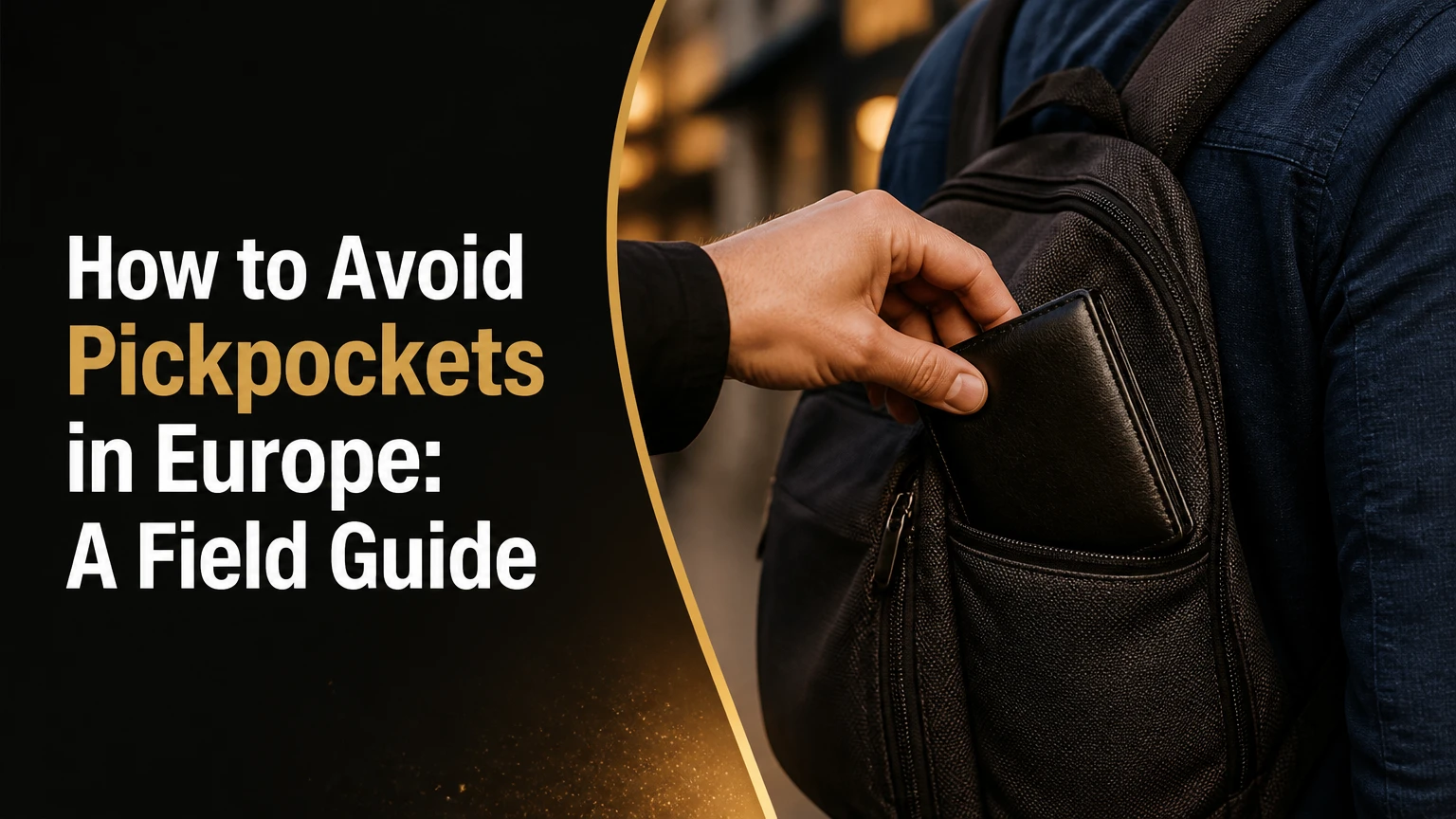
How to avoid pickpockets in Europe means reducing access, limiting distraction, and keeping valuables recoverable if theft occurs. Pickpocketing is usually a non-violent theft of phones, wallets, passports, or bags in crowded or distracting settings. A layered system works better than any single product: secure storage, deliberate attention, and rapid account controls.
Key Facts / Quick Answer
Keep your passport, backup card, and most cash in hidden storage, while carrying only the day’s spending limit.
Move a backpack to your chest in crowds and keep every zipper closed within your hand’s reach.
Treat unexpected contact, unsolicited help, petitions, spills, and sudden crowding as prompts to check your belongings.
A phone lanyard reduces a grab risk, but it does not prevent account takeover after the phone is stolen.
Photograph passport identification pages and save bank emergency numbers before departure.
If theft occurs, freeze cards and the mobile service first, then report the incident and replace documents.
How Pickpocketing Works in European Travel Settings
Pickpocketing is a proximity theft that depends on access and divided attention. The offender does not need to overpower a traveler if a pocket is open, a phone is visible, or a bag is behind the owner’s body in a dense crowd.
A typical incident has three phases: selection, distraction or concealment, and removal. The phases may happen in seconds, and the person who creates the distraction may not be the person who takes the item. The UK Foreign, Commonwealth and Development Office warns in its travel advice for Spain that “thieves can use distraction techniques,” a concise description of why apparent helpfulness deserves distance rather than confrontation.
The highest-value prevention point is the transition between distraction and contact. When someone bumps, blocks, spills, points urgently, or crowds a doorway, place one hand over your phone and wallet, step away, and assess the scene.
The roles behind a coordinated theft
Not every incident involves a group, and travelers should avoid assuming that a particular age, nationality, or appearance identifies a thief. Some thefts are opportunistic and solitary. Others use separate roles:
- Approacher: starts a conversation, asks for directions, or requests a signature.
- Blocker: stops at an escalator, doorway, platform entrance, or ticket machine.
- Remover: accesses a pocket, open bag, or table.
- Receiver: takes the item away, making recovery harder if the remover is challenged.
- Observer: watches who is carrying visible phones, cameras, or large amounts of cash.
This role separation explains why chasing one person rarely solves the problem. Your safest response is to protect yourself, create distance, identify witnesses, and contact transport staff or police.
Where Pickpocket Risk Rises
Pickpocket risk rises where strangers stand close together, travelers must make quick decisions, and bags or phones are temporarily unattended. Major stations, metro platforms, landmark approaches, outdoor cafés, festivals, nightlife streets, and ticket queues create these conditions in many European cities.
The risk is not a permanent property of Paris, Rome, Barcelona, London, Prague, or any other destination. It changes by neighborhood, event, crowd density, time, and your behavior. Official travel advisories from the US Department of State and national foreign ministries commonly identify crowded tourist areas and public transportation as settings where petty theft occurs.
| Setting | Typical exposure window | Vulnerable item | Safer adjustment |
|---|---|---|---|
| Metro doorway | 10-30 seconds | Phone, wallet | Store phone before doors open |
| Ticket machine | 2-5 minutes | Open purse, card | Stand sideways and refuse unsolicited help |
| Landmark queue | 15-45 minutes | Rear backpack pocket | Wear bag in front with zippers closed |
| Outdoor café | 20-60 minutes | Phone on tabletop | Keep phone in a zipped pocket |
| Nightlife district | 30-120 minutes | Phone, room key, card | Carry one card and limited cash |
| Street market | 10-40 minutes | Wallet, camera | Use a closed cross-body bag in front |
Summer travel increases exposure because more visitors create dense queues and transit loads, but winter crowds, holiday markets, and major sporting events can produce the same conditions. Rush hour, approximately 7:30-9:30 a.m. and 5:00-7:00 p.m., is a practical warning period rather than a universal crime schedule.
A simple threat-triage rule
Use three questions when entering a crowded setting:
- Can another person reach my valuables without moving my clothing or opening a lock?
- Would I notice if someone touched the back of my bag?
- Can I leave the crowd without stopping to search for my phone or passport?
If the answers are no, no, and no, change the setup before proceeding. Put the phone away, move the bag forward, and separate deep-storage documents from daily spending items.
Which Distraction Scams Should You Expect?
Distraction scams create a reason for you to look away, stop moving, or expose where you keep money. The safest response is consistent: decline, regain control of your belongings, move toward staff or a public business, and avoid handling a stranger’s object near your pockets.
| Distraction pattern | What the traveler experiences | Immediate risk | Correct response |
|---|---|---|---|
| Petition or clipboard | Signature request near a landmark | Waist-level pocket access | Say “No, thank you,” cover valuables, keep walking |
| Spill or stain | Food or drink appears on clothing | Wallet removed during cleaning | Step back, refuse assistance, clean privately |
| Ticket-machine help | Stranger reaches toward controls | Card, PIN, or wallet exposure | Cancel the transaction and use staff |
| Doorway squeeze | Sudden pushing as doors close | Phone or pocket theft | Leave the doorway and secure belongings |
| Dropped coins or object | Items scatter beside you | Attention directed downward | Keep walking and check your pockets |
| Map or sign placed over table | Object covers a phone | Grab-and-run theft | Put the phone away before engaging |
A legitimate person may ask for directions, and a genuine accident may happen. You do not need to determine intent in the street. A brief refusal protects you better than prolonged politeness.
Expert insight: The most useful response is not constant suspicion. It is a rehearsed interruption. Travelers who decide in advance to cover valuables and create distance react faster than travelers who try to interpret a stranger’s motive while being physically crowded.
How Should You Carry Cash, Cards, and Documents?
Carry valuables in two layers: accessible daily items and hidden backup items. The daily layer should contain one payment card, a small spending amount, and the transit item you need; the hidden layer should contain the passport, backup card, and emergency cash.
A typical daily limit for many city trips is $40-$60 in cash, adjusted for local prices and your itinerary. Do not carry every card, all travel funds, or your passport in the same exposed wallet. A passport usually belongs in secure storage during ordinary sightseeing unless an operator or authority requires it.
| Item | Recommended location | Typical quantity | Recovery value |
|---|---|---|---|
| Daily cash | Closed front pocket | $40-$60 | Limits direct loss |
| Primary card | Zipped inner pocket | 1 card | Supports same-day spending |
| Backup card | Hidden pouch or lodging safe | 1 card | Preserves payment access |
| Passport | Hidden pouch or secure lodging storage | 1 document | Prevents embassy disruption |
| Emergency cash | Separate hidden location | $100-$200 | Covers transport and food |
| Transit card | Dedicated front pocket | 1 card | Avoids opening main wallet |
A money belt is suitable for documents and backup funds, not constant public access. Reaching beneath clothing at a station advertises its location and can expose the rest of your belongings. A hidden pouch works best when loaded before leaving the room and left untouched during the day.
Which security gear is worth using?
No bag makes theft impossible. Products reduce access time, improve visibility, or add physical resistance, but comfort and correct use determine whether a feature helps.
| Security option | Typical price in USD | Useful specification | Main limitation |
|---|---|---|---|
| Hidden money belt | $15-$45 | Under-clothing pouch | Hot and awkward to access |
| Locking zipper day bag | $60-$180 | Dual zipper clips or locks | Slower access in queues |
| Slash-resistant cross-body bag | $40-$150 | Cut-resistant strap | Still vulnerable when left on a chair |
| Phone tether | $10-$30 | Breakaway or reinforced connector | Does not protect accounts |
| Front-pocket wallet | $10-$40 | Tight fit, closed edge | Not secure if left on a table |
| RFID-blocking sleeve | $5-$20 | Contactless-card shielding | Does not stop physical theft |
RFID protection addresses unauthorized wireless reads from compatible cards. It does not prevent someone from taking a wallet, guessing a PIN, or persuading you to approve a payment. Treat RFID as a narrow feature, not a complete anti-theft system.
Anti-theft bag versus ordinary cross-body bag
An anti-theft bag can justify its extra cost when you carry a camera, medication, tablet, or multiple documents. A simple cross-body bag can be equally effective for a light itinerary if it has a closed compartment, sits in front of your torso, and remains under your hand in crowds.
Choose based on access and behavior:
- Use a small cross-body bag for museums, markets, and transit.
- Use a backpack for longer walking days, but move it to your chest in dense crowds.
- Use a hidden pouch for passports and backup funds.
- Avoid a bag that requires removal or full opening every time you pay.
- Keep valuables in separate compartments so one opening does not expose everything.
Expert insight: A highly secure bag that is uncomfortable often creates more risk because travelers place it on café floors, chair backs, or luggage racks. A modest bag that stays attached to your body usually provides better real-world protection.
What Should You Do Before Leaving Home?
Prepare the recovery system before preparing the sightseeing itinerary. A stolen phone or passport becomes more disruptive when you cannot access account numbers, identity records, bookings, or emergency contacts.
Complete these steps 24-48 hours before departure:
- Photograph the identification page of your passport and any visa.
- Record card issuer emergency numbers and store them offline.
- Save copies in an encrypted cloud folder and on a second device.
- Enable device tracking, screen locking, and remote erase.
- Confirm that two-factor authentication has a backup method.
- Add a trusted contact who can help with account recovery.
- Check travel insurance terms for police reports, electronics, and document replacement.
- Carry a paper list of one emergency contact and your insurer’s claim number.
Do not store card photographs, passport scans, or recovery codes in an unlocked public notes app. Use a password manager or encrypted storage, and test that the backup can be opened without the stolen device.
| Preparation task | Time required | Failure prevented | Verification method |
|---|---|---|---|
| Device tracking | 5-10 minutes | Unrecoverable phone | Test location from another device |
| Card contact list | 10 minutes | Delayed account freeze | Call one issuer before travel |
| Passport backup | 5 minutes | Embassy identification delay | Open encrypted copy offline |
| Two-factor backup | 10-20 minutes | Locked email account | Use a secondary method |
| Insurance review | 15-30 minutes | Rejected claim | Note report and receipt rules |
How to Behave on Streets, Transit, and at Meals
Your body position matters more than the brand printed on a bag. Keep valuables in front of you, maintain a hand on the closure in crowds, and avoid standing with a phone in one hand while your attention is fixed on a map.
On trains and buses, secure the phone before boarding and keep bags between your feet only when your hands remain on them. Do not place a backpack on a luggage rack beyond your view during a short urban ride. At a doorway, let a rush pass rather than competing for the last second before the doors close.
At restaurants, keep a bag on your lap or loop its strap around your leg without trapping yourself. Never place a phone near the table edge, hang a purse on a chair back, or put a wallet in a jacket draped behind you.
At ATMs, inspect the area before inserting a card. Shield the keypad, decline unsolicited help, and put cash away before walking. If the machine retains the card, contact the bank immediately rather than following a stranger to another machine.
| Situation | Avoid | Prefer | Time to correct |
|---|---|---|---|
| Reading a map | Phone held at shoulder height | Step inside a café or station office | 30 seconds |
| Boarding a train | Phone beside closing doors | Phone zipped away before boarding | 5 seconds |
| Eating outdoors | Phone on table edge | Zipped pocket or hand-held use | 10 seconds |
| Using an ATM | Counting cash beside machine | Store cash before leaving | 20 seconds |
| Carrying luggage | Passport in outer pocket | Documents in interior compartment | 1 minute |
Expert insight: The most common preventable failure is a temporary placement. A traveler may secure valuables correctly, then put a phone on a table “for one minute” or a passport in an outer pocket “while checking in.” Theft targets these transitions because attention is already occupied.
Special Situations That Need Different Tactics
Families, solo travelers, nightlife visitors, and people using mobility aids face different access problems. The correct system must remain usable while walking, boarding, supervising children, or managing a wheelchair.
For children, keep passports and payment cards with one designated adult rather than distributing them across children’s bags. Teach children not to stop for unsolicited approaches and give them a simple instruction: stay beside the adult and point out unusual contact without chasing anyone.
Solo travelers should avoid putting every essential item in one bag. Carry a small visible daily wallet, place the backup card separately, and tell lodging staff when you expect to return if walking at night.
Nightlife requires less property, not more. Take one card, limited cash, a room key, and a phone. Avoid carrying a passport, spare electronics, or a full wallet into a crowded bar.
Travelers using wheelchairs or mobility aids should secure bags to the chair frame with a closed attachment that they can still reach. A bag hanging behind the chair can be out of sight, while a bag on the footplate may obstruct movement or create a fall hazard.
At beaches and pools, assume unattended belongings are available to anyone nearby. Leave passports and backup cards in secure lodging storage, carry only a small amount of money, and use a waterproof pouch only for items that must accompany you.
What If Your Phone or Wallet Is Stolen?
Act in a fixed order because delay increases account and identity risk. Freeze payment cards and the mobile service first, then secure accounts, report the theft, and replace documents.
| Priority | Action | Target timeframe | Why it matters |
|---|---|---|---|
| 1 | Lock or erase phone remotely | 5 minutes | Blocks casual access |
| 2 | Suspend SIM or eSIM | 10-20 minutes | Reduces SMS takeover risk |
| 3 | Freeze cards and wallet apps | 10 minutes | Stops new transactions |
| 4 | Change email password | 15 minutes | Protects account recovery |
| 5 | File police report | Same day | Supports insurance and documents |
| 6 | Contact embassy or consulate | Same day if passport stolen | Starts replacement process |
Use another device or a lodging phone. Contact banks through their official websites or the number saved before travel, not through a number supplied by a stranger.
If the phone was unlocked when taken, treat email, password managers, payment apps, social accounts, and travel bookings as exposed. Ask the carrier to suspend the number, change the email password from a safe device, revoke active sessions, and remove payment tokens where possible.
If a passport is stolen, contact the nearest embassy or consulate and ask which photographs, identification copies, police report, application forms, and travel evidence are required. Replacement fees vary by nationality and service type. A typical emergency-document budget is $100-$200, excluding photographs, transport, and lodging.
Tourists often lose $200-$1,000 in combined cash and electronics, but that is a planning range rather than a universal average. The larger cost may be interruption: a police report, embassy appointment, replacement transport, and missed booking can consume one or two vacation days.
Do not chase a suspected thief into a crowd. Do not accuse someone without evidence or attempt a physical search. Move to a staffed location, preserve transaction alerts and location data, and provide police with time, place, direction of travel, descriptions, and serial numbers.
How Do You Choose Travel Insurance and Evidence?
Travel insurance claims depend on policy wording, not on the fact that a traveler was abroad. Many policies require prompt notification, a police report within a stated period, proof of ownership, and evidence that reasonable care was used.
Before departure, retain receipts or bank records for expensive electronics, record serial numbers, and photograph the device and bag. After theft, document the timeline while details remain fresh. Ask the police for a report number and obtain written confirmation if they cannot issue a full report immediately.
| Evidence | Typical source | Useful claim detail | Best storage |
|---|---|---|---|
| Phone serial number | Manufacturer account | IMEI or serial | Encrypted cloud file |
| Purchase proof | Retailer or bank | Date and price | PDF plus email |
| Theft report | Local police | Case number and date | Cloud and paper |
| Travel booking | Airline or hotel | Missed-service cost | Offline itinerary |
| Insurance policy | Insurer portal | Excess and exclusions | Offline PDF |
A claim may exclude unattended property, cash above a low limit, or items left in checked luggage. Read those exclusions before travel and adjust what you carry. Insurance reduces financial consequences; it does not reduce the moment of access that enables theft.
Frequently Asked Questions About how to avoid pickpockets in Europe
Are European cities safe for tourists traveling alone?
European cities are generally usable for solo travelers, but personal risk changes by setting rather than by continent-wide reputation. Use secure storage in crowds, reduce belongings at night, and choose staffed routes when returning from nightlife. Solo travelers should also separate backup payment methods so one theft does not remove every option.
Should I carry my passport while sightseeing?
Carry a passport only when an airline, hotel, border crossing, or authority requires it. During ordinary sightseeing, secure it in a lodging safe or hidden pouch where permitted. Keep a lawful digital or paper copy for identification support, but remember that a copy does not replace the original for travel.
Are backpacks safe on European public transportation?
Backpacks are usable when closed, monitored, and moved to the front in dense crowds. A rear-facing backpack with an accessible outer pocket is a poor choice on packed trains because the owner cannot see or feel the zipper. Keep essential documents out of the backpack’s outer compartments.
Does a money belt prevent pickpocketing?
A money belt greatly reduces casual access when worn under clothing and left closed, but it does not prevent every theft. It can be exposed during searches, lodging changes, or awkward public access. Use it for backup documents and funds, while keeping a small separate wallet for ordinary purchases.
Should I use a dummy wallet?
A dummy wallet may reduce pressure in a targeted robbery, but it is not a substitute for secure storage and can escalate confusion if someone demands it. Carrying less real property is safer than relying on a decoy. A dummy wallet also does nothing to protect a phone, passport, or digital accounts.
What is the safest response when someone bumps into me?
Cover the phone and wallet immediately, step away from the person, and check every closure without displaying cash. Do not argue in the crowd. If an item is missing, move to staff or a police station, freeze accounts, and write down the location and time before the details disappear.
Conclusion
The most reliable way to avoid pickpockets in Europe is to make valuables difficult to reach, keep distractions short, and preserve a backup route to money, identity documents, and communication. Carry only what the day requires, secure bags in front of your body, and treat unexpected contact as a prompt to regain control rather than as a social obligation.
