

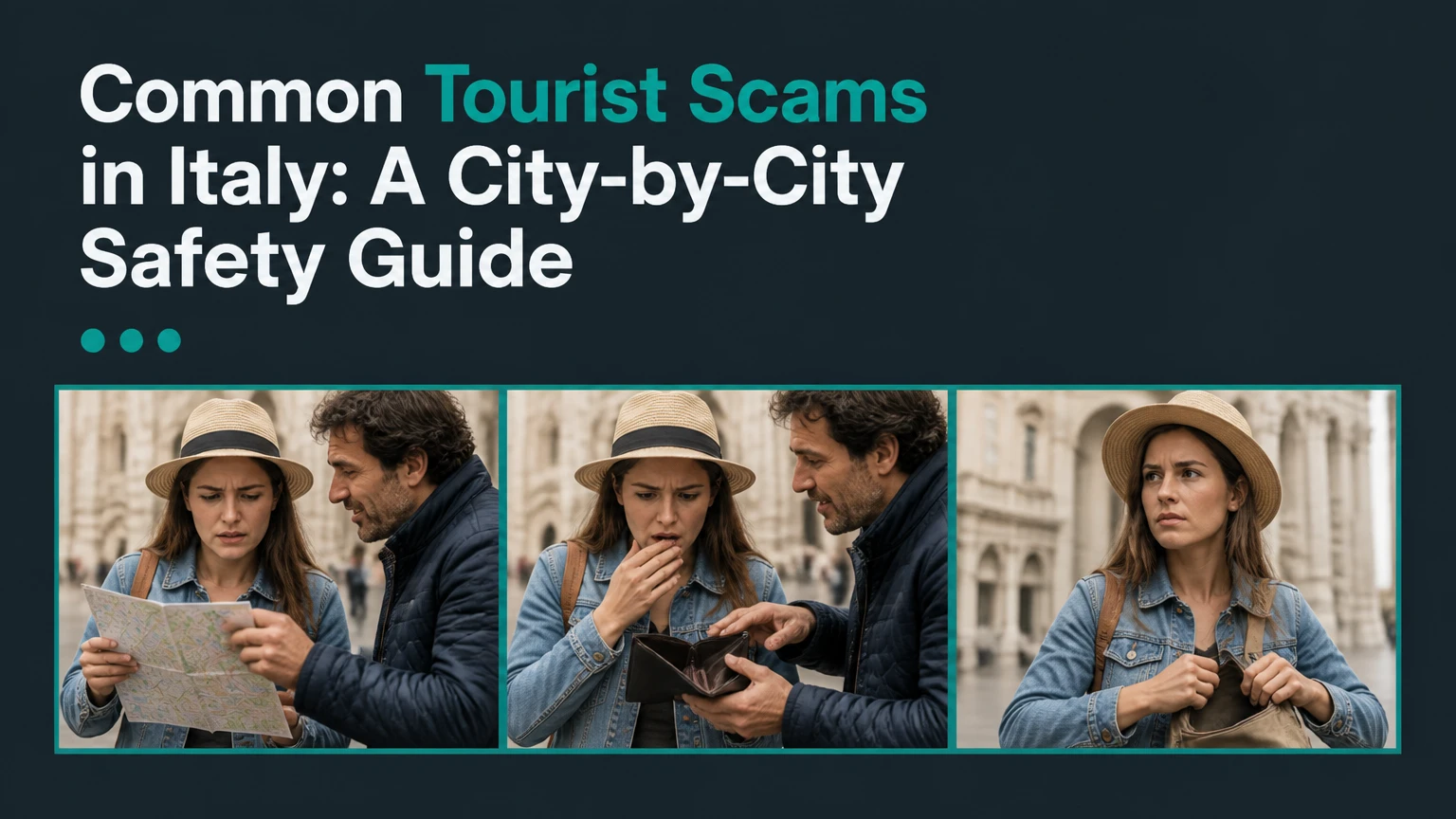
Common tourist scams in Italy are deceptive attempts to obtain money or valuables through distraction, false claims, pressure, theft, or overcharging. They concentrate around transport hubs, famous monuments, crowded public transit, restaurants, and nightlife areas, but simple refusal, secure belongings, verified bookings, and documented payments prevent most losses.
Key Facts / Quick Answer
A bracelet, flower, petition, or “gift” is not free if a stranger places it on you and demands money.
Use official taxi ranks, confirm the fare or meter before departure, and request a receipt.
Check restaurant menus for prices, service charges, cover charges, and all’etto, meaning a price per 100 grams.
Keep phones out of back pockets and bags closed in queues, metro entrances, train stations, and packed buses.
If a card, passport, or phone is stolen, block the payment method immediately and call 112 for emergencies in Italy.
Typical losses range from $5-$25 for street-pressure items to $100-$500 for transport, dining, or ticket fraud.
How Do Tourist Scams Work in Italy?
Italian tourist scams usually follow a four-stage sequence: approach, distraction, demand, and pressure. The person may appear friendly, distressed, official, or helpful, while an accomplice watches your hands, opens a bag, or waits for you to reveal cash.
The most useful rule is behavioral rather than geographical: unsolicited contact near a landmark deserves no conversation until you have verified the person and the request. A legitimate ticket office, police officer, hotel employee, or taxi driver can identify the organization they represent and allow you time to check independently.
| Scam stage | Typical tactic | Traveler’s best response |
|---|---|---|
| Approach | “Friend,” petition, directions, spilled drink, fake help | Step sideways and keep moving |
| Distraction | Object placed in hand, crowding, loud argument | Secure phone, wallet, and bag |
| Demand | Cash request, inflated fare, urgent payment | Return the item and state “No, grazie” |
| Pressure | Blocking, guilt, threats, accomplice involvement | Enter a staffed venue and call 112 if threatened |
In practice, politeness creates risk when it keeps the interaction alive. A brief raised palm, neutral expression, and continued movement work better than explaining why you do not want a bracelet or flower.
What Are the Most Common Street Distraction Scams?
The most common street tactics use low-value objects or emotional requests to control your attention. Bracelet sellers, rose sellers, petition groups, fake charity collectors, and staged spills can cause either a direct payment demand or an opportunity for an accomplice to access a pocket.
Common examples include:
- Braided friendship bracelets tied to a wrist near the Colosseum or Milan’s Duomo.
- Roses presented to couples, followed by a demand of about $10-$30.
- Clipboards requesting signatures for animal rights, disability support, or anti-drug campaigns.
- A stranger pointing at a stain on clothing while another person reaches toward a bag.
- Unlicensed “guides” offering help outside the Vatican Museums, Pompeii, or major stations.
- People asking visitors to take a photograph, then demanding payment for the favor.
A “free” object has no price until you accept it. If someone places it on your body, put it down immediately or return it without opening your wallet.
What Should You Say to a Street Solicitor?
Say “No, grazie” once, avoid debate, and move toward a hotel, shop, museum entrance, or police officer. Do not hand over your passport, phone, wallet, or signature, and do not allow a stranger to inspect a stain or hold your belongings.
If a person blocks your path, raise your voice enough to attract witnesses and say “Lasciami passare”, meaning “Let me pass.” If the behavior becomes threatening or involves theft, call 112. Do not chase a suspected pickpocket through an unfamiliar crowd.
Where Are Pickpockets Most Likely to Operate?
Pickpockets favor predictable moments when travelers stand still, manage luggage, or face competing visual demands. Rome’s Metro Line A, Florence’s station approaches, Venice’s vaporetto queues, Milan Centrale, Naples Centrale, and crowded buses all create suitable conditions.
| Exposure point | Why attention drops | Safer habit |
|---|---|---|
| Train platform exit | Luggage, maps, and arrival fatigue | Use a cross-body bag in front |
| Metro entrance | Ticket gates and crowd compression | Put phone away before the gate |
| Monument queue | Slow movement and camera use | Zip the bag before photographing |
| Bus or tram | Sudden stops and body contact | Keep valuables in an inner pocket |
| Café terrace | Phone on table and loose handbags | Keep both attached to your body |
The highest-risk item is often the phone, because it is easy to grab and can expose banking, email, boarding passes, and two-factor authentication. A locked phone, separate payment card, and offline copy of accommodation details limit the damage.
Expert insight: the vulnerable moment is frequently the 30 seconds after a train arrives, not the monument itself. Travelers open navigation apps, count unfamiliar currency, and drag luggage while local commuters create natural cover.
How Can You Avoid Taxi and Transport Fraud?
Use a marked taxi from an official rank, verify the vehicle identification, confirm whether the journey is metered or subject to a published fixed fare, and request a receipt. A driver who approaches you inside a station or airport and insists on a private cash price is not the safest option.
Official taxi rules vary by municipality, airport, time, luggage, and passenger count. Rome, Milan, Naples, and other cities publish their own tariffs, so a generic “standard base rate” is unreliable. For planning, convert current fares into dollars only after checking the city or airport authority’s current tariff.
| Transport situation | Typical legitimate planning range | Warning sign |
|---|---|---|
| Short urban taxi ride | $12-$30 | Driver refuses the meter without a stated rule |
| Major city airport to center | $35-$75 | Cash quote far above the posted airport fare |
| Late-night urban ride | $18-$45 | No tariff card or vehicle identification |
| Unlicensed ride solicitation | $50-$150 claimed fare | Driver approaches inside arrivals hall |
A driver may legally add published supplements for night service, luggage, airport access, or extra passengers. The problem is an undisclosed price, a manipulated meter, or a claim that the posted tariff does not apply.
How Do Currency-Switching and Fare Scams Happen?
Currency-switching fraud occurs when a passenger hands over a larger banknote and the driver quickly returns a smaller one, claiming the payment was short. Count the notes aloud, keep the denomination visible, and pay by card when the terminal displays the correct amount.
Before leaving, photograph or note the taxi number, license plate, pickup location, and approximate time. If the driver disputes the payment, ask for a receipt rather than arguing about the banknote. A hotel reception desk or local police station can help identify the correct complaint channel.
Is FreeNow Safer Than a Street-Hailed Taxi?
A regulated taxi booked through a recognized platform can provide a vehicle record, estimated route, digital payment, and trip history, but an app does not eliminate every risk. Check that the license plate and driver match the booking before entering.
The safest choice depends on availability and local regulation. Official taxi ranks remain practical at airports, while app bookings reduce negotiation at busy stations and late at night.
How Do Restaurant and Menu Scams Work?
Restaurant overcharging usually depends on unclear pricing rather than a completely fictitious venue. A menu may omit the cost of specials, quote seafood and meat by weight, add disclosed cover charges, or present a bill that the diner never checks.
Italian restaurants generally must display prices, although formats differ. All’etto means the price is for 100 grams, so a fish priced at $9 per 100 grams costs about $54 before other charges if the portion weighs 600 grams.
| Bill item | Typical amount in USD | What to verify |
|---|---|---|
| Coperto per person | $1-$4 | Listed on the menu or posted price list |
| Pasta in a central tourist area | $14-$30 | Portion price and included ingredients |
| Fish priced all’etto | $7-$18 per 100 g | Weight before cooking |
| Clearly disclosed service charge | 0%-15% | Percentage and menu wording |
| Undisclosed surprise charge | $20-$150 | Ask for an itemized explanation |
A coperto is a disclosed cover charge, not automatically an illegal fee. A service charge may also be lawful when clearly stated, and rules can differ by venue and municipality. The practical test is whether the customer could see the charge before ordering.
Expert insight: a restaurant’s outside appearance is a weak quality signal. The stronger test is a readable menu with item prices, portion units, current specials, and payment terms before anyone seats you.
What Should You Check Before Ordering?
Photograph the menu if prices are difficult to remember, ask “Quanto costa in tutto?” for the total price, and confirm weight-based items before cooking. If a server will not state the price, choose another dish or leave before ordering.
Check these details:
- Menu price for each selected item.
- Unit of measure for fish, meat, and market-priced specials.
- Coperto or bread charge per person.
- Service charge, if any, and its percentage.
- Price of bottled water and wine.
- Whether the bill matches the table number and order.
If a bill is wrong, request an itemized receipt and point to the menu. Pay the undisputed amount, document the discrepancy, and ask the venue to call local police if staff become aggressive. Do not sign a card receipt for an amount you have not verified.
Are Ticket Scalpers and Fake Guides Common?
Unofficial ticket sellers can charge several times the normal admission price, sell counterfeit QR codes, or claim that a genuine ticket requires an additional “guide fee.” The safest booking path is the official website of the museum, archaeological park, church, or public transport operator.
| Purchase | Typical official planning range | Higher-risk alternative |
|---|---|---|
| Major museum entry | $15-$35 | Street seller promising immediate entry |
| Guided small-group visit | $40-$120 | Unlicensed guide demanding cash at gate |
| Vatican-area tour | $50-$160 | “Skip the line” seller with no company details |
| City transit ticket | $2-$10 | Person selling a used or altered ticket |
Third-party tours are not automatically fraudulent. A legitimate operator should provide a business name, cancellation terms, contact details, total price, and a receipt before payment.
Avoid handing your phone to a stranger who wants to “scan” a ticket unless you can see the official gate or operator. A QR code screenshot can be copied, invalidated, or linked to a booking under another person’s name.
Which Italian Cities Need Different Precautions?
The same tactic changes form by location. Rome concentrates monument solicitation and metro pickpocketing, Venice adds restaurant and transport confusion, Florence combines crowded historic-center streets with station theft, and Naples requires particularly careful station and taxi decisions.
| City | Common exposure | Typical location | Safer alternative |
|---|---|---|---|
| Rome | Bracelets, petitions, fake guides | Colosseum, Termini, Metro Line A | Official ticket portal and taxi rank |
| Milan | Bracelets and phone theft | Duomo, Centrale, shopping streets | Bag in front and verified transport |
| Venice | Menu ambiguity and fake tours | St. Mark’s, Rialto, vaporetto queues | Read menu, use official ACTV channels |
| Florence | Petitions and crowded theft | Duomo, Ponte Vecchio, station | Secure bag and compare menus |
| Naples | Taxi pressure and station theft | Napoli Centrale, airport arrivals | Official rank and prechecked route |
| Pompeii | Unlicensed guides and ticket claims | Station and archaeological entrance | Official park ticket office |
Waterfronts, festival areas, football match routes, and nightlife districts create temporary hotspots in every city. A quiet street is not automatically safer if no staffed business is open.
When Does Risk Increase During a Trip?
Risk rises when crowds, fatigue, darkness, alcohol, and luggage overlap. Summer crowds increase opportunities for contact-based theft, while winter visitors may face more isolated approaches after dark; there is no reliable national dataset proving that one season has a fixed scam rate.
| Situation | Main vulnerability | Preventive adjustment |
|---|---|---|
| Arrival after 9 p.m. | Fatigue and transport pressure | Preselect the official taxi or train route |
| Midday landmark visit | Crowds and distraction | Carry only one accessible payment method |
| Rain or sudden spill | Clothing inspection and confusion | Step into a shop before checking belongings |
| Nightlife return | Alcohol and poor attention | Use a tracked ride and buddy check |
| Family travel | Children create divided attention | Assign one adult to bags and documents |
Scammers do not need a particular month. They need divided attention, a visible wallet, or a traveler who feels unable to leave.
What Is the Safest Payment and Document Setup?
Carry one primary card, a backup card separately, and a small amount of cash for transport or small purchases. Keep the passport in a hotel safe when lawful and practical, but carry the original when an accommodation, border, or authority specifically requires identification.
Digital wallets reduce the number of times a physical card is exposed, but they do not replace transaction checks. Set banking alerts, lower card limits if your issuer permits it, and freeze a card immediately after suspicious activity.
| Item | Recommended setup | Recovery benefit |
|---|---|---|
| Primary payment card | Wallet or mobile wallet | Fast everyday replacement |
| Backup card | Separate locked location | Preserves access after theft |
| Passport copy | Encrypted phone file | Helps identify document details |
| Emergency cash | $40-$100 in small notes | Covers transport after card freeze |
| Accommodation details | Offline address and phone | Helps police or taxi staff assist |
Do not photograph both sides of a payment card in an unprotected gallery. Store copies of travel insurance, prescriptions, and emergency contacts in a secure offline location.
What Should You Do After a Scam or Theft?
After a suspected scam, protect yourself first, preserve evidence second, and pursue recovery third. Move to a staffed location, freeze cards and mobile wallets, record the time and place, and contact the relevant police or operator without risking a confrontation.
- Leave the immediate interaction and check your wallet, phone, passport, and bag.
- Freeze stolen cards through the banking app or issuer.
- Change banking and email passwords if a phone or unlocked device is missing.
- Use device tracking to lock the phone, but do not arrange a private recovery.
- Photograph the bill, taxi receipt, ticket, vehicle plate, or seller.
- Call 112 for an immediate threat, robbery, injury, or urgent police assistance.
- File a police report, known as a denuncia, and obtain the report number.
- Contact travel insurance and your embassy or consulate for document guidance.
For a disputed restaurant charge, ask for an itemized receipt and keep the card transaction record. For a taxi dispute, record the vehicle number and contact the municipal taxi authority or airport operator. Recovery is more likely when the complaint includes a time, amount, location, and identifiable business.
Expert insight: reporting a small theft can matter even when the money is unrecoverable. A police report may be required by an insurer, mobile carrier, card issuer, or passport authority.
What Mistakes Make Travelers Easier Targets?
The most damaging mistake is treating a suspicious approach as a social obligation. Travelers often explain themselves, open a wallet to end the conversation, or place a phone on a table while negotiating, which creates the exact distraction the offender needs.
Avoid these habits:
- Keeping a phone in a back pocket or an open coat pocket.
- Hanging a handbag on the back of a café chair.
- Counting cash in a station entrance.
- Accepting a “free” item to avoid seeming rude.
- Following a stranger to a ticket office or taxi.
- Giving a card to a server who takes it out of sight.
- Assuming a fixed taxi fare applies in every Italian city.
- Signing a document without reading its language or purpose.
A secure cross-body bag is useful only when its zipper faces inward and the bag stays in front in crowds. A hotel safe reduces passport exposure, but leaving every payment method inside it creates a separate problem if the wallet is lost.
What Are the Best Alternatives to Risky Convenience?
Verified infrastructure costs a little planning time but reduces negotiation, uncertainty, and recovery problems. Book major attractions through the official operator, use marked taxis or recognized booking platforms, and choose restaurants that display a complete menu before seating you.
| Risky convenience | Safer choice | Time cost | Typical financial difference |
|---|---|---|---|
| Street ticket reseller | Official attraction website | 5-15 minutes | Saves $20-$100 |
| Unsolicited station driver | Official taxi rank | 5-20 minutes | Avoids $20-$80 overcharge |
| Restaurant with no visible menu | Posted itemized menu | 3-8 minutes | Avoids $30-$250 surprise |
| Open backpack in metro | Front-facing zipped bag | Under 1 minute | Protects $200-$1,500 in devices |
| Cash-only unknown vendor | Licensed shop with receipt | 5-10 minutes | Improves dispute evidence |
The cheapest option is not always the safest, and the most expensive option is not automatically official. Verification is the key variable.
Frequently Asked Questions About common tourist scams in Italy
Is Italy safe for solo travelers?
Italy is generally manageable for solo travelers who protect belongings, avoid unsolicited services, and plan late-night transport. Solo visitors face more pressure because no companion can verify a fare or watch luggage, so use staffed venues, share itineraries, and avoid displaying cash while navigating.
Can I refuse to pay an unexpected restaurant charge?
Ask for the itemized bill and compare every charge with the menu. A disclosed coperto or service charge may be legitimate, while an undisclosed amount deserves an explanation. Pay the undisputed portion, request a receipt, and call 112 if staff threaten or physically block you.
Are street vendors in Italy always scammers?
No. Some street vendors are licensed and sell legitimate goods, but licensing and product quality are difficult to verify during a rushed approach. Do not buy from a person who pressures you, blocks a walkway, or changes the price after the item is in your hand.
Should I carry my passport while sightseeing?
Carry the original when Italian authorities, accommodation providers, or a specific activity require it; otherwise, a secure hotel safe is often preferable for ordinary sightseeing. Keep a protected copy and emergency contact details, because a copy supports reporting but does not replace the passport for official travel.
Is cash safer than a card in Italy?
Neither payment method is universally safer. Cash limits card exposure but can be snatched, while cards offer transaction records and rapid freezing. Use small notes, keep cash divided, inspect the terminal amount, and activate instant banking alerts for every purchase.
What Italian emergency number should tourists use?
Call 112 for urgent police, medical, or fire assistance in Italy. For nonurgent theft, visit a police station to file a report, retain the report number, and notify the bank, insurer, transport operator, or consulate according to the loss.
Conclusion: The Practical Rule for Common Tourist Scams in Italy
Common tourist scams in Italy depend on speed, distraction, unclear prices, and the assumption that visitors will avoid making a scene. Keep bags closed and in front, reject unsolicited objects, verify taxis and menus before committing, use official booking channels, and report theft promptly. Calm refusal is usually more effective than confrontation.
