

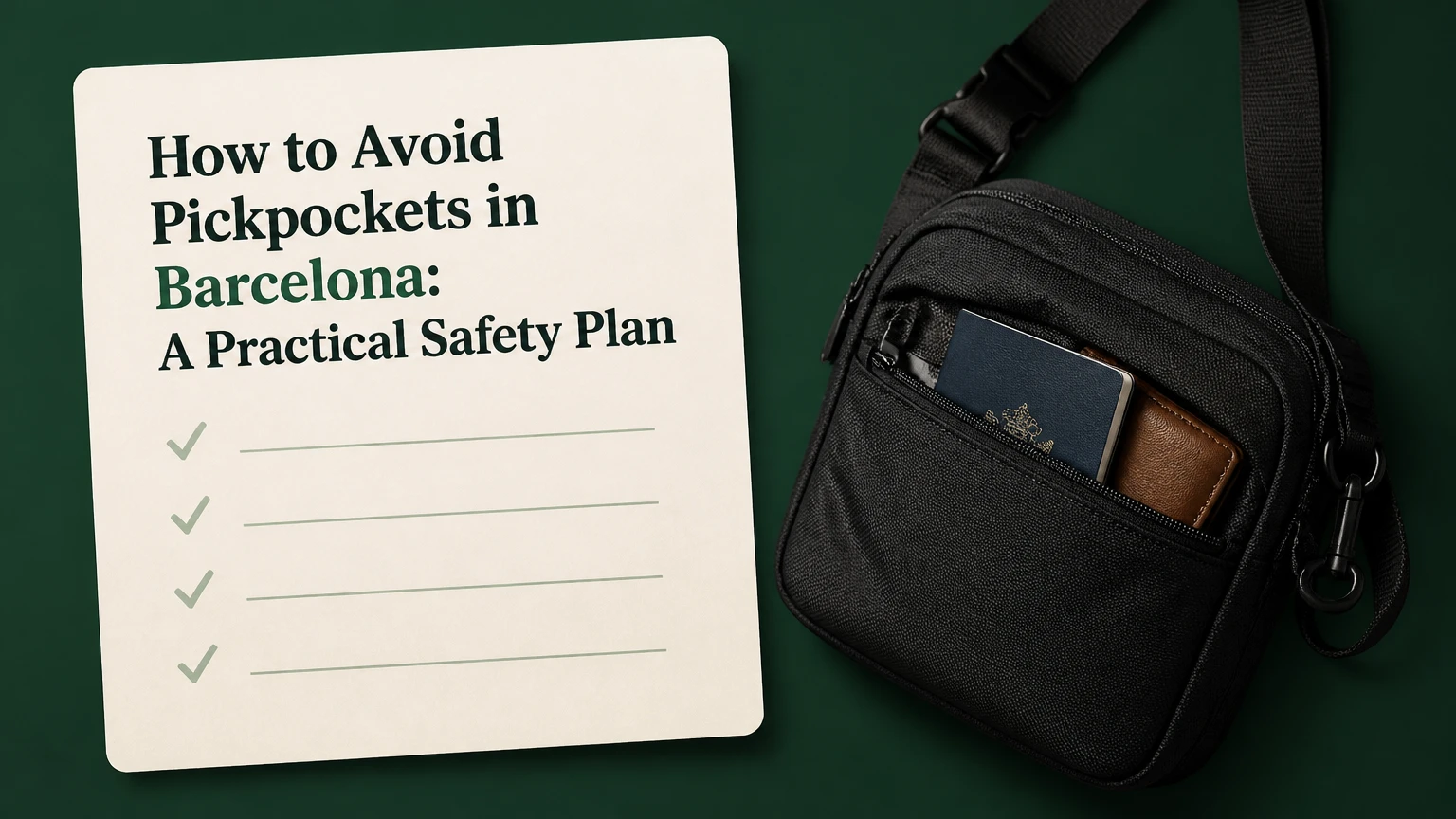
Barcelona pickpocketing is opportunistic theft that uses distraction, crowding, and unsecured belongings rather than overt violence. The most effective protection combines a zipped bag held in front, separated payment methods, deliberate phone use, and extra attention during transitions such as metro boarding, restaurant seating, and landmark photographs.
Key Facts / Quick Answer
Keep a phone, passport, and wallet in closed compartments that remain in front of your body.
On crowded public transport, place a backpack on your chest and keep one hand on every opening.
Never leave a phone on a café table or a bag on a chair back, even in an expensive venue.
Barcelona theft often occurs during divided attention, especially boarding, ticket-machine use, navigation, and outdoor dining.
Spain distinguishes theft of property below a legal value threshold of 400 euros, approximately US$430 depending on exchange rates, from more serious offenses. The threshold does not reduce your need to report a theft.
If a theft occurs, cancel cards first, remotely lock the phone, report the incident, and contact your embassy or consulate for lost travel documents.
What Pickpockets Target in Barcelona
Barcelona thieves usually target portable items with immediate resale value or high replacement costs. Smartphones, wallets, passports, cameras, and open handbags are attractive because they can be removed quickly while the victim’s attention is elsewhere.
The highest-risk setting is not necessarily a particular street. Risk rises when three conditions overlap: close physical contact, a reason to look away, and an easy escape route. A person checking a metro ticket machine while holding an open shoulder bag is more exposed than a person walking through the same station with a secured bag.
Spain’s legal distinction between minor theft and more serious theft has often been simplified online. The commonly cited threshold is 400 euros, approximately US$430, for a lower-level theft offense when other aggravating circumstances do not apply. The amount changes with the exchange rate, and legal classification depends on the facts. The threshold is not permission to steal, a guarantee of a small penalty, or a reason to avoid reporting.
Barcelona locations that require tighter habits
Tourist concentrations create opportunity because visitors stop, photograph, queue, read maps, and carry unfamiliar valuables. The location table describes situations rather than declaring any area permanently unsafe.
| Setting | Typical vulnerability | Safer position | Main prevention action |
|---|---|---|---|
| Las Ramblas and nearby lanes | Dense pedestrian flow and sudden stops | Bag in front, away from curb | Keep moving before checking directions |
| Gothic Quarter alleys | Narrow passage and limited sightlines | Wallet in a closed front compartment | Avoid phone use at a doorway or corner |
| Sagrada Família entrances | Queues, tickets, photography | Crossbody bag under one hand | Secure belongings before joining the line |
| Metro Lines 3 and 4 | Tourist connections and door crowding | Center of carriage, away from doors | Board without holding a phone externally |
| Barceloneta and city beaches | Unattended towels and bags | One person remains with belongings | Take only what the beach activity requires |
| Outdoor terraces | Tabletop distraction and passing access | Bag on lap or secured at feet | Keep the phone off the table |
How Barcelona Pickpocketing Works
Barcelona pickpocketing depends on a short attention gap, not on sophisticated equipment. A distraction may be verbal, physical, visual, or social, while an accomplice uses the resulting proximity to reach a pocket or bag.
Common approaches include a map or petition held close to your body, an unexpected spill, a request for directions, an offered flower, or a playful football interaction. The approach itself is not proof of criminal intent. The practical rule is to protect your belongings before answering, then create distance.
A coordinated group may separate the approach from the theft. One person occupies your attention, another reaches the bag, and a third receives the item. Searching the first person or arguing about the distraction may waste the few seconds needed to secure yourself.
Common distraction setups and the correct response
| Setup | Attention diverted by | Vulnerable item | Safer response |
|---|---|---|---|
| Map or petition | Paper placed across your view | Wallet or phone | Step back and keep both hands on belongings |
| Spill or mustard | Stranger offering to clean clothing | Jacket pockets and bag | Decline help, move to a secure place, clean later |
| Football or leg trick | Unexpected contact or balance change | Trouser pockets | Say “No, gracias,” regain distance, check possessions |
| Dropped coins or sudden stop | Abrupt obstruction in a queue | Backpack rear pocket | Do not bend immediately; check the person behind you |
| Ticket-machine assistance | Unsolicited help at a machine | Phone, wallet, card | Finish the transaction and move away before checking items |
| Flower or bracelet offer | Social pressure and hand contact | Open purse or phone | Keep hands closed, refuse, and continue walking |
Expert insight: The most useful warning sign is not a person’s clothing or nationality. It is an approach that changes your body position while requiring you to look down, turn around, open a bag, or hand over an object.
How to Use the Barcelona Metro Safely
The safest metro habit is to secure belongings before reaching the platform, because boarding is when people naturally split attention between doors, route maps, and companions. Keep a backpack on the front of your body, hold a crossbody bag against your abdomen, and stand away from the carriage doorway when possible.
Lines 3 and 4 connect several heavily visited areas, but no line is risk-free and incident patterns change. Crowded trains, station exits, escalators, and ticket machines create the relevant conditions.
Use this boarding sequence:
- Stop beside a wall or open area before checking the route.
- Put the phone away before the train arrives.
- Close every zipper and place your hand over the main opening.
- Let the first rush enter instead of forcing yourself through the doorway.
- Stand in the carriage interior, not directly beside the doors.
- Check your belongings after leaving the station, not in the crowd at the exit.
An escalator blockage deserves immediate attention. If someone stops suddenly or drops an object, protect the bag first, keep your feet stable, and avoid placing a phone or wallet on a step while helping.
Expert insight: A backpack worn on the back can feel secure because the straps are tight, yet its rear zippers remain outside your visual field. Moving the same bag to the chest during crowd compression improves detection and makes access physically harder.
Which Bag and Storage Method Works Best?
No bag is theft-proof. The best everyday arrangement is a small crossbody bag or compact backpack with closed compartments, worn in front during crowds and kept physically attached to you while seated.
A money belt can protect backup documents and cash, but it is inconvenient for frequent access. Repeatedly reaching beneath clothing in public can expose its location and cause travelers to leave it open. Use it for reserve items, not for the payment method needed at every shop.
| Storage method | Access time | Crowd protection | Main weakness | Best use |
|---|---|---|---|---|
| Open trouser pocket | 1 second | Low | Item can slide or be lifted | Avoid for phones and wallets |
| Closed front pocket | 2-4 seconds | Medium | Exposed when reaching | Small cash and transit card |
| Crossbody bag in front | 3-6 seconds | High | Strap can be cut or pulled | Daily sightseeing |
| Front-worn backpack | 4-8 seconds | High | Less comfortable in heat | Metro and dense queues |
| Hidden money belt | 10-20 seconds | Very high | Slow, warm, inconvenient | Backup cards and documents |
| Hotel safe reserve | 2-5 minutes | High while stored | No access if needed outside | Emergency cash and spare card |
Choose equipment by construction and behavior rather than a product label. Useful features include two-way zippers, a strap that stays under your hand, internal compartments, and enough capacity to avoid overfilling. Cut-resistant fabric may slow a thief, but it does not prevent an unattended bag from being taken.
How to Protect Phones, Cards, and Passports
The phone is often the most exposed item because travelers use it for maps, translation, tickets, photographs, and payment. Barcelona visitors should decide where the phone returns after every use, rather than carrying it loosely while walking.
Use a simple storage hierarchy:
- Phone: closed front pocket or bag compartment immediately after navigation.
- Primary card: accessible compartment under direct hand control.
- Backup card: separate bag or hotel safe.
- Passport: secured accommodation storage unless identification is required.
- Cash: divided into a daily amount and a reserve.
- Travel documents: encrypted cloud copies plus a paper emergency record.
Never put a phone beside a drink on a terrace. A passerby can take it without entering the seating area, while a distraction at the table can make the theft appear accidental.
Passports should not be carried casually around the city unless a specific requirement makes it necessary. Carrying a photocopy or secure digital copy may help with identification, but requirements vary, so confirm current guidance from your government and the accommodation provider.
Restaurants, Hotels, Beaches, and Nightlife
Upscale venues reduce some forms of street exposure, but they do not eliminate theft. Hotel breakfast rooms, lobby seating, rooftop bars, restaurant terraces, and crowded nightlife venues still contain unattended phones, chair-back bags, and distracted guests.
At a restaurant, keep the bag on your lap or on the floor with a strap looped around your leg or a fixed chair structure. Do not attach it to a movable chair that can be pulled away. A phone placed under a menu remains accessible and is not meaningfully protected.
At the beach, carry a minimal kit: one payment method, a small amount of cash, a key, and a phone only when necessary. Leave passports, spare cards, and large amounts of cash secured at the accommodation. One member of a group should remain with belongings if swimming conditions make unattended storage unavoidable.
| Situation | Risky behavior | Better arrangement | Check frequency |
|---|---|---|---|
| Café terrace | Phone beside a drink | Phone in zipped front compartment | After every use |
| Restaurant | Bag on chair back | Bag on lap or secured at feet | When standing up |
| Hotel breakfast | Wallet in loose jacket | Closed bag held or worn in front | Before leaving table |
| Beach visit | Full wallet and passport | Minimal cash and one card | Before entering water |
| Nightlife queue | Phone in rear pocket | Front compartment under hand | At each crowd squeeze |
| Taxi or rideshare exit | Phone left on seat | Check seat, floor, and door pocket | Before closing door |
Alcohol increases delay in noticing contact and makes belongings easier to leave behind. Set a phone alarm or buddy check before moving between venues.
When Does Theft Risk Increase?
Risk usually increases during daylight sightseeing, lunch queues, evening dining, and late-night movement, but time alone does not predict an incident. Summer crowds from June through August can increase opportunity, while busy weekends and major events can create similar conditions at other times.
A practical risk scale is more useful than a fixed “danger hour”:
| Condition | Exposure level | Example | Immediate adjustment |
|---|---|---|---|
| Quiet, purposeful walking | Lower | Moving with closed bag | Keep normal awareness |
| Landmark photography | Medium | Stopping near an entrance | Secure bag before raising phone |
| Queue or ticket machine | High | Buying metro access | Use one hand for the bag |
| Packed carriage doorway | High | Boarding at peak flow | Wait for the next train |
| Late nightlife transfer | High | Tired group leaving a venue | Use a buddy check and taxi verification |
| Beach swimming | High | Bags left on towels | Reduce valuables or maintain watch |
Expert insight: The riskiest moment is often the transition between activities, not the activity itself. Travelers secure belongings while entering a museum, then relax during the café stop and leave the phone exposed when they stand to pay.
The Barcelona Theft-Prevention Routine
A reliable routine removes decisions when the city is crowded. Complete the preparation before departure, then repeat the physical check at every transition.
Before leaving home
- Enable device tracking, remote lock, and cloud backup.
- Record the phone’s IMEI and serial number.
- Photograph passport identification and payment cards without storing full card details in an unprotected note.
- Notify the bank of travel and save its international cancellation number.
- Pack one backup card separately from the wallet.
- Confirm travel insurance requirements for police reports and original receipts.
- Choose a bag that closes fully and remains in front in crowds.
During the day
Keep your phone away while walking between destinations. If directions are necessary, stop beside a wall or inside a shop, orient yourself, and put the device away before continuing.
Use a spoken refusal without accusation: “No, gracias,” “Basta,” or “Please step back.” Do not allow an unfamiliar person to wipe clothing, hold a map over your belongings, tie anything around your wrist, or guide your hands toward a ticket machine.
At every transition
Perform a five-second check: phone, wallet, passport, bag closure, and travel companion. This is especially useful after leaving a metro carriage, taxi, restaurant, beach, or crowded attraction.
What to Do If Something Is Stolen
Act quickly, but do not chase or physically confront a suspected thief. The priority is to prevent secondary losses, preserve account access, and create the documentation needed for travel and insurance.
| Action | Target timeframe | Typical cost or result | Evidence to retain |
|---|---|---|---|
| Freeze payment cards | 5-15 minutes | Usually no fee | Cancellation reference |
| Remote-lock phone | 5-10 minutes | Usually no fee | Device account notice |
| Contact mobile carrier | 10-30 minutes | Replacement SIM often US$10-US$30 | Account confirmation |
| File police report | Same day if possible | Usually no report fee | Report number and copy |
| Replace emergency travel document | 1-3 business days, varies | Government fee often US$100-US$200 | Appointment and receipt |
| Replace phone | Same day to several days | Typical US$300-US$1,500 | Purchase and insurance records |
First, move to a safe public location and check whether the item was misplaced. Freeze cards through the banking application or telephone service, then use the device locator to lock the phone. Do not erase a phone immediately if authorities or an insurer may need location or account evidence, unless personal safety requires it.
Next, report the theft to the Mossos d’Esquadra or the Guàrdia Urbana. Ask for a written report, often called a denuncia, and list identifying details such as the phone IMEI, passport number, card issuer, and approximate location. A report does not guarantee recovery, but insurers and consular services commonly need documentation.
If a passport is missing, contact your embassy or consulate. Emergency-document availability, fees, photographs, and appointment times vary by nationality. A 24-48-hour delay is possible, but it is not a universal service standard.
If force, threats, injury, or confinement occurred, treat the incident as a potential robbery rather than ordinary pickpocketing. Call 112 for an immediate emergency and seek medical documentation where appropriate.
Special Situations for Families and Solo Travelers
Children should not carry passports, large amounts of cash, or all family payment cards. Assign one adult to manage documents and another to supervise children during ticket purchases, boarding, and street navigation.
Solo travelers need a different control system because there is no companion to watch the bag during photographs or swimming. Use a secure bag, avoid placing items on tables, and choose staffed storage or accommodation for valuables rather than relying on improvised hiding places.
Wheelchair users and travelers with strollers should keep bags on the body or in a closed compartment that remains within view. A bag hanging from a stroller handle is both easy to remove and easy to overlook during movement through a crowd.
People who depend on a phone for medical information or translation should carry a printed emergency card and a small backup battery separately. That redundancy reduces the pressure to keep the phone constantly exposed.
Frequently Asked Questions About how to avoid pickpockets in Barcelona
Is Barcelona safe for tourists who use normal precautions?
Barcelona is generally navigable for tourists, but petty theft remains a practical risk in crowded tourist areas, public transport, dining spaces, and nightlife. Normal precautions should include closed bags, separated payment methods, controlled phone use, and a deliberate check whenever you leave a vehicle or venue.
Should I carry my passport while sightseeing in Barcelona?
Carry a passport only when identification or a specific service requires the original document. Otherwise, secure it at your accommodation and keep a protected copy or digital record available. Ask your government or accommodation about current identification requirements because a copy may not satisfy every official request.
Are hotel safes reliable for valuables?
A hotel safe reduces exposure while you are outside, but it is not an absolute guarantee. Use it for reserve cash, spare cards, and documents, keep the access code private, and retain only the valuables you need for the day. A safe cannot help if you need the stored item unexpectedly.
Can pickpockets take a phone from a front pocket?
A front pocket is safer than a rear pocket, but an open or loose pocket remains vulnerable during crowd contact. Use a closed compartment, keep your hand over it in queues and metro doorways, and avoid holding the phone loosely while walking or boarding.
What should I do if I notice a suspicious person following me?
Enter a staffed shop, hotel, museum, or transport office and ask for assistance rather than walking to your accommodation. Call local emergency services if you face threats or immediate danger. Do not lead the person to your hotel room, confront a group, or attempt to recover property yourself.
Does travel insurance cover pickpocketing in Barcelona?
Many policies cover theft subject to exclusions, deadlines, excesses, proof of ownership, and a police report. Check whether unattended belongings, phones, passports, and alcohol-related incidents are covered before travel. Report the loss promptly and keep the denuncia, replacement receipts, carrier records, and card-cancellation evidence.
Conclusion
The most effective way to how to avoid pickpockets in Barcelona is to control access to your belongings during distraction, crowding, and transitions. Wear a closed bag in front, keep phones off tables and rear pockets, separate cards and documents, and respond to a theft by freezing accounts, locking devices, filing a report, and contacting your consulate.
