

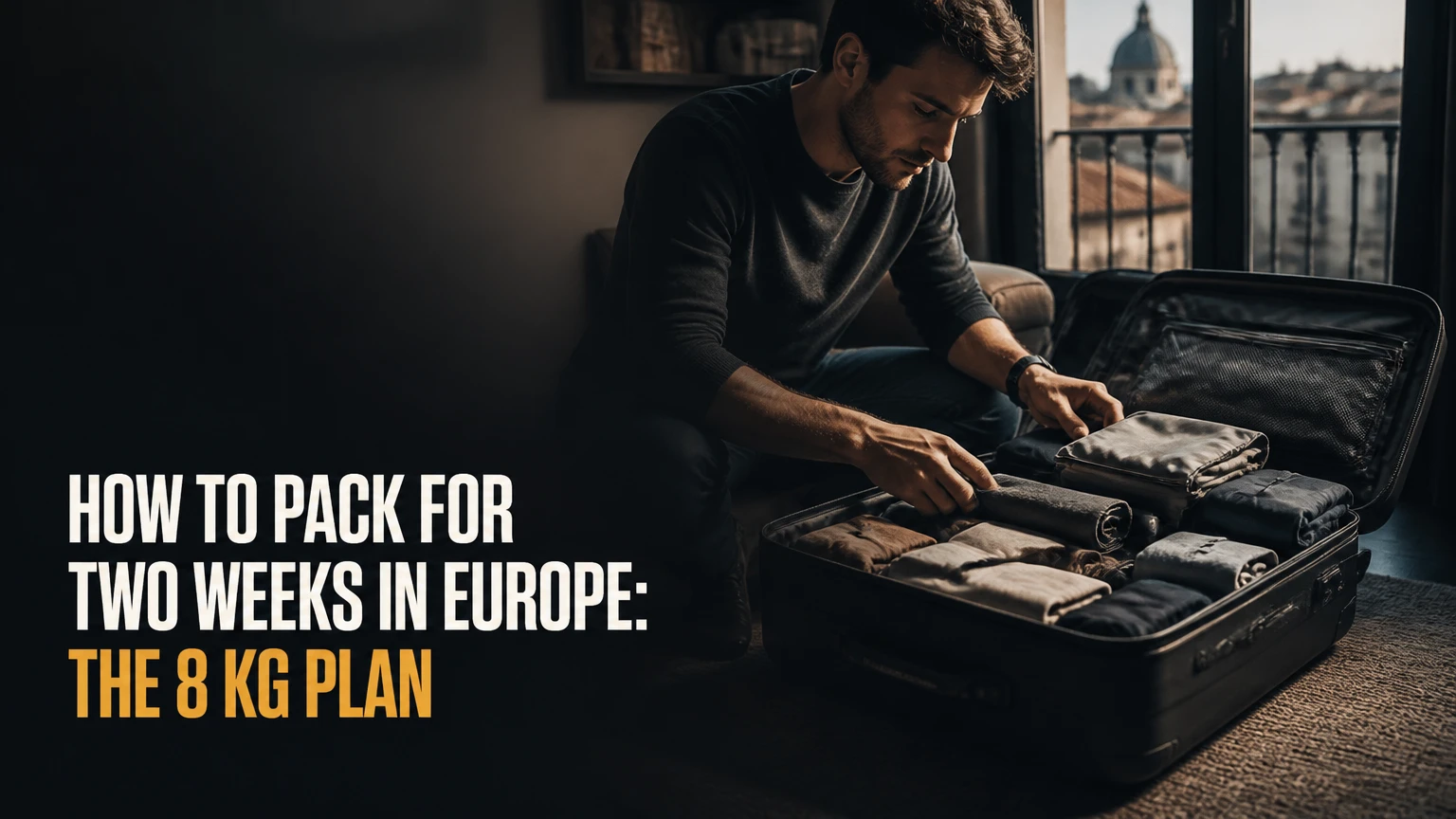
How to pack for two weeks in Europe is a mobility problem, not a clothing problem. Build a washable capsule wardrobe for 5-7 days, carry one adaptable layer, use two broken-in shoe options, and verify every airline’s size and weight rules before departure. A practical target is 7-10 kg when your itinerary includes trains and budget flights.
Key Facts / Quick Answer
Pack clothing for 5-7 days, not 14 days, and schedule laundry around day 6 or 7.
A 35-40 liter clamshell backpack usually handles a mobile itinerary better than a large spinner.
Wear the bulkiest shoes and heaviest layer during transit.
Ryanair, easyJet and other European carriers have different cabin and personal-item rules by fare, so the booking confirmation is the controlling source.
Keep passport, medication, electronics, one change of clothes and valuables in your personal item.
Leave 15-20% of the bag empty if you expect souvenirs or regional food purchases.
What does packing for two weeks in Europe require?
Packing for a two-week European trip requires a compact, washable system that can move through airports, railway stations, cobbled streets, hotel stairs and changing weather. The system combines a 5-7 day wardrobe, two useful shoes, destination-specific documents, a small technology kit and a luggage choice matched to the route.
The two-week duration does not determine the clothing volume. Laundry access, temperature range, planned activities and transport rules determine it. A traveler visiting Amsterdam, Prague and Vienna in May may need one rain shell and a warm mid-layer; a July route through Athens and Sicily needs more sun protection but fewer insulating clothes.
The most reliable rule is to pack for the hardest day of movement. If the itinerary includes four train changes, a third-floor apartment without an elevator and one flight on a low-cost carrier, a light backpack has greater practical value than extra capacity.
The operating target
Use these targets before selecting individual garments:
| Packing variable | Practical target | Why it matters |
|---|---|---|
| Clothing coverage | 5-7 days | Supports one laundry cycle |
| Main bag volume | 35-40 L | Fits a mobile urban itinerary |
| Loaded weight | 7-10 kg | Reduces lifting and airline-limit risk |
| Empty capacity | 15-20% | Allows souvenirs and imperfect folding |
| Shoe count | 2 pairs maximum | Controls the heaviest clothing category |
| Laundry interval | Day 5-8 | Prevents an overloaded final week |
How to build a two-week capsule wardrobe
A two-week European capsule wardrobe uses interchangeable colors, quick-drying fabrics and layers that work across casual, active and smart-casual settings. Start with five tops, three or four bottoms, two insulating or weather layers, underwear for five to seven days and two pairs of comfortable shoes.
The classic 5-4-3-2-1 framework is a useful prompt, not a law. Its categories are often explained inconsistently, so count actual garments rather than relying on the label. Two pairs of shoes should not be confused with “three layers,” and a swimsuit should be added only when the itinerary requires one.
Choose a base palette of two neutrals plus one accent. Navy, black and cream create more combinations than five unrelated colors. A patterned shirt can supply visual variety without requiring another complete outfit.
| Category | Standard quantity | Hot-weather adjustment | Cool-weather adjustment |
|---|---|---|---|
| Short- or long-sleeve tops | 5 | 6 lightweight tops | 4 tops plus thermal base |
| Bottoms | 3-4 | 2 shorts or skirts, 1 trouser | 2 trousers, 1 dark jean |
| Underwear | 5-7 sets | 5 quick-dry sets | 7 sets for slower drying |
| Socks | 5-7 pairs | 4-5 pairs | 6-7 wool-blend pairs |
| Mid-layers | 1-2 | 1 thin cardigan | 1 fleece or knit, 1 vest |
| Weather shell | 1 | Packable rain shell | Waterproof shell with hood |
| Sleepwear | 1 set | 1 lightweight set | 1 warm set |
| Swimwear | 0-1 | 1 if needed | 0 unless spa or hotel pool |
Choose fabrics that recover between washes
Merino wool resists odor and regulates temperature, but it costs more and can be damaged by rough washing. Lightweight synthetic blends dry quickly and handle sink laundry well, while linen feels cooler but wrinkles and may dry slowly in humid rooms. Heavy denim is a poor one-bag choice because it absorbs water and takes longer to dry.
Pack one garment that looks appropriate for a restaurant, concert or religious site. A collared shirt, dark blouse or unbranded knit can cover more situations than a separate formal outfit. European cities do not require a universal dress code, but churches, upscale restaurants and some clubs may reject beachwear, athletic shorts or exposed shoulders.
Use an outfit matrix before packing
Lay every proposed top beside every bottom. Remove any garment that creates fewer than two useful outfits or requires a special shoe. This test catches the common mistake of packing attractive individual pieces that cannot work together.
A practical seven-day rotation might include three casual walking outfits, one activity outfit, one smart-casual outfit, one laundry day and one repeat combination. Repeating clothing is normal; changing the combination, layer or accessory creates variety without adding weight.
Which luggage works best for European transport?
A 35-40 liter front-opening backpack is usually the best luggage for a multi-city European itinerary because it keeps both hands free and handles stairs, platforms and uneven pavement. A small spinner can be better for a single hotel, business travel or travelers who cannot comfortably carry weight on their backs.
European transport is not one uniform environment. High-speed rail stations may have elevators, but a platform change can still involve stairs, and historic hotels often have narrow staircases. Cobblestones are especially hard on small spinner wheels, while a backpack transfers weight to the wearer and can become uncomfortable after several hours.
| Luggage type | Typical size or weight | Best route | Main limitation |
|---|---|---|---|
| Clamshell backpack | 35-40 L, 1.2-2.0 kg empty | 3 or more cities, rail travel | Shoulder and hip fatigue |
| Two-wheel carry-on | 35-45 L, 2.0-3.0 kg empty | Airports and smooth pavements | Poor on cobblestones |
| Four-wheel spinner | 35-45 L, 2.5-3.5 kg empty | One hotel or resort | Wheels catch on rough surfaces |
| Soft duffel with straps | 30-40 L, 0.8-1.5 kg empty | Short stays and flexible storage | Limited structure and organization |
| Checked suitcase | 60-90 L, 3.5-5.0 kg empty | Winter gear or family travel | Baggage claims and train handling |
In practice, bag weight matters as much as volume. A 40-liter case that weighs 3.5 kg empty consumes roughly half of a 7 kg allowance before clothing enters it. A lighter 35-liter pack may carry less on paper but provide more usable allowance.
Measure the packed bag, not the advertised bag
Airline measurements can include wheels, handles and external pockets. Measure the loaded bag at its widest points, then compare the result with the fare’s cabin allowance. Ryanair, easyJet, Wizz Air and national carriers publish different rules, and those rules can vary by ticket type and route.
The European Union’s airport security rules generally restrict liquids in cabin baggage to containers of 100 milliliters or less inside a transparent bag, but airport implementation and temporary screening changes can affect the process. Check the departure airport and airline shortly before travel rather than relying on a packing blog.
How do you meet airline, airport and rail limits?
Meeting European travel limits requires separating the personal item from the cabin bag and checking the exact fare conditions before packing. The smallest allowance may be a personal item under the seat, while a larger cabin bag may require priority boarding or an additional fee.
Do not plan around a generic “European carry-on size.” A carrier may permit a 55 x 40 x 20 cm cabin bag in one fare and only a smaller under-seat item in another. Weight limits commonly fall between 7 and 10 kg, but the published airline rule controls.
| Item or rule | Typical planning figure | Verification point | Packing response |
|---|---|---|---|
| Personal item | 40 x 25 x 20 cm typical | Fare page and booking | Put documents and electronics here |
| Cabin bag | 55 x 40 x 20 cm common range | Airline baggage page | Measure wheels and handles |
| Cabin weight | 7-10 kg common range | Ticket conditions | Weigh after final packing |
| Liquid container | 100 ml maximum | Departure airport | Use a transparent liquids bag |
| Checked allowance | 20-23 kg common range | Ticket receipt | Price it before airport arrival |
| Power bank | Airline-specific watt-hour rule | Carrier dangerous-goods page | Carry in cabin, protect terminals |
The Transportation Security Administration’s 3-1-1 rule applies to flights departing the United States: containers must hold 3.4 ounces, or 100 milliliters, and fit in one quart-sized bag. European departures use their own security procedures, but the same 100 milliliter container strategy minimizes confusion.
What should go in the personal item?
Keep irreplaceable and arrival-critical items under the seat:
- Passport, visas, travel insurance details and payment cards
- Prescription medicine in original labeled packaging
- Phone, e-reader, camera and charging cables
- One clean top, underwear and essential toiletries
- Glasses, contact lenses and a small snack
- Copies of reservations and emergency contacts
A personal item should not become a second overloaded suitcase. It must fit under the seat, remain within the airline’s dimensions and stay light enough to carry alongside the main bag.
What shoes, toiletries and technology should you pack?
Pack two broken-in pairs of shoes: one supportive walking shoe and one lighter option suitable for warm weather or smart-casual occasions. Wear the heavier pair in transit, because shoes often weigh 0.8-1.4 kg per pair and consume disproportionate luggage space.
Test walking shoes on at least three outings before departure. European sightseeing can involve 15,000-25,000 steps on demanding days, although actual distance varies by itinerary. A fashionable shoe that creates a hot spot on a local walk will become a trip-wide problem.
| Packing area | Recommended quantity | Typical packed weight | Specific rule |
|---|---|---|---|
| Walking shoes | 1 pair worn | 0.8-1.2 kg | Test for 10 km comfort |
| Second shoes | 1 pair packed | 0.4-0.8 kg | Choose sandals or loafers |
| Toiletry liquids | 5-8 small containers | 0.3-0.7 kg | Decant only what you need |
| Universal adapter | 1 | 0.1-0.3 kg | Confirm USB-C output |
| Power bank | 1 | 0.2-0.4 kg | Keep in cabin baggage |
| Laundry kit | 1 small kit | 0.1-0.2 kg | Include sink stopper and cord |
| First-aid kit | 1 small pouch | 0.1-0.3 kg | Bring blister care |
Most continental European outlets use Type C or Type F plugs at approximately 230 volts and 50 hertz. The United Kingdom and Ireland use Type G, while Switzerland commonly uses Type J. A plug adapter changes the connection shape; it does not convert voltage.
Check the input label on hair dryers, curling irons and electric shavers. Dual-voltage devices marked “100-240 V” are generally suitable with the correct adapter, while single-voltage United States devices may require a converter or replacement.
Reduce liquids without reducing hygiene
Use solid shampoo, bar soap, toothpaste tablets or small refillable containers where practical. Sunscreen, moisturizer and contact-lens solution often account for more volume than travelers expect, so buy standard products locally when a specific brand is not medically necessary.
Avoid packing a full pharmacy. Bring essential prescriptions, basic pain relief, blister treatment, oral rehydration packets and any medication that may be difficult to replace. Keep prescriptions in original packaging, and carry a copy of the generic name because brand names vary by country.
How should you plan laundry and weather?
Schedule one full laundry cycle around day 6 or 7, then pack enough underwear and socks to cover delays. Sink washing works for thin synthetics and merino, but it is unreliable for heavy cotton, denim and garments that need high heat to dry.
A laundromat commonly costs about $6-$12 per load in major European cities, converted from typical local prices and subject to country and machine size. Hotel laundry costs substantially more and may charge per item, so use it for urgent pieces rather than the whole wardrobe.
| Laundry method | Typical cost in USD | Drying time | Best use |
|---|---|---|---|
| Sink wash | $0-$3 | 8-24 hours | Underwear and thin tops |
| Shared laundromat | $6-$12 per load | 60-120 minutes | Full mid-trip reset |
| Hotel service | $25-$80 for several items | 12-48 hours | Business or urgent laundry |
| Self-service hostel | $5-$10 per load | 60-150 minutes | Budget multi-city travel |
Pack a lightweight detergent sheet or a 30-60 milliliter liquid detergent container. Roll wet garments in a towel and press out water before hanging them, but never twist merino or stretch fabrics because twisting damages fibers and distorts fit.
Build the list around the coldest and wettest forecast
Check reliable forecasts seven days before departure, then recheck 24 hours before leaving. A weather application cannot predict the entire two-week period accurately, so use seasonal normals for the later days and preserve one adaptable layer.
For summer, prioritize a sun hat, breathable shirts, sunscreen and a thin rain shell. For spring or autumn, replace one short-sleeve top with a thermal base and add a compact umbrella only if rain protection is not already covered by the shell. For winter, one warm coat may exceed the entire carry-on strategy, so wear it and accept fewer clothing items.
| Season | Add | Remove or reduce | Main risk |
|---|---|---|---|
| Summer | Sun hat, sandals, sunscreen | Heavy knitwear | Heat, sunburn and packed liquids |
| Spring | Thin fleece, rain shell | Extra shorts | Sudden temperature changes |
| Autumn | Merino base, waterproof shoes | Swimwear unless required | Wet clothing and early darkness |
| Winter | Warm coat, gloves, thermal base | Multiple light tops | Bulk and slow drying |
How should documents, money and security be handled?
Travel documents and money need redundancy, physical separation and offline access. Keep the passport and primary payment card accessible but concealed, store a backup card separately, and save essential reservations on the phone and in a secure offline file.
Passport validity rules differ by nationality and destination. Schengen visitors from outside the European Union commonly need a passport valid for at least three months after the planned departure from the Schengen Area and issued within the previous ten years, but travelers should confirm requirements through the European Commission or their government’s official travel portal.
Use a low-profile crossbody bag with a strong strap and zipped compartments in crowded transit areas. A money belt is useful for backup documents, but it is inconvenient for frequent transactions and should not hold everything in one place.
Expert insight: the safest arrangement is distributed storage, not a single “security” pouch. Keep daily cash in one pocket, a backup card in a different bag and passport access separate from both, because losing one item then does not remove every payment option.
When is carry-on only the wrong choice?
Carry-on-only travel is a poor fit when the trip requires bulky winter equipment, medical devices, specialized sports gear, formal business clothing or supplies for children. A checked bag can be rational when the itinerary has one base, minimal transfers and a ticket that already includes baggage.
The decision should account for handling costs, not only airline fees. A traveler who cannot lift a loaded 10 kg bag onto a train rack may be better served by a lighter checked suitcase, a hotel transfer or fewer destinations.
| Situation | Carry-on-only result | Better alternative | Typical added cost |
|---|---|---|---|
| Three cities by train | High mobility | 35-40 L backpack | $0-$250 for bag |
| Ski or winter equipment | Severe volume pressure | Checked case or rental | $50-$150 baggage |
| Business conference | Wrinkling and shoe conflict | Garment folder plus cabin case | $30-$100 equipment |
| Family with young children | Limited spare clothing | One shared checked bag | $50-$150 baggage |
| One resort for 14 days | Capacity less important | Spinner suitcase | $0-$100 baggage |
| Souvenir-heavy route | No return capacity | Packable duffel checked home | $40-$150 return fee |
Checked luggage also creates a delay risk. If a bag is delayed, the traveler may need to buy clothing and toiletries, so retain one change of clothes, medication and essential electronics in the personal item even when checking a suitcase.
What packing mistakes create the most trouble?
The most expensive packing mistakes involve weight, footwear, irreplaceable items and assumptions about airline rules. Removing low-use items before departure usually improves the trip more than buying premium organizers.
- Pack the wardrobe and test every outfit.
- Remove garments that create only one combination.
- Select shoes and wear-test them outdoors.
- Add documents, medication and technology to the personal item.
- Weigh the main bag and personal item separately.
- Check each airline, fare and departure airport.
- Run one laundry cycle before finalizing quantities.
- Leave 15-20% of the main bag empty.
- Photograph the contents and luggage exterior.
- Recheck weather and restrictions 24 hours before leaving.
Expert insight: compression cubes reduce volume, not mass. A cube can make a bag look organized while allowing travelers to exceed the airline scale, which is why weighing the packed bag matters more than achieving a flat visual profile.
Another practitioner rule is to protect the first 12 hours, not the imagined perfect trip. Pack arrival clothes, medicine, charging equipment and basic washing supplies where they can be reached without unpacking the entire bag.
Do not pack a large “just in case” category. Replaceable items such as a basic T-shirt, umbrella or inexpensive toiletries can usually be purchased locally, while passport, medication, prescription eyewear and specialized camera equipment are much harder to replace.
How should you pack by departure date?
A staged process prevents last-minute weight growth and catches document problems before the airport. Complete the first test pack seven days before departure, because that leaves enough time to remove items, exchange a bag or buy missing equipment.
| Time before departure | Task | Completion test |
|---|---|---|
| 14 days | Check passport, visas, insurance and route | All documents meet destination rules |
| 10 days | Confirm airline baggage conditions | Every fare has a saved allowance |
| 7 days | Test-pack clothing and weigh bags | Main bag stays under the strictest limit |
| 3 days | Download maps, tickets and translation tools | Key files work offline |
| 2 days | Wash travel clothes and charge devices | Laundry is dry and batteries work |
| 1 day | Pack liquids, medication and personal item | Security items remain reachable |
| Departure morning | Recheck weather and gate bag rules | Outer layer and shoes match conditions |
Use a luggage scale after adding toiletries, chargers and snacks. A nominal 7 kg limit should not be treated as a 7.0 kg target if airport scales, clothing pockets or a second inspection could create uncertainty. A 0.3-0.5 kg buffer is a sensible practical margin.
Frequently Asked Questions About how to pack for two weeks in Europe
Can I pack for 14 days in a personal item only?
A personal item can work for 14 days only with frequent laundry, warm-weather clothing and very limited footwear. Most travelers will find a 20-30 liter personal item restrictive because shoes, toiletries and a weather layer consume fixed space. A 35-40 liter cabin bag provides a more realistic balance for multi-city travel.
What should I wear on the plane to save luggage space?
Wear the bulkiest comfortable shoes, long trousers and the heaviest adaptable layer on the flight. Avoid wearing every heavy garment, because airports and cabins can be hot. Keep removable layers practical for the destination, and make sure pockets do not become a way to evade a measured baggage limit.
How much cash should I bring to Europe?
Carry a small amount of local currency for transport machines, small cafés and emergencies, typically $50-$100 equivalent per traveler. Use two payment cards from different networks when possible, notify your bank if required and keep backup cash separate from the primary wallet. Cash needs vary by country and travel style.
Should I bring a towel to European hotels and hostels?
Bring a towel only when the accommodation does not provide one or your itinerary includes swimming, beaches or hostels with rental charges. A compact microfiber towel typically weighs 150-350 grams and dries faster than cotton. Confirm the property’s amenities before adding it, because a full-size towel wastes valuable capacity.
How do I pack souvenirs without exceeding the bag limit?
Reserve 15-20% of the bag’s volume and approximately 1 kg of weight before departure. Choose flat textiles, small packaged goods or local digital purchases rather than ceramics and bottles. A packable duffel is useful for a checked return flight, but it does not eliminate airline weight or fragile-item risks.
Can I bring a hair dryer or straightener to Europe?
Bring a dual-voltage device marked 100-240 V, or use the accommodation’s hair dryer. A plug adapter alone does not convert voltage, and a single-voltage United States styling tool can overheat on a 230-volt European circuit. Check the wattage and destination socket type before packing the appliance.
Final packing rule for a two-week European trip
How to pack for two weeks in Europe becomes straightforward when the bag is designed around movement, laundry and the strictest transport segment. Pack five to seven days of coordinated clothing, two tested shoes, one weather system, essential documents and a 0.3-0.5 kg weight buffer. The best setup is the lightest one you can carry comfortably through every transfer.
