

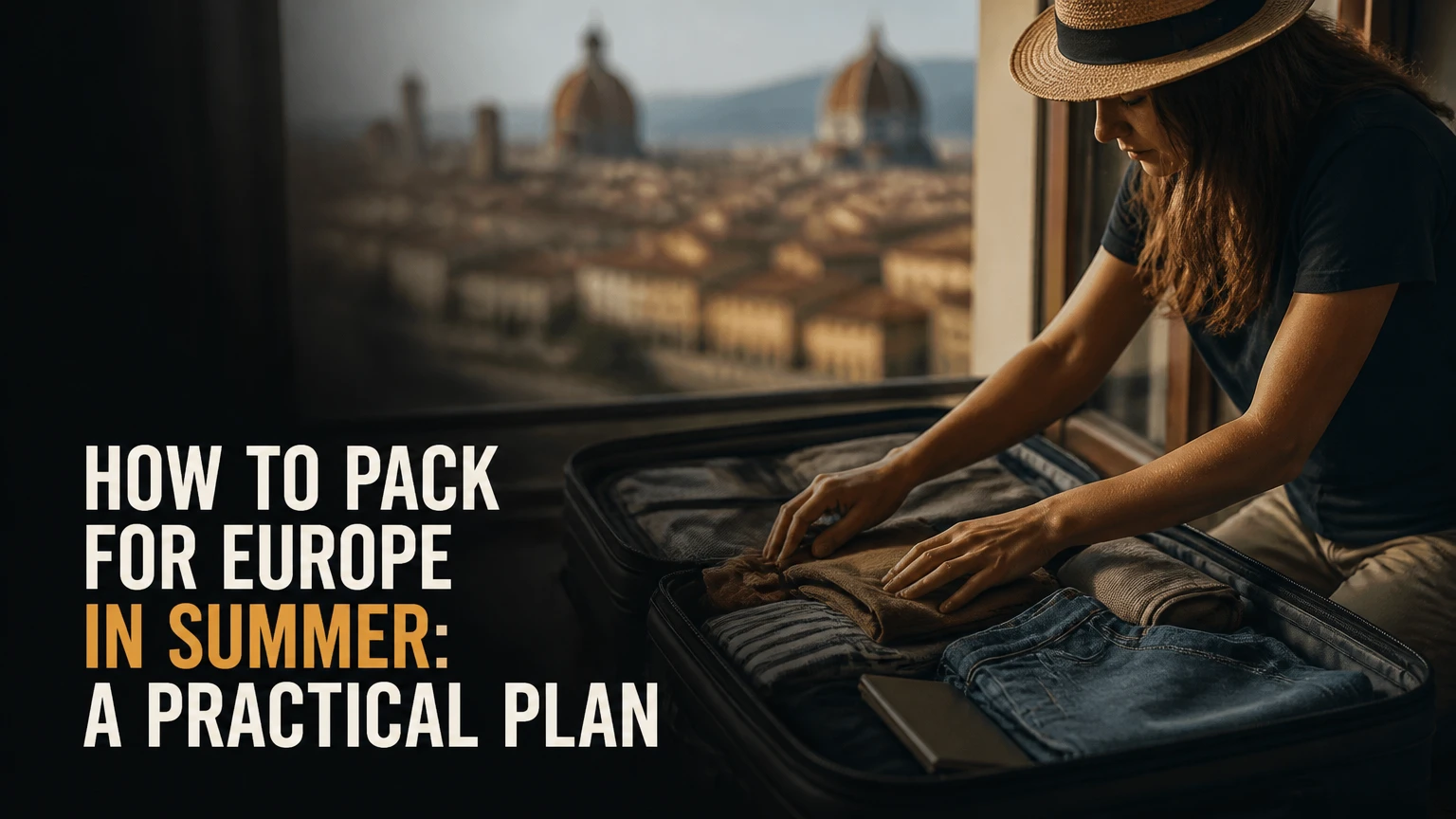
How to pack for Europe in summer means building a lightweight capsule wardrobe around heat, walking, laundry, local dress rules, and airline limits. The most reliable plan uses 5-7 tops, 3-4 bottoms, two versatile shoes, one outer layer, and enough personal essentials for 5-7 days between washes.
Key Facts / Quick Answer
Plan for 5-7 days of clothing, even on a two-week trip, and wash small items every 3-4 nights.
A practical carry-on target is 6.5-8 kg, but each airline sets its own cabin and personal-item rules.
Wear your heaviest shoes and jacket in transit to protect luggage weight.
Pack one shoulder-and-knee covering layer for churches, monasteries, and religious museums.
Choose linen blends, lightweight cotton, merino, and quick-drying synthetics according to climate and laundry access.
Test the fully packed bag on stairs and cobblestones before departure, not only on an airport floor.
What Does Summer Packing for Europe Require?
Summer packing for Europe requires a compact system that handles temperature changes, long walking days, laundry gaps, and multiple transport modes. Mediterranean cities can reach 30-35°C in July, while northern coastlines, mountain towns, ferries, and air-conditioned trains may feel cool enough for a light layer.
A useful capsule is smaller than most first-time travelers expect. Five tops, four bottoms, two pairs of shoes, underwear for five days, swimwear, sleepwear, and one thin jacket cover most city itineraries when laundry is available.
The central trade-off is comfort versus redundancy. A second swimsuit or dress can be more useful than a duplicate sweatshirt, but a rain shell may matter more than either item in Ireland, the Alps, or a storm-prone coastal itinerary.
Start With the Itinerary, Not the Country
A single country can contain several packing climates. A July trip combining Rome, the Amalfi Coast, and the Dolomites needs different layers from a week in Copenhagen, Stockholm, and Oslo.
| Itinerary condition | Typical daytime range | Add to the base capsule | Reduce or omit |
|---|---|---|---|
| Mediterranean city | 28-35°C | Sun hat, sandals, breathable shirts | Heavy knitwear |
| Northern capital | 18-26°C | Light rain shell, thin sweater | Extra swimwear |
| Alpine town above 1,000 m | 14-27°C | Fleece or merino layer, trail shoes | Dress shoes |
| Atlantic coast | 17-25°C | Hooded shell, quick-dry trousers | Thick denim |
| Mixed city and beach | 24-32°C | Swimsuit, cover-up, packable tote | Formal clothing |
These are planning ranges, not forecasts. Check each destination seven days before departure and again 48 hours before leaving. Weather determines the outer layer; the itinerary determines shoes and clothing coverage.
How Many Clothes Should You Pack?
For a 7-14 day trip with access to a sink or laundromat, pack clothing for approximately five days rather than the full calendar. The quantity works because underwear, socks, and lightweight tops dry quickly, while bottoms can usually be worn several times.
| Clothing category | Minimum quantity | Comfortable quantity | Selection rule |
|---|---|---|---|
| Everyday tops | 5 | 7 | At least 2 should work for religious sites |
| Bottoms | 3 | 4 | Include one long or below-knee option |
| Underwear | 5 pairs | 7 pairs | Wash on nights 3 and 6 |
| Bras or base layers | 2 | 3 | Rotate moisture-prone items |
| Socks | 3 pairs | 5 pairs | Match shoes and expected walking |
| Dresses or skirts | 1 | 2 | Choose pieces that layer over shoulders |
| Swimwear | 1 set | 2 sets | Two sets help when beach time is consecutive |
| Sleepwear | 1 set | 1 set | Use a clean T-shirt only if necessary |
| Light outer layer | 1 | 2 | Jacket plus thin cardigan for cold regions |
The 5-4-3-2-1 rule is a useful starting framework, not a law. Its common version means five tops, four bottoms, three shoes, two dresses or swimsuits, and one jacket. For most travelers, three shoes is the upper limit, including the pair worn during transit.
A two-week trip does not automatically require twice the clothing. It requires a laundry plan. A two-week hiking trip, a wedding itinerary, or travel without laundry access does require a different calculation.
Build Outfits Before Packing Items
Select combinations rather than isolated favorites. Every top should coordinate with at least two bottoms, and every shoe should support at least two planned activities.
A dependable city capsule might contain:
- Two linen-blend shirts, two quick-dry T-shirts, and one modest blouse or collared shirt
- One lightweight trouser, one walking short, one skirt or casual dress, and one optional fourth bottom
- One swimsuit, one cover-up, and one thin scarf or overshirt
- Five pairs of underwear, three to five pairs of socks, and a compact sleep set
- One neutral layer that works in museums, trains, churches, and evening restaurants
Expert insight: the most efficient color palette is not necessarily neutral. Two base colors plus one accent often create more useful combinations than an entirely beige wardrobe, because the accent can distinguish outfits without adding another garment.
Which Luggage Works Best for European Travel?
A 35-40L backpack or compact cabin suitcase works best when the itinerary includes trains, stairs, budget flights, and frequent hotel changes. A checked suitcase provides more capacity, but its extra volume encourages redundant clothing and becomes difficult on uneven streets.
| Luggage type | Typical capacity | Best use | Main drawback |
|---|---|---|---|
| Personal item backpack | 20-25 L | One to three nights, strict budget fare | Limited shoes and outerwear |
| Travel backpack | 35-45 L | Rail travel, stairs, hostel transfers | Shoulder strain above 8-10 kg |
| Two-wheel cabin roller | 35-45 L | Mixed pavement and moderate walking | Less stable on cobblestones |
| Four-wheel cabin spinner | 35-45 L | Airports and smooth hotel floors | Wheels catch on old stone |
| Checked suitcase | 60-75 L | Long stays, equipment, formal events | Bag fees, stairs, waiting time |
Backpacks are not automatically better. A poorly fitted 40L pack can cause more fatigue than a two-wheel roller, especially for travelers with back, shoulder, or balance limitations. A roller is reasonable for an itinerary with one hotel base and taxi transfers.
Compare Carry-On and Checked-Bag Costs
Airline fees vary by route, fare, season, and purchase time. Typical budget-airline planning ranges are approximately $25-$75 for a prepaid checked bag and $60-$120 when baggage is rejected or purchased at the airport, but the booking screen controls the actual price.
| Cost item | Typical range in USD | When the charge applies | Budgeting action |
|---|---|---|---|
| Prepaid checked bag | $25-$75 per segment | Added during booking | Buy before airport arrival |
| Airport or gate baggage purchase | $60-$120 per segment | Bag exceeds included allowance | Measure and weigh at home |
| Self-service laundromat | $5-$10 per load | One wash and dry cycle | Share one load with a companion |
| Hotel laundry service | $4-$9 per item | Staff-washed individual garments | Reserve for urgent pieces |
| Replacement T-shirt | $10-$35 | Lost, stained, or forgotten item | Buy locally instead of overpacking |
These prices are typical planning estimates converted to USD, not universal tariffs. Ryanair, easyJet, Wizz Air, and national carriers can apply different dimensions to the same fare class, and “cabin bag” may mean an overhead item rather than an under-seat personal item.
What Airline Dimensions and Weight Should You Check?
Airline baggage rules must be checked against the exact fare and route because European carriers do not share one standard. A common personal-item limit is about 40 x 20 x 25 cm, while a paid or included cabin bag often falls near 55 x 40 x 20 cm, with weight limits commonly between 7 and 10 kg.
| Baggage category | Common planning size | Common planning weight | What to verify |
|---|---|---|---|
| Under-seat personal item | 40 x 20 x 25 cm | 5-7 kg | Handles, wheels, and expansion |
| Overhead cabin bag | 55 x 40 x 20 cm | 7-10 kg | Fare inclusion and route |
| Standard checked bag | 158 cm total dimensions | 15-23 kg | Maximum linear dimensions |
| Long-haul checked allowance | 158 cm total dimensions | 23-32 kg | Ticket class and airline |
| Small day bag | 30-35 cm wide | 1-3 kg loaded | Security and museum restrictions |
Use the airline’s own app or booking confirmation rather than a luggage retailer’s generic chart. Measure the exterior, including wheels, handles, and hard-shell protrusions. Expansion zippers can turn a compliant suitcase into an oversized one.
The Transportation Security Administration describes its liquid rule as the “3-1-1 liquids rule.” For flights departing the United States, pack liquids, aerosols, gels, creams, and pastes in containers of 100 ml or less inside one quart-sized bag. European airport screening rules are not identical at every location, so follow the departure airport’s instructions for the return journey.
Use a Practical Weight Budget
A 7 kg limit leaves little room for heavy footwear or electronics. A workable target is 6.5 kg before airport purchases, which preserves a small margin for scale differences.
| Item group | Target weight | Typical contents |
|---|---|---|
| Clothing | 2.5-3.0 kg | Five tops, three bottoms, underwear, sleepwear |
| Shoes | 1.2-1.8 kg | One packed pair, one worn pair |
| Toiletries | 0.5-0.8 kg | Liquids, solid products, medication |
| Electronics | 0.7-1.2 kg | Charger, phone, power bank, camera |
| Bag and organizers | 1.0-1.5 kg | Empty backpack or cabin roller |
| Margin | 0.3-0.7 kg | Souvenirs and scale variation |
Expert insight: the empty bag is part of the weight calculation. A 2.8 kg hard-shell roller consumes 40% of a 7 kg allowance before clothing enters it, while a 1.2 kg travel backpack leaves room for a jacket and a second pair of shoes.
Which Fabrics and Layers Handle European Heat?
Lightweight linen blends, merino wool, cotton, and technical synthetics each solve a different problem. Linen improves airflow but wrinkles; merino controls odor and temperature but can cost more; quick-dry synthetics dry fastest but may retain body odor in intense heat.
| Fabric | Drying after sink wash | Heat performance | Best application | Limitation |
|---|---|---|---|---|
| Linen blend | 6-12 hours | Excellent airflow | Shirts and loose trousers | Wrinkles readily |
| Lightweight cotton | 12-24 hours | Comfortable in dry heat | T-shirts and dresses | Slow in humid rooms |
| Merino wool | 8-16 hours | Odor control across temperatures | Travel shirt and thin layer | Higher replacement cost |
| Nylon or polyester | 3-8 hours | Good moisture transfer | Underwear and active tops | Odor varies by finish |
| Heavy denim | 24-48+ hours | Poor in high heat | One established pair only | Heavy and slow to dry |
A three-layer system handles most European summer conditions:
- Wear a breathable base layer for walking.
- Add a thin shirt, cardigan, or overshirt for trains and museums.
- Carry a packable rain shell for wind and showers.
Air conditioning changes perceived comfort quickly. A 32°C afternoon can become a cold train or gallery environment within minutes, so a thin layer is more useful than a heavy hoodie.
Do not pack a thick cotton sweatshirt “just in case” unless the forecast and elevation support it. A 200-300 gram merino layer or wind shell usually provides more temperature range at less volume.
How Many Shoes Should You Bring?
Two pairs are enough for most city trips, while three pairs make sense only when the itinerary combines formal events, beaches, or strenuous trails. Every shoe must be broken in and tested for at least one long walk before departure.
A practical footwear system includes:
- Supportive walking sneakers with a grippy, flexible outsole
- Lightweight sandals that stay secure on stairs and tolerate heat
- Optional slip-ons or dress shoes only for formal dinners, weddings, or dedicated beach days
White sneakers are versatile, but color should not override fit. Cobblestones expose weak heel counters, thin soles, and loose straps faster than smooth sidewalks do.
Use a simple test at home: walk 10,000-15,000 steps in the primary pair, then wear the socks intended for the trip. If friction appears during the test, Europe will amplify it. Pack blister plasters, but do not treat them as a substitute for suitable shoes.
Expert insight: a third shoe often creates a false sense of preparedness. Travelers usually need a different outsole or coverage level, not another visual style. A secure sandal can replace slip-ons for many Mediterranean itineraries, while trail shoes cannot replace comfortable city footwear on a long museum day.
What Toiletries, Medication, and Technology Belong in the Bag?
Travel toiletries should be reduced to daily necessities, while medication and documents deserve redundancy. Decant liquids into 100 ml containers, choose solid versions where practical, and keep prescriptions in original labeled packaging.
Pack:
- Toothbrush, toothpaste, deodorant, sunscreen, lip balm, and basic skincare
- Prescription medication for the full trip plus several extra days
- Copies of prescriptions and generic medication names
- Small first-aid supplies, blister treatment, and oral rehydration salts
- Contact lenses, glasses, and a spare pair if needed
- A universal adapter compatible with the destination’s sockets
Most continental European destinations use Type C or Type F sockets at approximately 230 V and 50 Hz. The United Kingdom, Ireland, Malta, and Cyprus commonly use Type G sockets. An adapter changes plug shape; it does not convert voltage.
Check every heated device before packing. Hair dryers, curling irons, and some electric shavers require dual-voltage compatibility, usually marked “100-240 V.” A multi-port USB-C charger can reduce cable clutter, but keep a power bank in cabin baggage because airlines generally prohibit spare lithium batteries in checked luggage.
Protect documents separately from electronics. Store a passport, payment card, insurance details, and emergency contacts in a secure day bag, with encrypted digital copies available offline.
How Do You Handle Laundry on the Road?
Sink washing works for underwear, socks, and lightweight tops, but it is less effective for thick trousers or cotton hoodies. Wash small loads every three or four nights instead of waiting until the entire capsule is dirty.
A compact laundry kit contains solid detergent sheets, a universal sink stopper, a thin travel clothesline, and a small waterproof bag. Rinse thoroughly, press garments inside a towel to remove excess water, and hang them where air circulates rather than inside a humid bathroom.
| Laundry method | Typical cost in USD | Drying timeframe | Suitable garments |
|---|---|---|---|
| Hotel sink wash | $0-$2 | 4-24 hours | Underwear, socks, thin tops |
| Shared laundromat | $5-$10 | 1-2 hours | Full capsule and towels |
| Hotel laundry service | $4-$9 per item | 12-48 hours | Delicate or urgent items |
| Travel wash bag | $0-$2 after purchase | 4-18 hours | Small daily loads |
Laundry access changes what “minimal” means. A hotel with no balcony, poor ventilation, or a strict no-hanging policy may require a laundromat on day five.
What Clothing Works for Churches, Hiking, and Beaches?
A light scarf, overshirt, or loose trousers solves many dress-code problems without adding a special outfit. Major churches, monasteries, and religious museums may require covered shoulders and knees, but enforcement differs by site and can change seasonally.
For mixed activities, choose convertible coverage:
- Knee-length shorts or trousers for historic religious sites
- A breathable overshirt for sleeveless tops
- A swimsuit with a quick-dry cover-up for beaches and hotel pools
- Lightweight trail trousers and proper socks for hikes
- One polished shirt, blouse, or dress for restaurants and evening events
Do not assume every European city accepts beachwear away from the waterfront. In Barcelona, Rome, Dubrovnik, and Greek islands, local rules or social expectations may discourage swimwear in shops, public transport, and historic centers.
Hiking creates the largest equipment jump. If the route includes technical terrain, carry shoes with the required grip, blister prevention, sun protection, and a rain layer. Do not substitute fashion sneakers for mountain footwear because the same trip includes city sightseeing.
How Should You Pack the Bag?
Pack by weight and access, not simply by garment category. Heavy items should sit close to the back in a backpack or low and centered in a roller, while the first-day outfit and liquids should remain easy to reach.
- Check the forecast, itinerary, airline fare, and baggage dimensions.
- Wear the heaviest shoes and outer layer during transit.
- Place shoes in washable bags at the base or edges of the luggage.
- Add bottoms, then rolled or folded tops, then underwear in a small cube.
- Keep medication, documents, electronics, and one emergency outfit in cabin access zones.
- Fill gaps with socks and soft accessories, but do not use them to justify extra clothing.
- Weigh the closed bag, measure it, and test it on stairs.
- Remove the least versatile 10-20% of items 48 hours before departure.
Compression cubes save space but do not reduce weight. They can also make a bag appear smaller while encouraging overpacking, so use a luggage scale after compression.
A useful emergency outfit consists of underwear, one top, lightweight bottoms, and essential medication in the personal item. That combination protects against a delayed checked bag or a missed connection.
When Is Checked Luggage the Better Choice?
Checked luggage is appropriate when medical equipment, child supplies, specialist sports gear, or formal clothing cannot fit safely in a cabin bag. It also makes sense for a long hotel stay with few transfers, where the convenience of extra capacity outweighs airport collection time.
Checked baggage is a poor choice when the itinerary includes multiple budget flights, overnight trains, ferry connections, old-town stairs, or hotel changes every two nights. Cobblestones and narrow sidewalks make large spinners slower than their airport performance suggests.
Before checking a bag, keep these items with you:
- Passport, medication, cash, cards, and travel documents
- Lithium batteries, power banks, and essential electronics
- One change of clothes and basic toiletries
- Irreplaceable jewelry and valuables
- Prescription glasses and critical medical devices
Travel insurance may reimburse delayed or lost baggage, but reimbursement terms, receipts, and time limits vary. Photograph the bag and contents before departure, and keep purchase receipts for expensive equipment.
What Common Packing Mistakes Cause Problems?
The most expensive mistakes involve footwear, airline assumptions, and poor weather planning. Travelers often pack more shirts while ignoring the weight of shoes, cosmetics, camera equipment, and the empty suitcase.
Avoid these errors:
- Bringing brand-new shoes for 15,000-step sightseeing days
- Assuming every airline allows the same cabin dimensions
- Packing heavy denim, thick towels, or dense cotton hoodies
- Carrying full-size sunscreen and shampoo when local replacements are easy
- Forgetting a modest cover-up for churches and monasteries
- Putting medication or power banks in checked luggage
- Packing a rain shell only after seeing a forecast for sunshine
- Using a white or delicate garment without considering frequent transit
- Bringing three pairs of shoes that perform the same function
A forgotten T-shirt is replaceable. A lost prescription, unsuitable shoe, or overweight bag can disrupt the itinerary immediately.
Expert insight: the best “just in case” item is usually a layer with two jobs. A long-sleeved linen shirt can provide sun protection, church coverage, modesty, and cool-evening comfort, while a single-purpose formal jacket may be worn once.
When Should You Prepare for the Trip?
Begin four weeks before departure, because footwear and baggage testing need more time than toiletries. The final edit should happen after the weather forecast becomes reliable, not when the suitcase first looks complete.
| Time before departure | Task | Pass condition |
|---|---|---|
| 4 weeks | Inventory clothes and test shoes | Primary shoes complete a 10,000-step walk |
| 3 weeks | Confirm itinerary and activities | Hiking, beach, formal, and religious-site needs identified |
| 2 weeks | Decant toiletries and check medication | Liquids fit security rules and prescriptions cover the trip |
| 1 week | Complete a dry-run pack | Bag closes without expansion and weighs under target |
| 48 hours | Check destination forecasts | Outer layer and rain plan match actual conditions |
| Departure day | Reweigh and inspect documents | Weight, dimensions, passport, and power-bank placement confirmed |
Take photographs of the final packed layout. The record helps identify missing items at the next hotel and makes repacking faster during a multi-city trip.
Frequently Asked Questions About how to pack for Europe in summer
Is a carry-on enough for two weeks in Europe?
A carry-on is enough for two weeks when you pack five to seven days of clothing and wash small items every three to four nights. It becomes less practical for formal events, technical hiking, winter extensions, or destinations without accessible laundry. A 35-45L bag usually works better than a maximum-size case on rail-heavy routes.
Should I bring a backpack or rolling suitcase?
Choose a backpack for frequent stairs, trains, ferries, and uneven old-town streets, provided the loaded weight remains comfortable for your body. Choose a rolling suitcase for airport transfers, smooth pavements, and one or two hotel bases. Test both on stairs before deciding, because wheel quality and harness fit vary substantially.
What should I wear on the flight to save luggage space?
Wear the heaviest comfortable shoes, long trousers, and a light jacket or overshirt. Avoid wearing every heavy item merely to meet a weight limit, because overheating and uncomfortable transfers can outweigh the saved grams. Keep the outfit suitable for walking, security screening, and a cooler aircraft cabin.
How do I pack for rain and hot weather together?
Use quick-drying clothing, a compact rain shell, and shoes with a secure outsole rather than a large umbrella and heavy waterproof coat. A thin shell protects against wind and showers while taking less space than a poncho or insulated jacket. Check humidity and rainfall, not only the temperature forecast.
Can I buy forgotten items in Europe?
You can usually replace basic toiletries, T-shirts, umbrellas, socks, and common over-the-counter products in European cities. Prescription medication is different because brand names, strengths, and dispensing rules vary. Carry enough prescribed medication for the trip, its original packaging, and supporting documentation instead of relying on a local replacement.
What should I pack for Italy, Greece, and Switzerland together?
Pack breathable city clothing, one modest knee-and-shoulder covering layer, secure walking shoes, swimwear, and a thin warm layer for Switzerland. Alpine evenings can be cool even during a Mediterranean summer, and mountain weather changes quickly. Add trail footwear only if the planned routes require it, because it is heavy and specialized.
Conclusion
The most reliable way to pack for Europe in summer is to combine a five-day capsule, two genuinely different pairs of shoes, one versatile outer layer, and a scheduled laundry routine. Confirm the exact airline allowance, test the loaded bag on stairs, and use the 48-hour weather check to remove low-value items. This method keeps how to pack for Europe in summer focused on mobility, comfort, compliance, and realistic daily use rather than maximum wardrobe variety.
