

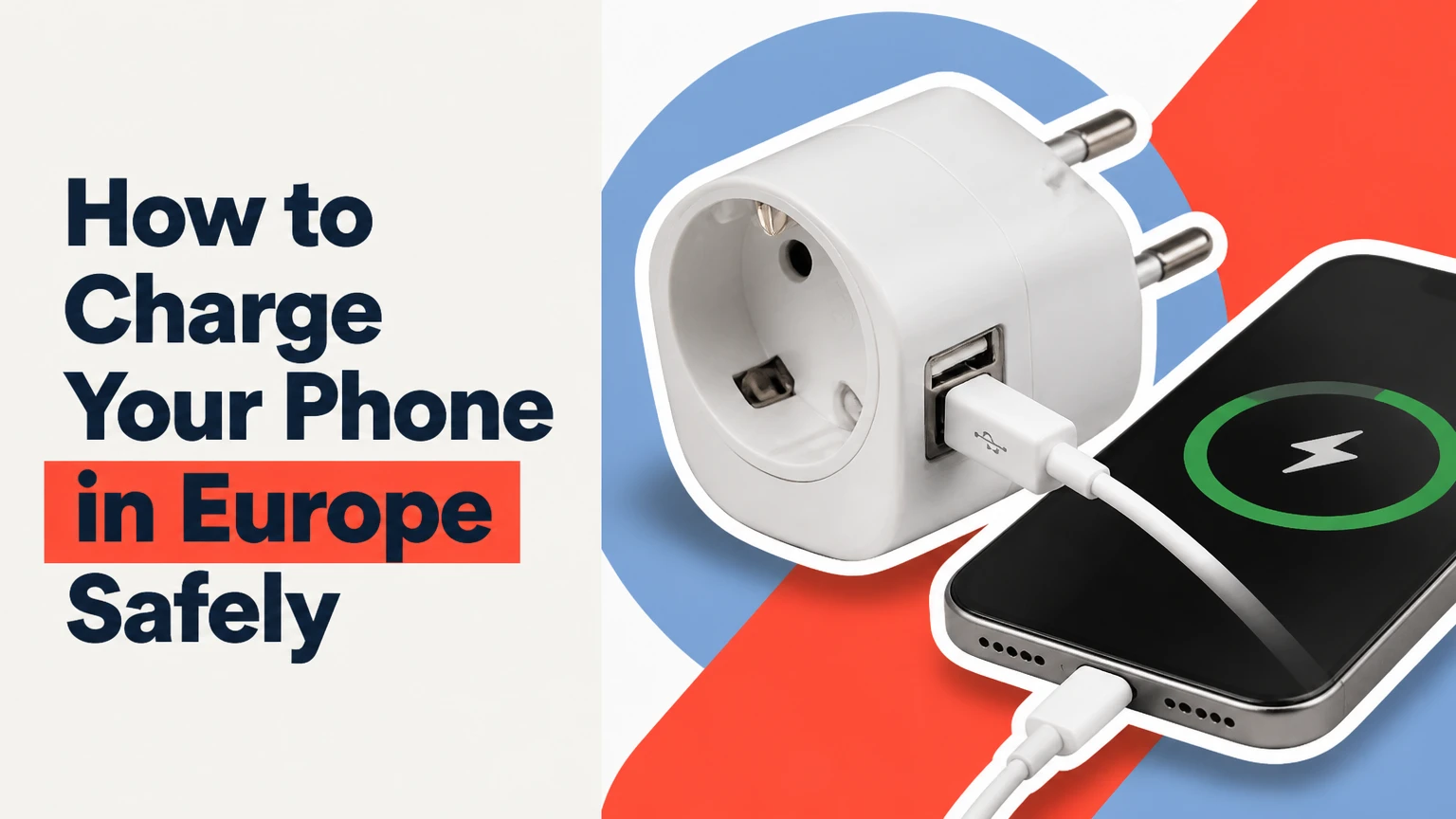
Charging a phone in Europe means connecting a dual-voltage USB charger to the local outlet through the correct physical plug adapter or a charger with European pins. Most modern phone chargers accept 100-240V at 50/60Hz, so they do not need a voltage converter. Check the charger label before departure, then match the adapter to every country on your itinerary.
Key Facts / Quick Answer
Europe generally supplies 230V AC at 50Hz, while the USA and Canada generally supply 120V at 60Hz.
A phone charger labeled Input: 100-240V ~ 50/60Hz can normally be used with a passive plug adapter.
Continental Europe commonly uses Type C, E, and F sockets; the United Kingdom and Ireland use Type G.
Switzerland, Denmark, and Italy can require different adapters, even though many two-pin chargers fit some of their sockets.
A plug adapter changes pin shape. It does not reduce voltage.
A typical 10,000mAh power bank weighs about 170-230 grams and must travel in carry-on baggage, not checked baggage, under common airline rules.
How European Phone Charging Works
European phone charging has two separate requirements: electrical compatibility and physical compatibility. The charger must accept the local voltage and frequency, while the plug or adapter must fit the wall socket.
A modern wall charger converts alternating current from the outlet into the low-voltage direct current used by a phone. The charger, rather than the phone battery, performs the main voltage conversion. A passive travel adapter only changes the arrangement of the pins.
What does 100-240V mean?
The marking 100-240V ~ 50/60Hz means the charger is designed to accept a broad range of household voltages and both common grid frequencies. A charger with that label can generally operate in Europe, North America, Japan, and many other regions when used with the correct plug shape.
Look for the input specification on the charger brick, not only on the phone. A label may list:
| Charger label | European use | What you need |
|---|---|---|
| Input: 100-240V, 50/60Hz | Normally compatible | Plug adapter or European-pin charger |
| Input: 110-120V, 60Hz only | Not directly compatible | Manufacturer-approved converter, if available |
| Output: 5V, 2A | Low-power USB output | Suitable for basic phone charging |
| Output: 5V, 3A or 9V, 3A | Up to 15W or 27W under stated conditions | Compatible cable and phone |
The output figures describe what reaches the device. The input figure determines whether the charger can safely connect to the European grid.
Does 50Hz damage a phone charger?
A reputable phone charger marked 50/60Hz is designed for both frequencies, so Europe’s 50Hz supply does not normally damage it. The frequency difference matters more to motors, clocks, heating appliances, and older equipment than to a modern switched-mode USB charger.
The European Commission describes the harmonized low-voltage supply in Europe as nominally 230V, although actual household voltage can vary within permitted limits. A charger with a 100-240V input range is built to tolerate that normal variation.
Which Plug Adapter Fits Each European Country?
The correct travel adapter depends on the wall outlet, not the phone brand. Type C two-round-pin plugs fit many continental European sockets, but a Type C plug is not a universal legal or mechanical solution for every country.
| Destination | Common socket type | Typical phone-charger requirement | Grounding note |
|---|---|---|---|
| France, Spain, Netherlands | Type C, E, or F | Type C-compatible adapter | Type E sockets use an earth pin |
| Germany, Austria, Portugal | Type C or F | Type C or Schuko-compatible adapter | Type F is grounded |
| United Kingdom, Ireland, Malta, Cyprus | Type G | UK-style three-rectangular-pin adapter | Grounded socket with shutter protection |
| Italy | Type C, F, or L | Type C often works; Type L may require adapter | Socket combinations vary |
| Switzerland | Type C or J | Slim Type C may fit; Type J adapter gives best fit | Swiss sockets have recessed geometry |
| Denmark | Type C, K, or E/F in some locations | Type C often works for two-pin chargers; Type K adapter may be needed | Grounding compatibility varies |
Type C, E, and F sockets
Type C, often called the Europlug, has two thin round pins and is ungrounded. It is intended for low-power, double-insulated equipment such as many phone chargers.
Type E sockets, common in France and several neighboring countries, use a protruding earth pin. Type F Schuko sockets, common in Germany and much of continental Europe, use grounding clips on the sides. A two-pin Type C phone charger can usually connect to both, provided the socket accepts its pin diameter and spacing.
A grounded laptop power supply is different. Do not assume that a two-pin phone adapter provides protective earth for a three-pin laptop or medical device.
Type G in the United Kingdom and Ireland
Type G has three rectangular pins and a larger body than continental European plugs. A continental Type C adapter will not fit a Type G socket. Travelers visiting London, Dublin, Edinburgh, Belfast, Valletta, or Nicosia need a Type G adapter.
Many Type G sockets contain shutters and a switch. The switch can remain off while inserting the plug, then be turned on after the charger is connected.
Adapter, Converter, or European Charger?
A plug adapter changes the physical plug shape; a voltage converter changes the electrical voltage. Modern USB phone chargers usually need the first and not the second.
| Equipment | Typical input rating | Use with passive adapter in Europe? | Converter guidance |
|---|---|---|---|
| iPhone USB-C charger | 100-240V, 50/60Hz | Yes | Not needed |
| Android USB-C charger | 100-240V, 50/60Hz | Yes | Not needed |
| Older 120V-only shaver | 120V, 60Hz | No | Use dual-voltage model or approved converter |
| American hair dryer | Often 120V only, 1,200-1,875W | No | Avoid small travel converters; use a European dryer |
| Laptop USB-C charger | Usually 100-240V, 50/60Hz | Yes | Not needed if label confirms range |
A converter cannot repair a charger that is damaged, counterfeit, overheating, or paired with an unsuitable cable. Converters also add bulk, waste energy as heat, and can have power limits below those of hair dryers or curling irons.
Expert insight: The most common serious packing error is checking the phone specification while ignoring the charging brick. The phone may accept USB power worldwide, but a 120V-only wall charger can fail when connected to 230V through a cheap adapter.
How Fast Will a Phone Charge in Europe?
Charging speed in Europe is determined by the phone, charger, cable, battery temperature, and charging protocol. The European outlet does not make a phone charge faster or slower by itself.
| Charging setup | Typical maximum power | Typical 0-100% time | Typical 0-50% time |
|---|---|---|---|
| Basic USB-A charger | 5W | 2.5-4 hours | 60-90 minutes |
| USB-C charger, standard profile | 10-15W | 1.75-3 hours | 35-60 minutes |
| USB-C Power Delivery charger | 20-30W | 1-2 hours | 25-40 minutes |
| High-output phone charger | 45W or more | 45-90 minutes | 15-30 minutes |
These are typical ranges for modern phones with batteries around 4,000-5,000mAh. Battery chemistry and manufacturer software cause the charging rate to slow substantially near 80-100 percent.
USB-C PD and PPS
USB Power Delivery, or USB-C PD, allows the phone and charger to negotiate a supported voltage and current. A 65W charger does not force 65W into a phone that accepts 25W. The phone requests the power it can use.
Samsung phones may benefit from Programmable Power Supply, or PPS, when paired with a compatible Samsung charger or third-party charger. Apple iPhones can use USB-C PD, but maximum charging speed varies by iPhone generation and battery conditions.
A charger with several ports may also reduce output when multiple devices are connected:
| Charger configuration | Advertised output | Typical shared output | Practical result |
|---|---|---|---|
| Single-port USB-C | 30W | 30W to one device | Fast phone charging |
| Two-port USB-C | 65W | 45W plus 20W | Phone and tablet together |
| USB-C plus USB-A | 40W | 25W plus 15W | Phone and watch or earbuds |
| Four-port travel charger | 100W | Often 65W plus shared remainder | Laptop, phone, and accessories |
Expert insight: A high-wattage charger is useful only when the cable and phone support its charging protocol. Buying a 100W brick for a phone limited to 27W adds weight without reducing charging time.
Which Charging Setup Should You Pack?
The best setup depends on the number of devices, countries, and nights away from a hotel outlet. A basic adapter is cheapest, while a multi-port GaN charger reduces the number of separate bricks.
| Charging option | Typical USD price | Typical weight | Best for | Main limitation |
|---|---|---|---|---|
| Single-region plug adapter | $5-$15 | 30-70g | One country group and one charger | Does not add USB power |
| Universal adapter | $15-$40 | 120-250g | Multi-continent itinerary | Bulky and may fit loosely |
| GaN USB-C travel charger | $25-$80 | 90-220g | Phone, tablet, and laptop | Requires separate plug conversion or built-in pins |
| 10,000mAh power bank | $15-$45 | 170-230g | Transit and long sightseeing days | Must be recharged and carried in cabin |
When is a universal adapter worthwhile?
A universal adapter is worthwhile when an itinerary includes Type G, Type C/E/F, North American Type A/B, or other regional sockets. It is less attractive for a week in France and Italy if a small European adapter already covers the trip.
Sliding-pin adapters can sag from loose wall sockets because their body is heavier than a simple Europlug. A short USB-C cable reduces leverage and makes accidental disconnection less likely.
When should you use a power bank?
Use a power bank during flights, train journeys, day tours, and situations where public outlets are occupied. A 10,000mAh model typically provides about 5,000-7,000mAh of usable energy after conversion losses, enough for roughly one full modern-phone recharge plus reserve.
The Federal Aviation Administration advises passengers to keep spare lithium batteries and power banks in carry-on baggage. Airlines can impose stricter limits, so check the carrier’s policy before departure. A 10,000mAh power bank is usually below the common 100Wh threshold, but the watt-hour marking on the battery is the authoritative figure.
How to Charge Safely in a Hotel or Rental
The safest process is to verify the charger, use the correct adapter, inspect the outlet, and keep heat away from bedding or luggage.
- Read the charger input label and confirm 100-240V, 50/60Hz.
- Identify the socket type for each destination, including the United Kingdom or Switzerland if applicable.
- Choose a certified adapter with firm pins and no exposed internal metal.
- Connect the cable to the charger before switching on a switched Type G outlet.
- Place the charger in open air, away from pillows, blankets, and direct sunlight.
- Check the phone after 10-15 minutes for abnormal heat, odor, buzzing, or a loose connection.
- Disconnect the charger when leaving if the room has unreliable wiring or the charger becomes hot.
- Use a bright tape marker or colored sleeve so the adapter is visible during checkout.
Hotel outlets may be controlled by a master switch, a bedside panel, or a key-card system. Some bathrooms provide shaver-only outlets with low power and isolation transformers. Those outlets may charge a phone slowly or not at all.
Expert insight: A charger that feels mildly warm under load can be normal. A charger that becomes too hot to hold, emits a smell, makes a sharp electrical noise, or repeatedly stops charging should be unplugged and replaced, not “tested” with another adapter.
What Can Go Wrong With European Charging?
Most failures come from mismatched plugs, damaged accessories, overloaded travel adapters, or assumptions about public USB ports.
| Problem | Likely cause | Immediate action | Better prevention |
|---|---|---|---|
| Plug will not enter socket | Wrong regional adapter | Do not force it | Confirm Type G, J, K, or L needs |
| Phone charges slowly | Low-power brick, shared outlet, hot battery | Remove case and reduce use | Pack a 20-30W USB-C PD charger |
| Charger becomes very hot | Poor ventilation, counterfeit hardware, overload | Unplug and inspect | Buy reputable, safety-certified hardware |
| Laptop tingles or disconnects | Ungrounded adapter or poor socket contact | Stop using that connection | Use a grounded regional adapter |
| Adapter falls from wall | Heavy universal body or loose outlet | Support or relocate it | Use a short cable and compact adapter |
| Public USB port behaves oddly | Damaged or modified port, weak output | Use your own charger or power bank | Carry a wall charger and data-blocking cable |
Are public USB charging ports safe?
Public USB ports can provide power, but travelers cannot easily verify the port’s condition or data behavior. A compromised USB port could potentially attempt data communication with a connected device, although modern operating systems commonly require permission for access.
A personal wall charger connected to a normal electrical outlet is the more controllable option. If a public port is unavoidable, use a charge-only cable or a USB data blocker, keep the phone locked, and decline prompts requesting trust or file access.
Can a phone be charged from a train or airplane outlet?
Train and airplane outlets vary by operator, seat, and route. A socket may provide limited power, shut off during electrical faults, or accept only certain plug shapes. Charging from a power bank is more reliable during boarding, transfers, and long journeys.
Do not place a power bank in checked luggage. Do not use a visibly damaged lithium battery, swollen phone, frayed cable, or cracked charger.
Phone-Specific Charging Advice
iPhone and Android phones follow the same voltage principle: the wall charger must accept European input, while the phone receives regulated low-voltage USB power.
| Device scenario | Recommended charger | Cable requirement | Typical travel advice |
|---|---|---|---|
| iPhone with Lightning port | 20W USB-C PD | USB-C to Lightning | Use Apple-certified or reputable cable |
| iPhone with USB-C port | 20W or higher USB-C PD | USB-C to USB-C | Carry one cable for phone and power bank |
| Android phone, standard fast charge | 20-30W USB-C PD | USB-C to USB-C | Check whether PPS improves Samsung charging |
| Phone plus tablet | 45-65W multi-port GaN | USB-C cables rated for intended power | Confirm shared-output behavior |
| Phone plus laptop | 65-100W USB-C PD | 5A e-marked cable when required | Use a grounded adapter for three-pin equipment |
A phone may display “charging slowly” even with a powerful charger if the cable is damaged, the port contains lint, the phone is hot, or the charger lacks the manufacturer’s preferred protocol. Cleaning a charging port requires care; do not insert metal objects.
How Much Should a European Charging Kit Cost?
A realistic budget for one phone is about $10-$35 if the traveler already owns a dual-voltage charger. A multi-device kit with a GaN charger, regional adapters, two cables, and a power bank commonly costs $70-$170.
| Kit | Contents | Typical USD total | Suitable itinerary |
|---|---|---|---|
| Basic continental kit | Type C adapter and existing charger | $10-$25 | France, Germany, Spain, Italy |
| UK add-on kit | Type G adapter and existing charger | $8-$20 | United Kingdom or Ireland |
| Multi-device kit | 45-65W GaN charger, cables, adapter | $55-$120 | Phone, tablet, watch |
| Long-day backup kit | Charger, adapter, 10,000mAh power bank | $70-$165 | Photography, navigation, rural travel |
Airport adapters often cost $20-$50 for products available elsewhere at $5-$20. Convenience can justify the purchase during an emergency, but checking the charger label and buying before departure usually produces a better fit and lower cost.
Frequently Asked Questions About how to charge your phone in Europe
Can I charge my phone in Europe without an adapter?
You may charge without a separate adapter if your charger has interchangeable regional pins, a European plug, or a USB power supply built into a compatible travel adapter. A North American Type A or B plug normally will not fit continental European or Type G sockets by itself.
Will my American phone charger work in France or Italy?
An American phone charger labeled 100-240V and 50/60Hz will normally work in France or Italy with the appropriate plug adapter. France commonly uses Type E sockets, while Italy uses Type C, F, and L combinations, so socket fit can vary between buildings.
Do I need a different charger for the United Kingdom?
You need a different physical plug adapter for the United Kingdom because British sockets use Type G. You generally do not need a different electrical charger if your existing phone brick states 100-240V and 50/60Hz input.
Can I charge my phone from a hotel bathroom outlet?
A hotel bathroom shaver outlet may charge a phone slowly, but some provide limited power or are controlled by an isolation transformer. A bedroom or desk outlet is usually more suitable. Never use a shaver-only outlet for a hair dryer or another high-power appliance.
How many times will a 10,000mAh power bank charge my phone?
A 10,000mAh power bank typically provides one full charge for a phone with a 4,000-5,000mAh battery, with some energy lost during voltage conversion and heat. Real-world capacity is often about 5,000-7,000mAh at the phone’s operating voltage.
Should I bring a voltage converter for a phone?
You normally should not bring a voltage converter for a phone if the charger input says 100-240V, 50/60Hz. Bring a passive plug adapter instead. A converter is relevant only to a single-voltage appliance, and many high-wattage appliances are safer to replace with dual-voltage models.
Final Charging Checklist for Europe
To charge your phone in Europe reliably, pack a dual-voltage charger, the plug adapter for every regional socket on your route, a suitable cable, and a carry-on power bank for transit. Confirm the input label before flying, avoid forcing plugs, keep chargers ventilated, and treat a voltage converter as an appliance-specific device rather than a phone accessory.
