

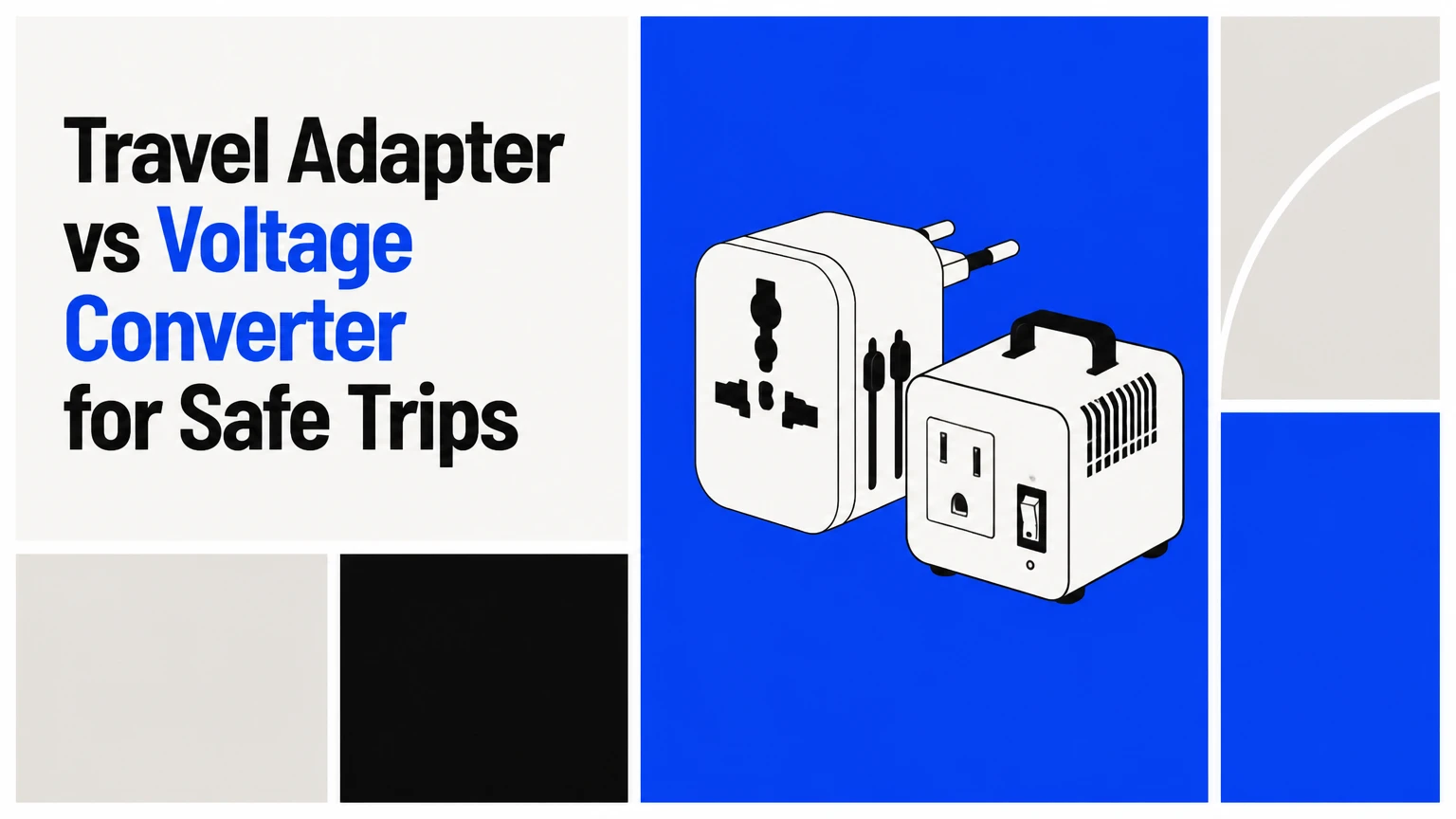
A travel adapter changes a plug’s physical shape so it fits a foreign socket, while a voltage converter changes electrical voltage for appliances that cannot accept the destination supply. An adapter does not alter voltage, current, or frequency. A converter cannot make every appliance compatible because wattage, grounding, waveform, and frequency still matter.
Quick answer:
A device labeled Input: 100-240V, 50/60Hz needs a plug adapter, not a voltage converter.
A device labeled 110-120V only can be damaged by a 220-240V outlet, even with an adapter.
A device labeled 220-240V only needs step-up conversion on a 100-127V supply.
USB-C laptop and phone chargers commonly accept 100-240V, but confirm the printed input range.
Converter capacity must exceed the appliance’s running wattage and tolerate its startup surge.
A converter changes voltage, but most travel converters do not change 50Hz electricity to 60Hz or the reverse.
Travel Adapter vs Voltage Converter: The Core Difference
The core difference is physical compatibility versus electrical compatibility. A travel adapter provides a matching pin arrangement, whereas a voltage converter transforms the incoming voltage before electricity reaches the appliance.
A socket can accept a plug mechanically while supplying the wrong voltage electrically. That is why a US two-flat-pin plug may fit a European Type C adapter while the connected 120V-only appliance receives approximately 230V. The adapter has solved the shape problem, not the power problem.
| Question | Travel adapter | Voltage converter |
|---|---|---|
| Changes plug shape | Yes, for named socket types | Usually, through an attached receptacle |
| Changes voltage | No, output equals wall voltage | Yes, step-down or step-up |
| Changes frequency | No | Usually no |
| Typical weight | 50-250 grams | 0.5-3 kilograms |
| Typical cost | $10-$35 | $30-$100 |
| Best match | Dual-voltage electronics | Single-voltage appliances |
| Main failure | Loose, hot, or incompatible connection | Overheating, incorrect output, or appliance damage |
Electrical Safety First summarizes the boundary clearly: “A travel adaptor will not convert the voltage.” That distinction matters because plug geometry provides no evidence that the appliance can tolerate the local electrical supply.
How Does a Travel Adapter Work?
A travel adapter routes electricity through differently arranged metal contacts without transforming the incoming supply. The adapter may contain shutters, a fuse, grounding contacts, or USB charging electronics, but a basic passive model does not regulate the wall voltage.
Common plug and socket types
Countries use regional configurations identified by lettered plug types. Voltage and plug shape are separate attributes, so a country can share a plug family with another country while using a different nominal supply.
| Plug type | Common locations | Typical voltage | Typical frequency |
|---|---|---|---|
| Type A and B | United States, Canada, Mexico | 100-127V | 60Hz |
| Type C and F | France, Germany, Spain, much of Europe | 220-240V | 50Hz |
| Type G | United Kingdom, Ireland, Singapore | 220-240V | 50Hz |
| Type I | Australia, New Zealand, Argentina | 220-240V | 50Hz |
| Type J | Switzerland, Liechtenstein | 220-240V | 50Hz |
The table gives typical nominal values, not a guarantee for every outlet. IEC 60038 defines standard supply voltages, while local utility tolerances and building wiring can produce small variations.
Adapter categories
The right adapter category depends on destination coverage, grounding, and charging needs.
- Single-region adapter: Fixed pins for one socket family, usually the smallest option.
- Universal adapter: Sliding or folding contacts cover several regions, but moving mechanisms create more points of failure.
- Grounded adapter: Includes an earth contact for appliances designed with a three-pin or grounded plug.
- USB adapter block: Adds USB-A or USB-C ports, although those ports have their own wattage and Power Delivery limits.
- Plug adapter with fuse: Common in Type G systems, where the fuse protects the appliance cord and plug circuit.
A universal adapter is not automatically suitable for a high-wattage appliance. Many models accept a plug rated for 10A or 13A but have weaker internal contacts, poor wall support, or no protective earth.
What an adapter cannot do
A plug adapter cannot lower 230V to 120V, raise 120V to 230V, stabilize unstable mains, convert 50Hz to 60Hz, or correct a damaged appliance. A USB port on an adapter may perform voltage regulation for USB devices, but that function does not change the voltage at the AC socket.
What Is a Voltage Converter?
A voltage converter is an electrical device that changes one AC voltage to another, usually by using a transformer or electronic switching circuit. A step-down unit changes approximately 220-240V to 110-120V; a step-up unit changes approximately 100-127V to 220-240V.
The converter must be selected for the appliance’s electrical behavior, not merely its label. A 1,500W resistive heater may require a different converter design from a 100W motor, even when both display similar nominal wattage.
| Converter type | Typical load | Typical rating | Typical continuous use | Main limitation |
|---|---|---|---|---|
| Resistive electronic converter | Hair dryer, curling iron | 500-2,000W | 10-30 minutes | Heat and waveform quality |
| Magnetic step-down transformer | Audio gear, some medical devices | 100-1,000W | 1-8 hours | Heavy and inefficient |
| Magnetic step-up transformer | 120V equipment on 230V supply | 100-1,000W | 1-8 hours | High mass and idle draw |
| Travel transformer | Small continuous electronics | 50-300W | 1-8 hours | Limited outlet capacity |
These are typical product ranges, not universal specifications. The manufacturer’s continuous rating, duty cycle, thermal protection, and output waveform take priority over a retailer’s headline wattage.
Electronic converters and transformers
Electronic converters use semiconductor switching and may produce a waveform that is unsuitable for some motors, audio equipment, timers, and sensitive control circuits. They are often compact and practical for short use with heating elements.
Magnetic transformers use coils and a magnetic core to transfer energy at the same frequency while changing voltage. They are heavier, but a correctly sized transformer generally provides a more predictable sine-wave output for compatible continuous loads.
Neither design automatically fixes frequency. A 50Hz motor supplied with 60Hz power can change speed, while a 60Hz motor operated at 50Hz can run hotter or draw abnormal current.
How to Check Whether You Need a Converter
Read the electrical input label before choosing travel equipment. The label usually appears on a charger, power brick, appliance handle, underside, or detachable power supply.
Follow this process:
- Find the input specification. Look for “Input,” “Rated voltage,” or “AC supply.”
- Identify the voltage range. A range such as 100-240V means the device accepts both major global supply bands.
- Check frequency. Confirm 50/60Hz when the device contains a motor, clock, fan, pump, or heating control.
- Record wattage or amperage. Multiply volts by amps when watts are not printed.
- Compare the plug and socket. Add a grounded adapter if the equipment requires protective earth.
- Size any converter above the load. Choose a continuous rating above running wattage and account for startup surge.
- Test the setup briefly. Stop if the adapter, converter, cable, or appliance becomes unusually hot, smells of insulation, or makes abnormal noise.
A label reading 100-240V, 50/60Hz, 65W indicates that the power supply handles global voltage and frequency ranges. The traveler needs only a suitable plug adapter, or a USB-C charger with the correct Power Delivery profile.
A label reading 120V, 60Hz, 1,500W indicates a single-voltage, high-draw appliance. On a 230V supply, the traveler would need a correctly rated step-down transformer, but buying a local or dual-voltage replacement is usually safer and lighter.
Destination Voltage Changes the Decision
The origin and destination countries determine whether conversion is even possible with ordinary travel equipment. Most international trips fall into a 100-127V group or a 220-240V group, but Japan is a major exception because it uses 100V.
| Origin | Destination | Wall supply change | Dual-voltage device | Single-voltage device |
|---|---|---|---|---|
| United States, 120V | France, 230V | Step-up required | Adapter only | Step-up converter required |
| United States, 120V | Japan, 100V | Step-down required | Adapter only | Check 100V tolerance |
| United Kingdom, 230V | United States, 120V | Step-down required | Adapter only | Step-down converter required |
| Australia, 230V | New Zealand, 230V | No voltage change | Adapter only | Adapter only |
| Germany, 230V | United Kingdom, 230V | No voltage change | Adapter only | Adapter only |
| Canada, 120V | Australia, 230V | Step-up required | Adapter only | Step-up converter required |
A dual-voltage appliance still needs a plug adapter when its native plug does not fit. “Dual voltage” describes electrical input, not mechanical plug compatibility.
Which Devices Usually Need Which Option?
Phones, tablets, laptops, mirrorless cameras, and modern shavers usually use external power supplies marked 100-240V. High-heat appliances and some motorized equipment require closer inspection because their input circuits may be single-voltage or frequency-sensitive.
| Device | Typical power | Likely input label | Recommended travel setup |
|---|---|---|---|
| Smartphone charger | 5-30W | 100-240V, 50/60Hz | Adapter or USB-C PD charger |
| Laptop charger | 45-240W | 100-240V, 50/60Hz | Adapter and correctly rated charger |
| Camera battery charger | 5-30W | 100-240V, 50/60Hz | Adapter only |
| Curling iron | 25-100W | 120V or 100-240V | Dual-voltage model or converter |
| Hair dryer | 1,000-2,000W | 120V or 220-240V | Local or dual-voltage model |
| CPAP machine | 30-120W typical | Often 100-240V | Confirm manufacturer specification |
| Electric clipper | 5-20W | 100-240V or single-voltage | Adapter, converter, or local charger |
| Coffee maker | 700-1,500W | Often single-voltage | Local appliance is usually practical |
USB-C chargers and laptops
USB-C Power Delivery chargers commonly accept 100-240V input and negotiate lower DC output voltages with compatible devices. A 65W charger may support 5V, 9V, 12V, 15V, and 20V profiles, but the laptop still requires the manufacturer’s minimum power level.
A USB-C port does not prove universal compatibility. Check the charger’s input label, output profiles, cable rating, and laptop requirements. A 100W charger cannot safely replace a proprietary 240W workstation adapter unless the computer supports that charging method.
Hair dryers and curling irons
Heating appliances create the most common converter mistake because their wattage is high and their use often lasts longer than a small travel converter’s duty cycle. A 1,500W hair dryer can exceed a 500W converter by 200%, causing thermal shutdown, melted insulation, or fire risk.
The safer choices are a dual-voltage travel appliance with a real voltage selector, a destination-country rental, or a low-cost local replacement. A dual-voltage switch must be set to the destination supply before connection.
CPAP machines and medical equipment
Many CPAP power supplies accept 100-240V, but the machine, humidifier, heated tubing, and manufacturer-approved power brick must be checked as a complete system. A converter should not be inserted into a medical setup unless the equipment maker specifies its use.
Travelers should carry the original power supply, confirm destination voltage with the manufacturer, and plan for outlet access. A battery backup may require separate airline and medical-device rules.
How Much Converter Capacity Do You Need?
Converter capacity must exceed the appliance’s continuous wattage, with additional margin for startup or heating surges. A practical rule is to choose at least 25% above continuous wattage for resistive loads and 50-100% above rated wattage for motors, compressors, and pumps unless the manufacturer gives a surge rating.
| Appliance load | Running wattage | Practical minimum rating | Additional concern |
|---|---|---|---|
| Phone and camera chargers | 30W combined | 50W | USB output profile |
| Laptop charger | 100W | 125-150W | Startup and charging reserve |
| Clipper | 15W | 25-50W | Motor waveform |
| CPAP power supply | 90W | 120-150W | Heated humidifier surge |
| Small fan | 60W | 120W | Motor startup current |
| Curling iron | 75W | 100-150W | Thermostat cycling |
| Hair dryer | 1,500W | 1,875W or higher | Heat, duty cycle, outlet rating |
| Coffee maker | 1,200W | 1,500W or higher | Heating cycle and surge |
For an appliance rated at 1,200W, a 25% margin produces a 1,500W target: 1,200 × 1.25 = 1,500W. This calculation does not override a converter’s duty-cycle restriction or a hotel outlet’s circuit rating.
Never connect multiple appliances to one converter unless the combined load remains below the converter’s continuous rating. A power strip increases the number of sockets, not the available wattage.
What Happens If You Use the Wrong Device?
Using only an adapter with a single-voltage appliance on the wrong supply can destroy the appliance quickly. The likely result depends on the circuit, but smoke, blown fuses, damaged capacitors, heating-element failure, and fire are all possible.
| Mistake | Electrical result | Likely symptom | Correct response |
|---|---|---|---|
| 120V appliance on 230V supply | Excess voltage across components | Flash, smoke, immediate failure | Unplug and do not retry |
| 230V appliance on 120V supply | Insufficient voltage | Weak heat, slow motor, no start | Use correct supply or converter |
| 500W converter with 1,500W dryer | Three times rated load | Overheating or shutdown | Stop and replace setup |
| Ungrounded appliance on grounded outlet | Earth path remains incomplete | Shock risk if insulation fails | Use approved grounded equipment |
| 50Hz motor on 60Hz supply | Speed and heating change | Noise, heat, incorrect timing | Confirm frequency compatibility |
| Loose universal adapter | Contact resistance rises | Hot plug, flicker, odor | Disconnect and replace adapter |
A converter also cannot repair a device designed for a different frequency. Clocks may gain or lose time, induction motors may change speed, and transformer heating can increase when frequency falls below the appliance’s design value.
Safety Details That Travelers Commonly Miss
The most dangerous assumption is that a universal adapter is a universal power supply. A travel adapter should fit firmly, preserve grounding where required, and carry a legitimate current rating from a recognized testing system.
Look for these checks:
- A visible current rating, such as 10A or 13A at a stated voltage.
- A grounded path for Class I equipment with an earth pin.
- Firm contact without rocking, sparking, or partial insertion.
- Thermal protection on high-wattage converters.
- A converter output socket that prevents accidental reverse connection.
- Country-specific fuse requirements, especially for Type G plugs.
- Manufacturer instructions for continuous operation.
- Certification marks appropriate to the market, such as UL, ETL, CE, or UKCA, interpreted as compliance markings rather than proof of every performance claim.
The practitioner rule is simple: never leave a high-wattage converter unattended in a hotel room. Heat accumulates inside luggage, on bedding, or against curtains even when the appliance itself appears normal.
Another counterintuitive risk is the outlet itself. Older hotel wiring may support a phone charger but not a 1,800W hair tool, and a converter does not increase the branch circuit’s capacity. If a breaker trips, reduce the load rather than repeatedly resetting it.
When Is Buying Locally Better?
Buying or renting a local appliance is often better than transporting a heavy transformer for a high-draw device. A local 230V hair dryer avoids conversion losses, plug incompatibility, overheating, and luggage weight.
| Item | Typical travel option cost | Typical weight | Best use case | Main trade-off |
|---|---|---|---|---|
| Basic plug adapter | $10-$20 | 50-120g | One destination | No voltage conversion |
| Universal adapter | $20-$35 | 150-300g | Several plug regions | Bulk and weaker support |
| USB-C PD charger | $25-$90 | 80-250g | Phones and laptops | Must match wattage |
| 300W transformer | $35-$70 | 1-2kg | Small continuous loads | Heavy for modest power |
| 2,000W converter | $70-$150 | 2-4kg | Short high-heat use | Heat and duty-cycle limits |
| Local hair dryer | $15-$50 | 500-1,200g | Longer stays | Purchase or disposal needed |
A local purchase is less attractive for regulated medical equipment, precision instruments, or specialized camera and computing hardware. Those products should travel with their specified power supplies instead of improvised substitutes.
A Practical Packing Decision
Choose equipment by electrical label first and plug shape second. This order prevents the common mistake of buying an adapter because the plug looks unfamiliar, then discovering that the appliance is single-voltage.
Use this compact decision tree:
- Does the label say 100-240V and 50/60Hz? Pack a suitable plug adapter or USB charger.
- Does the label show only 120V or only 230V? Compare it with the destination supply.
- Do the voltages differ? Check whether a converter exists for the appliance’s wattage and frequency.
- Is the load above 500W, motor-driven, heated, or medically important? Prefer a destination-compatible or manufacturer-approved solution.
- Does the appliance require earth grounding? Reject two-pin adapters that defeat the earth connection.
- Will the device run for hours? Use a continuous-rated transformer or avoid conversion.
- Are you carrying several chargers? Replace separate bricks with a properly rated GaN USB-C charger where compatible.
Frequently Asked Questions About travel adapter vs voltage converter
Can I use a travel adapter with a 120V appliance in Europe?
A travel adapter alone is unsafe for a 120V-only appliance in most of Europe because European outlets commonly supply approximately 230V. Use a correctly rated step-down transformer, or choose a dual-voltage or locally purchased appliance. A 100-240V device needs only the appropriate plug adapter.
Does a voltage converter change 50Hz to 60Hz?
Most voltage converters do not change frequency. A transformer changes voltage while preserving the supply frequency, and many electronic converters also leave frequency unchanged. Check motors, clocks, pumps, and timing devices carefully because 50Hz and 60Hz operation can alter speed, heat, or timekeeping.
Can I plug a power strip into a universal adapter?
You can only do so when the adapter, power strip, outlet, and combined load are all rated for the destination supply. A power strip does not convert voltage or add available wattage. Never use a two-pin adapter to defeat the grounding connection of a grounded power strip.
Is a voltage converter needed for an iPhone or Android phone?
A voltage converter is generally unnecessary for an iPhone or Android phone when the original charger states 100-240V, 50/60Hz input. The traveler still needs a plug adapter, or a compatible USB-C Power Delivery charger, for the destination socket and required charging speed.
Can a converter power a hair dryer continuously?
A converter can power a hair dryer only when its continuous rating exceeds the dryer’s wattage and its instructions permit the duty cycle. Many compact electronic converters are intended for short bursts of approximately 10-30 minutes. A dual-voltage dryer or local model is usually safer.
Should a CPAP user pack a transformer?
A CPAP user should first check the original power supply for a 100-240V input range, because many CPAP supplies already accept international voltage. If the supply is single-voltage, use only a solution approved by the equipment manufacturer, and include the humidifier and heated tubing in the compatibility check.
Conclusion
Travel adapter vs voltage converter decisions become straightforward when the appliance label comes first. A dual-voltage 100-240V device needs a correctly grounded plug adapter, while a single-voltage appliance may need a voltage converter matched to its wattage, frequency, duty cycle, and grounding requirements. For high-draw or medical equipment, a local or manufacturer-approved solution is often safer than a compact generic converter.
