

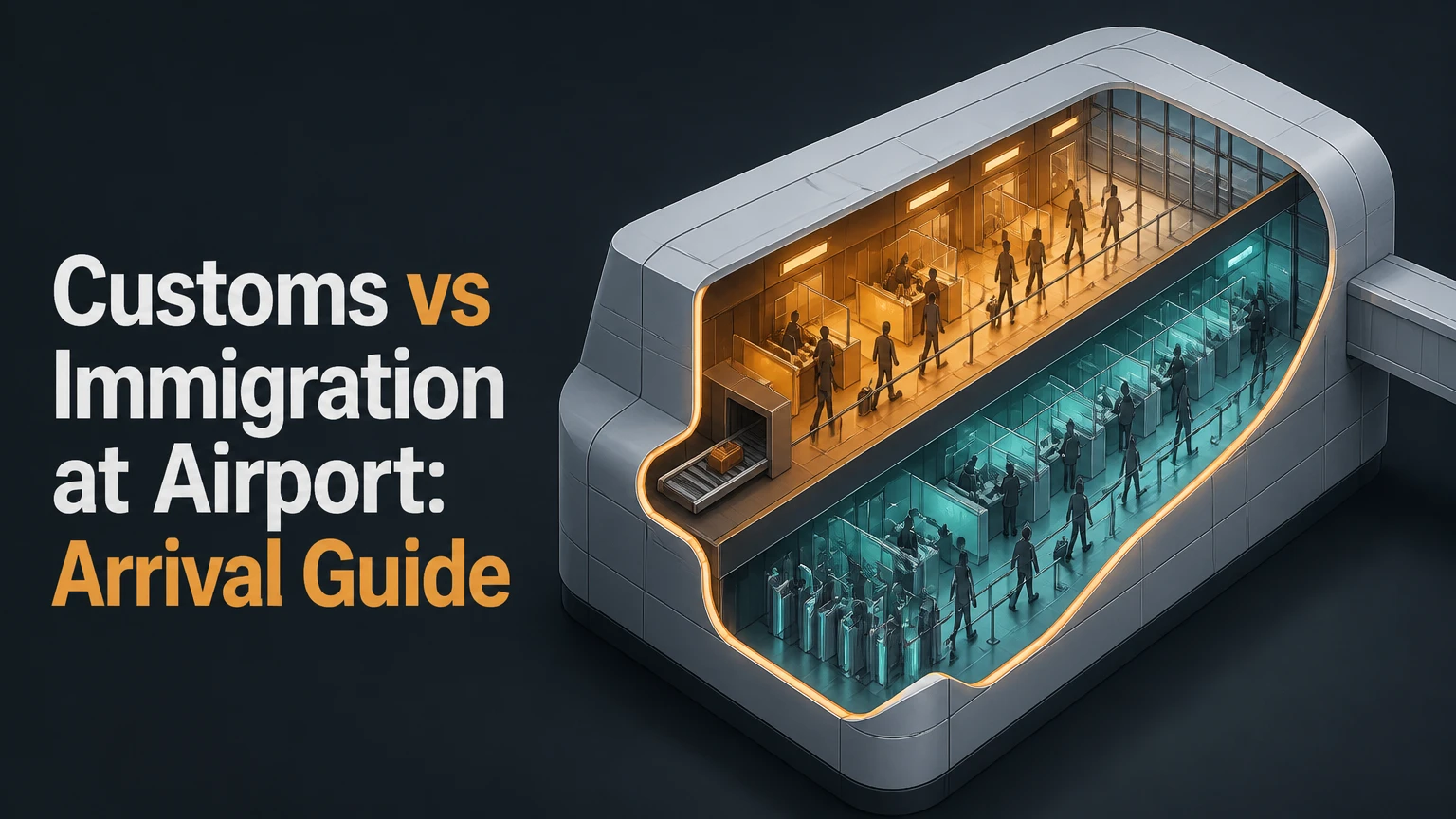
Customs vs immigration at airport refers to two separate border controls: immigration examines the traveler’s identity and right to enter, while customs examines goods, luggage, currency, and regulated items. On a normal international arrival, immigration comes before baggage claim and customs comes after it, although preclearance and transit procedures can change that order.
Key Facts
Immigration controls people, including passports, visas, residence permits, and admission decisions.
Customs controls goods, including luggage contents, food, plants, commercial items, and currency.
A typical arrival sequence is immigration, baggage claim, agriculture inspection where applicable, then customs.
A customs declaration is not the same as an immigration application. Declaring an item does not guarantee that the item is admissible.
A United States dollar equivalent of $10,000 is a reporting threshold in the United States, but other countries use different currencies and limits.
U.S. preclearance can complete immigration and customs before departure, allowing a traveler to arrive as a domestic passenger.
What Is the Difference Between Immigration and Customs?
Immigration is the border authority’s process for identifying a person and deciding whether that person may enter, remain, or transit. Customs is the process for controlling goods entering or leaving a country, collecting applicable duties, and enforcing import restrictions.
The distinction is functional rather than purely organizational. In some countries, one agency performs both jobs. For example, U.S. Customs and Border Protection combines the words in its name, but passport inspection and merchandise inspection remain different legal functions.
Immigration usually assesses:
- Passport validity and identity
- Visa, electronic authorization, or residence status
- Purpose and duration of travel
- Previous immigration violations
- Security or law-enforcement alerts
- Eligibility for admission under national law
Customs usually assesses:
- Personal belongings and purchases
- Food, plants, seeds, animal products, and medicines
- Alcohol, tobacco, firearms, and other restricted goods
- Currency and monetary instruments
- Commercial samples, inventory, and resale goods
- Whether tax, duty, or import permits apply
| Feature | Immigration | Customs |
|---|---|---|
| Main subject | Traveler | Goods and currency |
| Primary document | Passport, visa, residence permit | Declaration, invoice, import permit |
| Main decision | Admit, refer, or refuse entry | Release, assess duty, seize, or refer |
| Typical location | Passport-control hall | Baggage exit or customs hall |
| Typical consequence of violation | Refusal, removal, detention | Duty, seizure, civil penalty, prosecution |
What Is Airport Security?
Airport security is a third process that protects the aircraft, terminal, and aviation system from weapons, explosives, and prohibited dangerous articles. It normally occurs before departure, whereas immigration and customs usually occur during international arrival processing.
The Transportation Security Administration, or TSA, illustrates the difference in the United States. TSA PreCheck changes the departure security-screening experience. It does not decide whether a foreign national may enter the United States and does not waive a customs declaration.
| Process | Main question | Usual travel stage | Example authority |
|---|---|---|---|
| Airport security | Is the person or cabin baggage safe for aviation? | Before boarding | TSA, airport security authority |
| Immigration | May this person enter or transit? | International arrival | Border or immigration authority |
| Customs | May these goods enter, and is duty owed? | After baggage claim | Customs authority |
| Agriculture inspection | Could the goods harm crops, livestock, or ecosystems? | Arrival or customs referral | Plant and animal inspection authority |
How Does International Arrival Work?
International arrival normally follows seven stages: deplaning, border routing, immigration, baggage collection, customs declaration, possible secondary inspection, and exit. Airport layouts differ, but the legal separation between admission of people and importation of goods remains.
- Follow arrivals and border-control signs. Do not follow domestic-transfer signs unless airport staff direct you.
- Choose the correct immigration queue. Common lanes include citizens, residents, visa holders, visitors, diplomats, and e-gate users.
- Present travel documents. The officer or kiosk may review the passport, visa, electronic authorization, arrival card, and biometric data.
- Answer admission questions. Typical subjects include accommodation, purpose, intended length of stay, onward travel, and employment.
- Collect checked baggage. Some airports require all travelers to reclaim luggage before customs even when bags are tagged to a final destination.
- Complete the customs declaration. Use a paper form, kiosk, mobile application, or verbal process, depending on the country.
- Take the correct exit or inspection lane. A green lane means no goods requiring declaration under that jurisdiction’s rules, not immunity from inspection.
A border officer can refer a traveler to secondary inspection without alleging a crime. Referrals commonly resolve a document discrepancy, require an interpreter, verify a visa condition, or inspect luggage more closely.
When Does Customs Come Before Immigration?
Customs can be completed before ordinary arrival immigration when the departure airport provides foreign preclearance. The United States operates preclearance facilities in selected airports in Canada, Ireland, Aruba, Bermuda, The Bahamas, and other locations.
A precleared traveler completes U.S. immigration and customs formalities before boarding or departure. On arrival in the United States, the traveler generally enters through a domestic gate, but the preclearance decision still controls admission and the baggage remains subject to applicable rules.
Airports can also alter the apparent order for transfer passengers. A traveler changing planes in the Schengen Area may clear external-border immigration at the first Schengen airport, while customs may occur at the final destination if baggage or local procedure requires it. Always follow airport-specific transfer signs.
What Documents Do You Need at Each Control?
Immigration usually requires a valid passport and any entry authorization required by the destination. Customs usually requires an accurate declaration, although an officer may also request receipts, permits, prescriptions, or proof of ownership.
| Traveler situation | Immigration documents | Customs evidence | Frequent issue |
|---|---|---|---|
| Tourist | Passport, visa or ETA if required | Purchase receipts, declaration | Visa permits tourism but not employment |
| Resident returning home | Passport, residence card | Restricted-goods permits if applicable | Expired residence card |
| Student | Passport, student visa or permit | Medication and personal-item documentation | Enrollment or address question |
| Business traveler | Passport, business visa if required | Commercial invoice, ATA Carnet, equipment list | Samples mistaken for personal goods |
| Minor traveling alone | Passport, visa, consent documents | Declaration by parent or guardian | Missing parental authorization |
| Pet owner | Passport, import permit, health certificate | Vaccination and quarantine records | Airline acceptance does not equal import approval |
A return ticket, hotel booking, insurance policy, or invitation letter may help explain travel plans, but those items do not replace a passport or visa. Immigration officers may request them because admission criteria often include purpose, funds, accommodation, and intention to leave.
Customs valuation is separate from immigration purpose. Calling a purchased watch, laptop, or coat a “gift” does not necessarily remove it from the taxable value of imported personal goods. The relevant rule is usually ownership, destination, value, and intended use.
What Does Customs Check in Your Luggage?
Customs checks whether goods are admissible, restricted, correctly declared, and subject to tax or duty. Officers may use baggage x-ray, detector dogs, document review, questioning, physical inspection, or referrals to agriculture and health agencies.
The most frequently misunderstood category is food. A sealed package can still contain a prohibited animal or plant product. Beef jerky, fresh fruit, seeds, raw milk products, untreated wood, and soil may require declaration or may be prohibited even when commercially packaged.
| Item category | Common control reason | Typical document or action | Possible result |
|---|---|---|---|
| Fresh fruit or vegetables | Plant pests and disease | Declare and surrender if required | Inspection, disposal, or seizure |
| Meat and dairy | Animal disease and food safety | Product label, permit where required | Release, disposal, or seizure |
| Prescription medicine | Controlled-substance or quantity rules | Prescription, doctor letter, original packaging | Release, referral, or confiscation |
| Cash and monetary instruments | Financial transparency | Currency declaration | Release, report, seizure, or penalty |
| Firearms or ammunition | Public safety and licensing | Import permit and ownership records | Detention and prosecution risk |
| Commercial samples | Trade and valuation | Invoice, packing list, ATA Carnet | Temporary admission or duty |
| Plants, seeds, and soil | Invasive species | Phytosanitary certificate | Quarantine, treatment, or destruction |
Customs officers may inspect a laptop or camera to establish ownership, value, or commercial purpose. A traveler carrying five identical new phones, for example, may receive questions even if each device is individually legal.
Expert insight: An airline’s decision to accept a bag is not an import authorization. Airlines evaluate carriage and safety; border agencies evaluate whether the contents may enter the country.
How Do Declarations, Duties, and Cash Limits Work?
A declaration tells customs what you are carrying; it does not automatically make a restricted item legal. The traveler remains responsible for checking the destination’s current allowances, permits, prohibited-goods list, and reporting thresholds before departure.
Duty-free allowances vary by destination, nationality, route, age, residency, and item category. The frequently repeated “200 cigarettes and 1-2 liters of spirits” rule is not universal. The European Union, United Kingdom, United States, Canada, Australia, and Singapore apply different quantities and eligibility conditions.
| Jurisdiction or route | Cash reporting example | Personal allowance example | Practical warning |
|---|---|---|---|
| United States | More than $10,000 total currency or monetary instruments on FinCEN Form 105 | CBP applies traveler and item-specific duty rules | Threshold is not a tax-free guarantee |
| European Union entry | €10,000 or more when entering or leaving the EU | Alcohol and tobacco limits differ by route and member-state guidance | Intra-EU travel differs from external entry |
| United Kingdom | £10,000 or more when entering or leaving Great Britain | Personal allowances depend on country of departure | Northern Ireland rules can differ |
| Canada | C$10,000 or more in currency or monetary instruments | Alcohol, tobacco, and gifts have specific limits | Duty may apply above allowance |
| Australia | A$10,000 or more in currency or monetary instruments | Strict biosecurity rules cover food and plant material | Declare food even when uncertain |
| Singapore | S$20,000 or more in physical currency or bearer negotiable instruments | Goods and tobacco controls are highly item-specific | Some goods require permits before arrival |
For U.S. entry, the reporting threshold is more than $10,000 in combined currency and monetary instruments, not simply cash in one wallet. Reporting is generally free, but failure to report can result in seizure, civil penalties, or criminal investigation.
U.S. Customs and Border Protection uses the practical instruction, “When in doubt, declare it,” in traveler guidance. A declaration allows an officer to decide admissibility; concealment creates a separate enforcement problem.
Duty is commonly calculated from the customs value, tariff classification, origin, and applicable preferential agreement. A simple example is illustrative only: if dutiable goods have a customs value of $1,000 and the applicable rate is 8%, the assessed duty would be $80, before any taxes, processing fees, or special charges.
| Cost or service | Typical amount or range | When charged | Who sets it |
|---|---|---|---|
| Arrival immigration inspection | $0 at the airport | Every ordinary inspection | Destination government |
| Electronic travel authorization | About $7-$21 in cited examples | Before travel | Destination government |
| Visa on arrival | About $25-$100 in cited examples | Eligible arrivals | Destination government |
| Customs declaration | Usually $0 | When declaration is required | Destination government |
| Import duty | 0% to substantially higher rates | Dutiable goods | Tariff schedule |
| Broker or courier fee | $20-$150 or more | Formal or courier clearance | Private provider |
These are planning ranges, not universal prices. Government websites and embassy instructions control because fees and thresholds change.
How Long Do Immigration and Customs Take?
Typical international arrival processing takes 30-90 minutes from aircraft door to public arrivals during busy periods, but the range depends on queue volume, visa checks, baggage delivery, inspection referrals, and airport design. A straightforward immigration interview may take 60-90 seconds after the queue reaches the officer.
| Stage | Typical off-peak time | Typical peak time | Main delay factor |
|---|---|---|---|
| Walk from gate to immigration | 5-15 minutes | 10-25 minutes | Large terminal and shuttle |
| Immigration queue and inspection | 5-20 minutes | 30-90 minutes | Simultaneous wide-body arrivals |
| Baggage delivery | 10-30 minutes | 20-60 minutes | Ground handling and transfer priority |
| Green-channel customs exit | Under 5 minutes | 5-15 minutes | Queue and spot checks |
| Red-channel declaration | 15-45 minutes | 30-90 minutes | Valuation, permits, inspection |
| Total to public lobby | 25-70 minutes | 60-180 minutes | Combined operational delays |
A green-channel passage can take under a minute when no queue exists, but customs retains authority to stop and inspect travelers. A red-channel declaration takes longer because the officer may count goods, review receipts, calculate duty, and verify permits.
For a separate ticket or self-transfer, plan at least three hours at a major international airport when immigration, baggage reclaim, customs, and recheck are all required. Minimum connection times published by an airport or airline are more reliable than a generic internet estimate because they reflect local infrastructure.
What Happens If You Make a Mistake?
A declared item can be refused entry, confiscated, destroyed, quarantined, or released after duty and inspection. An undeclared item can produce those outcomes plus civil penalties, criminal exposure, travel delays, and loss of trusted-traveler privileges.
The response depends on the country, item, value, intent, and accuracy of the traveler’s answers. Customs may distinguish an accidental failure to understand a rule from deliberate concealment, but travelers should not rely on leniency.
Common consequences include:
- Immediate surrender or destruction of prohibited food
- Payment of duty and tax on eligible goods
- Civil monetary penalties for false or incomplete declarations
- Temporary detention while ownership or admissibility is investigated
- Seizure of currency, goods, or vehicles connected to smuggling
- Criminal referral for weapons, drugs, counterfeit goods, or deliberate fraud
If you realize that an answer on a declaration is wrong, tell the officer before leaving the controlled area. Do not move an item into another bag, discard packaging to hide its origin, or give a false value.
Expert insight: “Nothing to declare” means that no goods require declaration under that country’s law. It does not mean that every item is automatically legal, duty-free, or exempt from inspection.
Which Expedited Programs Actually Help?
Expedited programs reduce waiting at specific border or security processes, but none removes the legal requirement to provide truthful information. Global Entry can accelerate eligible U.S. arrivals, while TSA PreCheck and CLEAR primarily affect departure security.
| Program | Process affected | International arrival role | Typical eligibility condition |
|---|---|---|---|
| Global Entry | U.S. immigration and customs processing | Biometric arrival kiosk or app flow | Background review and interview |
| Mobile Passport Control | U.S. passport inspection | Eligible travelers submit arrival details | Eligible passport and participating airport |
| TSA PreCheck | U.S. departure security | None for arrival border control | Approved traveler profile |
| CLEAR | Identity step at selected U.S. security lanes | None for customs or immigration | Private membership and participating airport |
| E-gate system | Passport control | Faster immigration for eligible passports | Biometric passport and age or nationality rules |
| Airport fast track | Airport-defined queue | May cover immigration, not customs | Airline, ticket, or paid access |
Global Entry does not make restricted goods admissible. A member must still declare food, currency, agricultural products, and other controlled items, and a customs officer can refer the traveler for inspection.
Preclearance is different from an expedited program. It changes where the inspection occurs, while Global Entry changes how an eligible traveler is processed within an existing border system.
How Should You Prepare Before Landing?
The most reliable preparation combines document readiness with item-level research. Check the destination customs authority, immigration authority, embassy, and airline because each source answers a different question.
Use this arrival checklist:
- Verify passport validity, blank-page rules, visa requirements, and electronic authorizations.
- Save an offline copy of accommodation details, onward travel, invitation letters, and permits.
- Keep medicine in original labeled packaging with a prescription or doctor’s letter.
- Separate receipts for expensive purchases, business equipment, gifts, and temporary imports.
- Confirm food, plant, animal-product, tobacco, alcohol, and firearm restrictions.
- Count cash and monetary instruments using the destination’s reporting rule.
- Complete a digital or paper declaration accurately before reaching the inspection point.
- Keep documents and valuables in carry-on luggage, not checked baggage.
- Ask an officer before choosing a lane if the item or allowance is unclear.
Mobile Passport Control, Singapore’s SG Arrival Card, electronic customs declarations, and national e-gates can reduce paperwork where available. They do not override visa conditions, import permits, quarantine rules, or inspection authority.
Photography and phone rules vary by airport and country. Follow posted instructions in passport-control and customs areas rather than assuming a universal prohibition. Some facilities restrict photography, calls, or recording because officers, screens, and security procedures are sensitive.
What Are the Main Edge Cases?
The normal sequence becomes less predictable for transit passengers, passengers with separate tickets, travelers arriving with pets, and people carrying goods for business. The decisive question is whether the traveler is entering the country and whether the baggage is being imported there.
International Transit Without Entry
A sterile international transit passenger may remain airside and avoid local immigration and customs. That treatment is not guaranteed. Airports may require border clearance when the itinerary involves a terminal change, separate tickets, overnight transit, a low-cost carrier, or an onward destination outside the sterile-transfer system.
Baggage Sent to the Final Destination
A bag tag showing the final airport does not prove that customs formalities are complete. In countries that require first-point-of-entry clearance, the traveler may have to reclaim the bag, present it to customs, and recheck it even when the airline has tagged it onward.
Denied or Delayed Immigration
Customs clearance does not cure an immigration problem. If entry is refused, officials decide what happens to the traveler and baggage, which may include return on the next available flight, detention, or supervised departure.
Pets and Service Animals
A pet’s airline health documentation is separate from the destination’s import permit, vaccination, microchip, quarantine, and agriculture requirements. Service-animal status can affect cabin carriage and accessibility accommodations, but it does not automatically waive import controls.
Accessibility and Language Needs
Request airport assistance through the airline before travel and tell the officer if you need an interpreter or disability accommodation. A trusted companion may assist, but each traveler remains responsible for accurate answers and declarations unless a lawful representative is completing them.
Frequently Asked Questions About customs vs immigration at airport
Do I need to collect my luggage before immigration?
No. International airports normally place immigration before baggage claim because the country first verifies that the traveler may enter. Exceptions include some preclearance facilities and unusual transfer arrangements, so follow airport signs and staff instructions rather than assuming every terminal uses the same route.
Can customs officers deny me entry?
Customs officers can refuse particular goods, impose duty, seize prohibited items, or refer serious cases for enforcement. Immigration authorities decide whether a person may enter. In countries where agencies are integrated, the same border service may handle both decisions, but the legal questions remain separate.
Do children go through passport control and customs?
Yes. Children normally require their own passport and, where applicable, visa or travel authorization. Officers may request parental consent, custody documents, or evidence of accommodation. A parent or guardian generally declares the family’s goods, but the declaration must include items carried by every member of the group.
Can I bring prescription medicine through an airport?
Often, but approval depends on the medicine, quantity, destination, and prescription status. Keep medicine in original packaging and carry supporting medical documentation. Controlled drugs, injectable medicines, and supplies exceeding a personal-use quantity may require an import permit before travel.
What happens if my checked bag does not arrive before customs?
Tell the airline’s baggage desk and follow the airport’s customs procedure. Some airports allow a delayed-baggage declaration or written description of the contents; others require the traveler to complete customs formalities before leaving. Do not mark missing goods as absent if you are legally required to declare them.
Is a customs declaration the same as a visa?
No. A visa or electronic authorization addresses permission to seek entry, while a customs declaration addresses goods and currency. A traveler can hold a valid visa and still have goods seized, duties assessed, or entry delayed because of an inaccurate or prohibited import.
Conclusion
Customs vs immigration at airport describes two linked but different decisions. Immigration verifies the person and entry status; customs verifies luggage, goods, currency, and import compliance. Prepare the correct travel documents for passport control, research item-level restrictions for customs, declare uncertain goods, and allow 30-90 minutes for a typical busy international arrival.
