

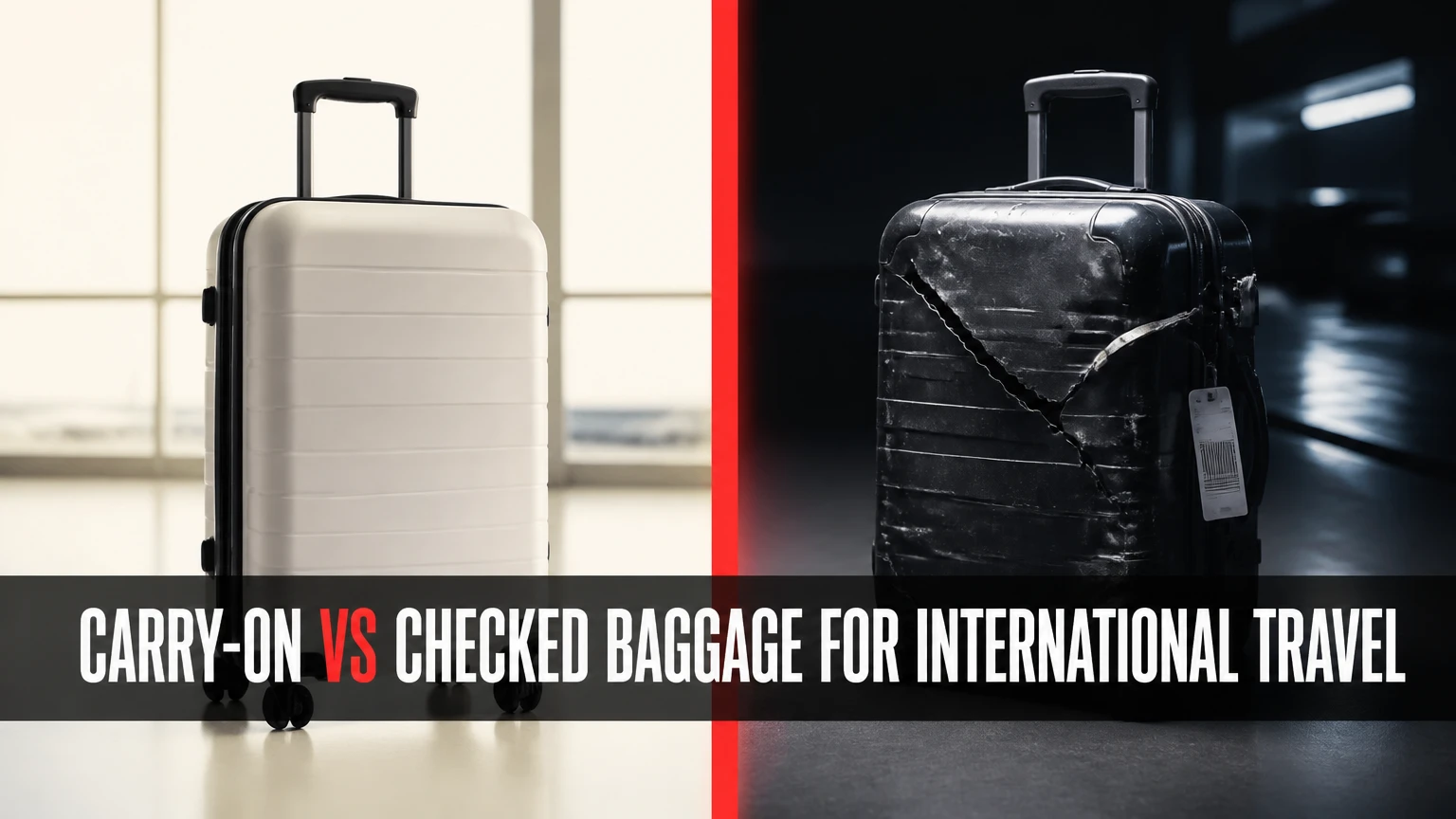
Carry-on versus checked baggage for international travel is a choice between keeping luggage in the cabin and transferring custody to the airline’s cargo system. Carry-on bags reduce waits and loss risk but restrict weight, liquids, and space; checked bags accommodate heavier loads, yet add fees, bag-drop time, claim delays, and connection risks.
Key Facts / Quick Answer
A typical international carry-on limit is about 55 x 40 x 20 cm and 7-10 kg, but the operating airline sets the enforceable rule.
A standard checked-bag allowance is commonly 23 kg and 158 cm total linear dimensions in economy.
Power banks, spare lithium batteries, and most e-cigarettes belong in cabin baggage, not checked luggage.
For a US international arrival, passengers generally collect checked bags before customs, then recheck them for the connecting flight.
A carry-on-only setup usually works best for trips of 7-10 days when laundry is available.
The safest general arrangement is a permitted cabin bag plus a personal item containing medication, documents, electronics, and one change of clothes.
What Each Bag Means
Carry-on baggage remains with the passenger from the departure terminal through the cabin, while checked baggage receives an airline tag and travels in the aircraft hold. The distinction affects access, security screening, liability, transfer procedures, and how quickly a traveler can leave the airport.
A carry-on normally means one cabin suitcase, backpack, or similar item placed in an overhead compartment. A personal item is a separate, smaller bag that must fit fully beneath the seat. Some basic economy and low-cost fares permit only the personal item, so “carry-on included” cannot be assumed from the aircraft’s physical capacity.
Checked baggage is accepted at a staffed counter or self-service bag drop. The airline weighs and measures it, attaches a routing tag, and sends it through baggage handling. At the destination, the traveler retrieves it from a carousel, although an airline may deliver it later after a delay or irregular-operation event.
The Three Bags Travelers Often Confuse
| Bag category | Typical maximum size | Typical weight rule | Where it travels |
|---|---|---|---|
| Personal item | 40 x 30 x 15 cm | Usually no published weight, must be liftable | Under the seat |
| Cabin bag | 55 x 40 x 20 cm | 7-10 kg on many international fares | Overhead bin |
| Checked suitcase | 158 linear cm | 23 kg in many economy fares | Cargo hold |
The measurements are typical examples, not universal standards. Ryanair, easyJet, Emirates, Singapore Airlines, British Airways, Air France, and United Airlines use different allowances by fare, aircraft, route, and frequent-flyer status. The operating carrier’s baggage page and booking confirmation control.
Carry-On vs Checked Baggage for International Travel
Carry-on baggage is usually the better choice when speed, control, and uninterrupted access matter more than volume. Checked baggage is usually the better choice when the trip requires bulky clothing, equipment, gifts, or liquids that cannot pass cabin screening. A hybrid arrangement often produces the best balance.
The central decision is not simply whether a suitcase fits. It is whether the traveler can tolerate carrying the load through terminals, keep the contents within security rules, and protect against a delayed bag. A 9 kg cabin bag may be physically manageable for one traveler but exhausting during a rail connection, while a checked suitcase can create a serious problem on a 75-minute international transfer.
Direct Comparison
| Decision factor | Carry-on baggage | Checked baggage | Practical consequence |
|---|---|---|---|
| Traveler access | Continuous access | No access during flight | Keep medication and documents in the cabin |
| Typical weight | 7-10 kg | 23 kg economy | Heavy clothing favors checking |
| Airport exit | No carousel wait | Often 20-45 minutes at claim | Cabin bags help travelers using late trains |
| Loss exposure | Gate-check risk remains | Misrouting or delay possible | Use a hybrid setup for essential items |
| Liquid capacity | Containers generally 100 ml or less | Full-size containers allowed | Toiletries favor the hold |
| Connection handling | Passenger carries the bag | Airline transfers or rechecks it | Short connections favor cabin baggage |
Expert Insight: Use a Weight Budget, Not a Bag Size
A cabin suitcase advertised as “40 liters” may consume 2.5-3.5 kg before packing. On a 7 kg airline limit, clothing, toiletries, and shoes may have only 3.5-4.5 kg available. Travelers who choose luggage by external volume alone often exceed the scale before adding a jacket or laptop.
Dimensions, Weight, and Cost
International baggage limits vary by airline, route, fare family, aircraft, and cabin class. A common cabin allowance is approximately 55 x 40 x 20 cm with a 7-10 kg limit, while a common checked allowance is 158 linear centimeters and 23 kg, but a budget fare can allow less or charge for every item.
“Linear dimensions” means length plus width plus height. A suitcase measuring 75 x 48 x 30 cm totals 153 cm and fits a 158 cm policy, while a 78 x 50 x 32 cm suitcase totals 160 cm and may incur an oversized charge even if the case looks ordinary.
Typical International Baggage Costs
| Baggage purchase | Budget-carrier typical range | Full-service international typical range | When the price changes |
|---|---|---|---|
| Cabin bag add-on | USD 25-70 per segment | Often USD 0 included | Fare type, route, and booking channel |
| First checked bag | USD 35-90 per segment | USD 0-100 | Long-haul fare and loyalty status |
| Second checked bag | USD 60-150 per segment | USD 75-200 | Route, advance purchase, and demand |
| Overweight bag | USD 50-200 | USD 100-300 | Weight band and airport payment |
| Oversized bag | USD 75-250 | USD 100-300 | Linear dimensions and equipment type |
These are typical planning ranges in USD, not quoted prices for a particular itinerary. Buying baggage online during booking is often less expensive than paying at the airport, but some airlines price each flight segment separately. A two-segment outbound journey can therefore turn a USD 50 bag into USD 100 in total charges.
Airlines often apply a piece concept, such as one 23 kg suitcase, or a weight concept, such as 30 kg distributed across several bags. A traveler cannot safely assume that a 28 kg bag is acceptable because the total party allowance is 46 kg. The ticket’s wording determines whether weight can be pooled.
Cabin and Checked Specifications
| Common policy feature | Typical international value | Main exception |
|---|---|---|
| Cabin suitcase height | 55-56 cm | Some airlines permit H56 cm or less |
| Cabin suitcase depth | 20-23 cm | Expandable cases may exceed it |
| Cabin weight | 7-10 kg | Some premium fares allow 12-14 kg |
| Checked economy weight | 23 kg | Some routes use 20 or 25 kg |
| Checked business weight | 32 kg | Piece count still limits total bags |
| Checked linear size | 158 cm | Sports equipment can use a special category |
The 32 kg threshold is common because airport workers may not be required to lift heavier individual pieces under local workplace rules. A suitcase above that weight may need repacking, special handling, or freight service rather than a simple excess-baggage payment.
How Much Baggage Should You Take?
Most travelers should take a cabin bag and personal item for a 3-7 day trip, add one checked suitcase for a 10-14 day trip or cold-weather itinerary, and check specialty gear when its dimensions or protection needs exceed cabin limits. Trip duration matters less than laundry access, climate, and planned activities.
A traveler visiting a warm destination with weekly laundry may pack fewer clothes for 14 days than a traveler attending a four-day winter conference. Shoes, coats, camera equipment, formalwear, and child supplies consume space faster than ordinary shirts and trousers.
Use these criteria:
- Choose cabin-only for short trips, flexible clothing, public-transit travel, and time-sensitive arrivals.
- Add checked baggage for bulky coats, full-size toiletries, gifts, hiking equipment, or multiple pairs of rigid shoes.
- Choose a hybrid setup when checked baggage is useful but medication, work equipment, and emergency clothing must remain accessible.
- Use specialty baggage rules for skis, golf clubs, bicycles, musical instruments, wheelchairs, and large sporting equipment.
- Reconsider checking a bag when the itinerary includes a short connection, separate tickets, or a first-entry customs inspection.
Families and Long Trips
Families should calculate the allowance per passenger and confirm whether infant tickets receive a separate checked piece, cabin bag, or stroller exception. A collapsible stroller may be gate-checked or accepted at the counter, but the procedure differs by airline and aircraft.
For long trips, plan a seven-day clothing cycle rather than packing one outfit per calendar day. Laundry detergent sheets, a sink-wash routine, and quick-drying fabrics can reduce a 23 kg suitcase to a cabin bag, although some accommodations restrict sink washing or provide no drying space.
What Goes in Each Bag
Carry-on baggage should contain items that are valuable, irreplaceable, legally restricted from the hold, or needed during a delay. Checked luggage can contain larger quantities of permitted liquids and ordinary clothing, but it remains inaccessible until baggage claim and may be exposed to impact, temperature changes, or routing errors.
The Transportation Security Administration, or TSA, states that “if you can spill it, spray it, spread it, pump it, or pour it, and it is larger than 3.4 ounces or 100 milliliters, then it should go in a checked bag.” TSA’s 3-1-1 liquids rule generally limits cabin containers to 100 ml, placed in one quart-sized transparent bag, although security authorities at other airports use their own implementation details.
Recommended Placement
| Item | Cabin baggage | Checked baggage | Reason |
|---|---|---|---|
| Prescription medication | Yes | No | Delays and temperature exposure |
| Power bank | Yes | No | Spare lithium batteries are restricted from the hold |
| Laptop and camera | Yes | No | Theft, impact, and access |
| 500 ml shampoo bottle | No at security | Yes | Container exceeds cabin limit |
| Passport and visa papers | Yes | No | Required at check-in and border control |
| Pocket knife | No | Usually yes, protected | Cabin security restriction |
| Spare clothing | Yes | Optional | Useful after a delayed bag |
| Aerosol toiletries | Limited | Often yes | Quantity and flammability rules apply |
Airline and government rules can be stricter than this table. Check the departure airport, transit airport, and destination authority for food, medication, weapons, chemicals, and plant or animal products.
Power banks must remain in the cabin under common aviation safety rules, and the International Air Transport Association publishes guidance for lithium-battery carriage. A tracker inside checked baggage is different from a spare battery: the tracker may be permitted under applicable conditions, while a loose power bank generally is not.
Fragile and Valuable Items
Do not check passports, cash, jewelry, irreplaceable photographs, high-value electronics, house keys, or essential business documents. Airlines may exclude or limit liability for fragile, valuable, or inadequately packed property under their conditions of carriage.
Musical instruments require a specific decision. A small instrument may fit within a cabin allowance, a larger instrument may require an extra paid seat, and a very large case may need checked or cargo service. A soft case does not convert oversized equipment into standard cabin baggage.
Airport Timing and Connection Risk
Checked baggage requires more airport time because the traveler must reach bag drop before the airline’s cutoff, while cabin-only travelers may proceed directly to security if online check-in and document verification are complete. For many international departures, arriving about three hours early is a practical target with checked luggage and about two hours may work for cabin-only travel, subject to airport conditions.
Bag-drop cutoffs commonly fall 45-60 minutes before scheduled departure, but some airports close earlier for document checks, remote stands, or long-haul flights. The published cutoff is not a suggested arrival time. Queue length, security screening, passport control, and gate distance still require a buffer.
A Practical Departure Sequence
- Check the ticket, operating carrier, and baggage allowance 24-48 hours before departure.
- Weigh and measure every bag at home, including wheels, handles, and external pockets.
- Complete online check-in, then confirm whether the airline requires a document check at the airport.
- Reach bag drop before the stated cutoff, keeping medication, electronics, and documents outside the suitcase.
- Photograph the bag, tag, and contents before surrendering checked luggage.
- Retain the baggage receipt until the final destination and inspect the carousel before leaving.
- Report delay or damage immediately at the airline’s baggage desk and keep the case reference number.
International Connection Rules
A checked bag may transfer automatically when all flights are on one booking and the airlines have an interline or codeshare agreement. The traveler may still need to collect and recheck it when entering a country that requires first-point customs clearance, changing to a separate ticket, changing airlines without an agreement, or spending an overnight stop.
The USA commonly requires arriving passengers to collect checked luggage after immigration and before customs at the first US airport, even when the bag is tagged to a later US destination. After customs, passengers normally place the bag on the connection belt or take it to the designated recheck point.
The same itinerary can produce different handling in Europe, Asia, or the Middle East. A connection through an airport within a customs or immigration zone may differ from a connection that crosses the zone’s external border. Ask the check-in agent, “Do I collect this bag at the transit airport?” and verify the bag tag’s final airport code.
Expert Insight: The Shortest Connection Is Often the Wrong Place to Check
A 90-minute legal minimum connection can become too short when the first flight arrives late, the passenger must clear immigration, and the bag requires rechecking. Cabin baggage does not eliminate the passenger’s border-control obligations, but it removes one physical handoff and can make a missed connection easier to manage.
Which Option Fits Your Trip?
Carry-on-only travel fits passengers who value control, can comply with the smallest allowance, and have a realistic way to wash clothes. Checked baggage fits passengers whose equipment, climate, mobility needs, or trip purpose makes a 7-10 kg cabin limit impractical.
| Traveler situation | Best default | Why | Main caution |
|---|---|---|---|
| 4-day warm-weather city trip | Cabin bag plus personal item | Low clothing volume and easy mobility | Shoes and liquids consume capacity |
| 12-day winter holiday | One checked bag plus personal item | Coat and layers exceed cabin weight | Keep a complete change in the personal item |
| Remote work trip | Cabin bag plus personal item | Laptop remains accessible | Confirm personal-item dimensions |
| Family with stroller | Checked suitcase plus cabin essentials | More total capacity | Verify stroller collection point |
| Separate-ticket connection | Cabin-only if possible | No bag recheck dependency | Follow each carrier’s allowance |
| Ski or golf trip | Checked specialty case | Protection and dimensions | Book equipment in advance |
A business traveler may prefer two cabin pieces to avoid waiting, but premium cabin rules can still impose a combined weight limit. A backpack packed with a laptop, camera, chargers, and documents can exceed 7 kg even when it fits beneath the seat.
Travelers with reduced mobility should not treat checked baggage as automatically easier. A heavy checked suitcase reduces lifting in the cabin but creates curbside, carousel, and ground-transport challenges. Request mobility assistance and confirm whether mobility devices receive separate handling.
Packing and Protection System
A reliable packing system separates access, compliance, and damage control. Put irreplaceable essentials in the personal item, distribute delay-sensitive clothing between bags, and leave enough weight margin to account for airport-scale differences.
Packing cubes can make a suitcase easier to organize, but they do not reduce mass. Compression increases available volume while making an overweight bag more likely, especially when travelers add dense shoes, books, or toiletries.
| Packing control | Typical target | Tool or method | Failure it prevents |
|---|---|---|---|
| Cabin weight margin | 0.5-1.0 kg below limit | Digital luggage scale | Airport-scale excess fee |
| Personal-item reserve | 20-30% empty space | Small backpack | Last-minute document or device storage |
| Checked-bag weight | 1-2 kg below allowance | Home scale | Gifts pushing the case overweight |
| Clothing rotation | 5-7 days | Quick-dry layers | Packing one outfit per day |
| Delay kit | One full change | Zip pouch in cabin bag | Arrival without checked luggage |
| Bag identification | Two contact labels | External and internal card | Detached luggage tag |
Photograph the suitcase interior, exterior, and contents before check-in. Keep receipts for expensive items and record serial numbers for electronics. An AirTag or similar Bluetooth tracker can provide location clues, but it does not replace the airline’s baggage report and may not update when the bag is inside a metal container or outside nearby devices.
Delayed, Lost, or Damaged Baggage
Delayed baggage means the airline has not delivered the bag when the passenger arrives; lost baggage generally means the carrier cannot locate or deliver it within the applicable investigation period. Report either event before leaving the airport when possible, because the baggage tag and claim receipt connect the report to the routing record.
For damage, photograph the suitcase before using it and report structural damage promptly. Airlines may distinguish normal wear, such as scuffs and minor scratches, from broken wheels, cracked shells, or damaged handles. The airline’s conditions of carriage specify deadlines and exclusions.
The Montreal Convention governs many international journeys and establishes limits for baggage liability in Special Drawing Rights, or SDRs. The International Civil Aviation Organization revised the baggage liability limit to 1,519 SDR per passenger effective December 28, 2024, although the recoverable amount depends on the proven loss, applicable treaty, and carrier process.
A sensible delay claim contains the baggage report number, boarding pass, bag tag, receipts for reasonable emergency purchases, and delivery address. Buy necessities proportionately. A premium wardrobe purchased during a one-night delay may be disputed even when a basic clothing replacement is reasonable.
Alternatives to Airline Baggage
Airline baggage is usually the lowest-cost option for ordinary clothing, but shipping can reduce airport handling and buying locally can remove transport weight. Neither alternative removes planning requirements, because delivery windows, customs, insurance, and destination prices affect the total outcome.
| Alternative | Typical cost in USD | Typical timeframe | Best use |
|---|---|---|---|
| Airline checked bag | USD 35-150 per segment | Same flight | Ordinary clothing and toiletries |
| Luggage courier | USD 100-400 per case | 2-7 days | Heavy gear and predictable lodging |
| Postal service | USD 60-250 per parcel | 5-21 days | Non-urgent durable items |
| Buy at destination | USD 10-250 initial spend | Same day to 2 days | Basic clothing and toiletries |
| Freight or cargo | USD 200-800+ | 3-14 days | Large equipment or relocation |
Luggage shipping works best when the hotel accepts packages, the traveler can ship several days early, and customs paperwork is straightforward. Confirm insurance exclusions for electronics, sporting equipment, and fragile goods.
Buying at the destination works for sunscreen, shampoo, basic shirts, diapers, and inexpensive adapters. It is less practical for prescription medication, specialty footwear, professional uniforms, or products unavailable in the destination country.
Frequently Asked Questions About carry on vs checked baggage for international travel
Can I take a backpack and a cabin suitcase on an international flight?
You can take both when the fare permits one cabin bag plus one personal item, but the backpack must fit completely beneath the seat and the suitcase must fit the published overhead dimensions. A large backpack may count as the cabin bag, leaving no second item or triggering a gate-check charge.
Do airlines weigh carry-on bags at international airports?
Many international and low-cost airlines weigh cabin baggage at check-in, security-adjacent sizers, or the gate. A typical limit is 7-10 kg, and staff may weigh the personal item together with the suitcase. Weigh the fully packed bags at home rather than relying on practices used by US domestic carriers.
Can I check a bag on a connecting international flight?
You can check a bag for a connecting itinerary when the airline accepts it and the route permits through-checking. You may still need to collect and recheck it at the first entry point into the USA, after customs, or when separate tickets and unrelated airlines are involved.
Is it safer to check valuables in a suitcase?
No. Keep cash, jewelry, passports, medication, electronics, confidential documents, and irreplaceable items in cabin baggage because checked luggage leaves your possession and may be delayed, opened for inspection, or damaged. Airline liability rules can also limit recovery for valuable or fragile property.
What happens if my checked bag is overweight?
The airline may charge an overweight fee, require repacking, apply a higher weight band, or refuse the individual piece above its handling limit. Typical international economy limits are 20-23 kg, while 32 kg is a common maximum for one accepted piece. A luggage scale prevents most surprises.
How early should I arrive for an international flight with checked luggage?
Arrive about three hours before departure when checking luggage, because bag drop, security, immigration, and gate access can each consume time. Cabin-only travelers may manage with about two hours at a familiar airport, but document checks, peak queues, and remote gates can require more.
Conclusion
The best choice in carry on vs checked baggage for international travel depends on allowance, trip conditions, and connection design rather than suitcase preference alone. Use cabin baggage for documents, medicine, electronics, and delay protection; check bulky or liquid-heavy items only after confirming the operating carrier’s size, weight, fee, and transfer rules.
