

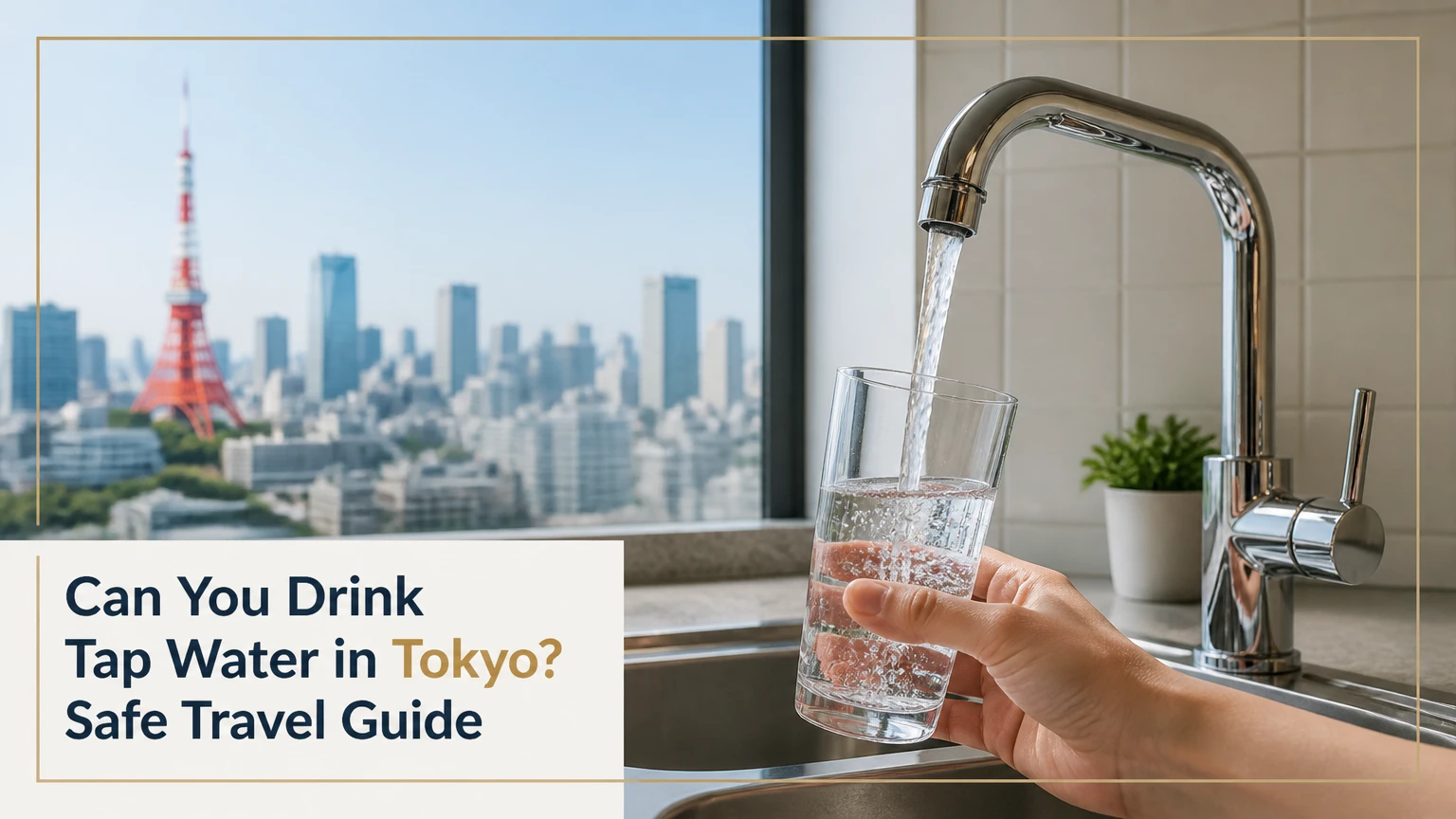
Yes, you can drink tap water in Tokyo directly from a cold faucet without boiling or filtering. Tokyo’s municipal supply is treated and monitored by the Tokyo Metropolitan Government Bureau of Waterworks, while building plumbing, storage tanks, and temporary advisories determine the final condition at a particular tap.
Key Facts / Quick Answer
Tokyo municipal tap water is potable at the point of supply and suitable for drinking, cooking, brushing teeth, and making tea.
Japan’s Waterworks Act sets 51 water-quality standards, including microbiological, chemical, and physical requirements.
Tokyo water is generally soft, with a typical mineral-content range of about 50-100 mg/L.
A typical residential water price is approximately $0.001-$0.002 per liter, excluding fixed service charges.
Let cold water run for 15-30 seconds after overnight stagnation in an older building.
Do not drink water from shrine or temple purification fountains unless a sign explicitly identifies it as drinking water.
Why Is Tokyo Tap Water Safe to Drink?
Tokyo tap water is safe because the public utility treats source water, disinfects it with controlled chlorine, and checks it against Japan’s drinking-water standards before distribution. The utility also monitors water quality through treatment plants, distribution facilities, and tap sampling points, rather than relying on a single test at the reservoir.
The Tokyo Metropolitan Government Bureau of Waterworks manages the metropolitan supply. Its public materials describe the service with the phrase “safe and delicious water,” a concise official description of the utility’s drinking-water objective rather than a claim that every private building faucet has identical taste.
Japan’s legal framework requires compliance with 51 drinking-water standards. These cover organisms such as Escherichia coli, metals including arsenic and mercury, organic chemicals, turbidity, pH, and other indicators. The standards are legal requirements, while WHO Guidelines for Drinking-water Quality and US Environmental Protection Agency rules provide useful international comparison points.
The important distinction is between municipal water quality and point-of-use conditions. Tokyo can deliver compliant water to a building connection, but a poorly maintained private storage tank, corroded faucet, or dirty aerator can affect water after it enters the property.
Tokyo Water Safety at a Glance
| Attribute | Tokyo supply | Practical meaning |
|---|---|---|
| Governing utility | Tokyo Metropolitan Government Bureau of Waterworks | Public authority responsible for the metropolitan network |
| Legal drinking-water standards | 51 parameters | Microbial, chemical, physical, and aesthetic controls |
| Typical hardness profile | Soft water, about 50-100 mg/L minerals | Mild taste and limited scale on kettles |
| Residual disinfectant | Controlled chlorine residual | Protection during distribution, with possible chlorine flavor |
| Household price | About $0.001-$0.002/L | Far below convenience-store bottled water |
| Main point-of-use variable | Private plumbing and storage tanks | Building condition can change taste or cleanliness |
How Does Tokyo Treat Its Water?
Tokyo treats river and reservoir water through multiple physical, chemical, biological, and disinfection stages. The sequence removes suspended material, microorganisms, and taste-producing organic compounds before a controlled chlorine residual protects the water in the distribution network.
Tokyo’s main sources include the Tone River and Arakawa River systems, with additional water associated with the Tama River system and reservoirs such as Ogouchi Dam. The exact source mix varies by waterworks area, season, reservoir operation, and network demand.
The treatment path typically includes the following stages:
- Source collection: Rivers, dams, and reservoirs provide raw water for treatment.
- Coagulation: Chemicals cause fine particles to bind into larger flocs.
- Sedimentation: Heavy flocs settle out of the water.
- Rapid sand filtration: Filter media capture remaining suspended particles and some microorganisms.
- Advanced treatment: Ozone and biological activated carbon reduce odor-producing compounds and difficult organic substances in facilities equipped for that process.
- Disinfection: Chlorine maintains microbiological protection as water travels through pipes.
- Distribution monitoring: Samples from treatment and network locations verify ongoing compliance.
Tokyo has invested heavily in advanced treatment for water affected by odor compounds. Ozonation oxidizes many organic molecules, while biological activated carbon supports microbial breakdown and adsorption. That combination helps explain why modern Tokyo water often tastes cleaner than untreated or lightly treated river-water supplies.
A frequently repeated online claim says every drop of Tokyo water receives exactly the same advanced process. The more accurate formulation is that treatment varies by plant and source area, while the distributed water must meet the applicable Japanese standards.
Treatment Stages and Their Function
| Stage | Main target | Typical result |
|---|---|---|
| Coagulation | Clay, silt, colloids | Larger particles form flocs |
| Sedimentation | Settled flocs | Most heavy suspended matter leaves the flow |
| Sand filtration | Fine particles and organisms | Lower turbidity before final treatment |
| Ozonation | Odor compounds and organic molecules | Reduced earthy or musty taste |
| Biological activated carbon | Biodegradable organics and residual compounds | Further taste and odor improvement |
| Chlorination | Pathogenic microorganisms | Protection through the pipe network |
What Does Tokyo Tap Water Taste Like?
Tokyo tap water usually tastes mild and relatively soft, with a possible light chlorine note. Taste depends on the treatment plant, season, faucet aerator, building storage tank, pipe material, water temperature, and how long water has remained in the internal plumbing.
Soft water contains fewer dissolved calcium and magnesium minerals than hard water. A typical total mineral or dissolved-solids range of roughly 50-100 mg/L gives Tokyo water a less mineral-heavy profile than imported waters such as Evian. The exact value varies by location and measurement method.
Residual chlorine is intentional. The disinfectant prevents microbial regrowth during distribution, but some travelers notice a swimming-pool-like aroma, especially when water is warm or has sat in a glass. Refrigerating water in a clean, covered container or using an activated-carbon pitcher can reduce that sensory effect.
Taste does not reliably indicate safety. A faint chlorine smell can occur in compliant water, while a metallic, earthy, or stale flavor may point to a building-level issue rather than the city supply.
Taste Causes at the Faucet
| Cause | Likely symptom | Practical response |
|---|---|---|
| Fresh municipal water | Mild chlorine note | Chill in a covered glass container |
| Overnight stagnation | Flat or metallic flavor | Run cold water for 15-30 seconds |
| Dirty aerator | Particles or altered flow | Remove and clean the faucet screen |
| Storage tank | Stale or tank-like taste | Ask building management about inspection |
| Old internal pipe | Metallic taste or discoloration | Stop using the affected tap and report it |
| Filtered water | Reduced chlorine taste | Replace the cartridge on schedule |
Expert insight: The first glass from an older apartment is often a plumbing sample, not a city-water sample. Flushing the cold line removes stagnant water, but it does not correct a contaminated storage tank or a deteriorating pipe.
What Does Tokyo Tap Water Cost?
Tokyo tap water typically costs around $0.001-$0.002 per liter in variable usage, although the household bill also includes fixed service charges and billing adjustments. A traveler using two liters daily would generally spend only a few cents over an entire month on the water itself.
Bottled water costs far more because the price includes packaging, transport, retail space, refrigeration, and brand distribution. A 500 mL bottle commonly costs about $0.70-$1.10 at a convenience store or vending machine, while a larger supermarket bottle may cost less per liter.
Public refill stations can reduce both cost and packaging. Availability changes by ward and venue, so travelers should check the current location in an app such as Mymizu or use clearly marked drinking-water facilities.
Typical Hydration Costs in Tokyo
| Option | Typical quantity | Typical price in USD | Packaging or equipment |
|---|---|---|---|
| Household tap water | 1 liter | $0.001-$0.002 variable cost | Reusable glass or bottle |
| Convenience-store bottle | 500 mL | $0.70-$1.10 | One PET bottle |
| Supermarket large bottle | 2 liters | $1.00-$2.00 | One large PET bottle |
| Carbon pitcher filter | 1 cartridge | $5-$15 | Cartridge replacement every 1-2 months, depending on use |
| Public refill station | 1 liter | Usually $0 | Reusable bottle |
| Tokyo-Sui bottled tap water | Around 500 mL | About $0.65-$1.00 where sold | Branded PET bottle |
Tokyo-Sui, also written Tokyo-Sui or Tokyowater in English-language descriptions, is bottled Tokyo tap water sold for promotional and public-awareness purposes. Its availability and price depend on the venue, so it should not be treated as a universal retail product.
Is the Problem Ever the Building Plumbing?
The main practical risk is usually the building’s internal water system, not Tokyo’s treated municipal supply. Older apartments and some low-rise properties may use rooftop or underground storage tanks, and the condition of those tanks, internal pipes, faucets, and aerators depends on property management.
Modern hotels generally provide potable cold water, but taste can vary between rooms. Older residential buildings deserve a quick check, especially when water comes from a tank rather than directly through a pressurized distribution line.
Use this decision process when entering unfamiliar accommodation:
- Check whether the tap has a drinking-water warning.
- Prefer the cold-water tap for drinking and cooking.
- Run the water for 15-30 seconds if the tap has been unused overnight.
- Look for cloudiness, unusual color, floating particles, or a persistent chemical or sewage-like odor.
- Ask the host or front desk whether the building uses a storage tank.
- Report an abnormal appearance or odor before consuming more water.
A brief flush is a freshness measure, not a sterilization procedure. Boiling cannot remove metals, salts, or many chemical contaminants, and a household filter cannot repair a contaminated tank.
Building Situations and Recommended Action
| Accommodation situation | Typical concern | Recommended action |
|---|---|---|
| New hotel, direct-pressure system | Taste variation | Drink cold tap water normally |
| Older apartment with storage tank | Stagnation or tank maintenance | Flush 15-30 seconds and ask management |
| Traditional guesthouse | Internal pipe age | Inspect appearance and use bottled water if abnormal |
| Long-vacant room | Stagnant faucet water | Flush until consistently cold |
| Accommodation under advisory | Localized contamination or outage | Follow the property or utility instruction |
| Room with no drinking-water label | Unclear fixture purpose | Ask staff before using decorative taps |
Tokyo properties must manage building-side facilities under applicable maintenance and sanitation rules, but compliance is not visible from the faucet. A caretaker’s maintenance record is more useful than the building’s age alone.
Can You Drink Tokyo Water During an Emergency?
Tokyo tap water may remain safe during a disruption, but earthquakes, power failures, pipe breaks, and official advisories can temporarily change access or usage instructions. Emergency water must be judged by the latest notice from the Tokyo Metropolitan Government, the local ward, or the property manager.
The most important distinction is between a boil-water advisory, a water outage, and a pressure or pipe-break notice. A boil-water advisory concerns possible microbial contamination and gives instructions for boiling or avoiding consumption. An outage concerns availability. A pipe-break notice may involve discoloration caused by disturbed sediment.
Do not rely on a generic assumption that all city water is always drinkable under every condition. In an emergency:
- Read the current notice from the ward or Tokyo Metropolitan Government.
- Ask hotel staff whether the tap is affected.
- Use sealed bottled water if the notice says not to drink.
- Do not consume visibly discolored or foul-smelling water.
- Follow instructions about cooking, brushing teeth, and ice.
- Recheck the advisory before returning to normal use.
Emergency Signals and Responses
| Observation | Possible cause | Immediate response |
|---|---|---|
| No flow | Outage or building equipment | Contact the property manager |
| Brown or cloudy water after construction | Disturbed sediment | Stop, flush only if instructed, report it |
| Official boil notice | Possible microbial risk | Boil according to the notice |
| Strong sewage odor | Plumbing failure | Do not drink; use sealed water |
| Normal appearance during earthquake alert | No automatic proof of safety | Check official local guidance |
| Water restored after outage | Sediment or air in pipes | Follow utility flushing instructions |
Where Can You Refill Water in Tokyo?
Travelers can refill bottles from hotel and restaurant taps, public drinking fountains, and participating shops or stations. Mymizu maps refill points across Japan, but locations can change, so the app or a visible sign should confirm current access.
Restaurants commonly provide complimentary water with meals. Asking for a refill is reasonable when the establishment offers self-service or table water, but a reusable bottle should not be filled from a restaurant fixture without permission.
Tokyo-Sui products may be found at selected government offices, events, and major venues. They demonstrate the drinkability of treated Tokyo water, but buying one is unnecessary for ordinary hydration when a clean tap is available.
Shrine and temple purification basins are different. A temizuya, or chozuya, is designed for ritual cleansing of hands and mouth before worship. The water may be running and visually clear, but that does not identify it as drinking water.
Safe Refill Locations
- Hotel room cold-water taps
- Clearly marked public drinking fountains
- Restaurant water stations
- Participating refill shops listed by Mymizu
- Government or transport venues with drinking-water signage
- Supermarkets, when staff or signage permits bottle filling
Should You Use a Filter or Boil the Water?
Most travelers do not need to filter or boil Tokyo tap water for ordinary drinking. Use a carbon filter for taste, consider boiling when following medical or infant-feeding guidance, and switch to sealed bottled water when a building or government advisory identifies a specific problem.
Activated-carbon filters can reduce chlorine and some organic compounds, but performance depends on cartridge design, contact time, and replacement. A filter left wet and unreplaced can become a hygiene problem, especially in hot weather.
Boiling is effective against many microorganisms when performed correctly, but it does not remove every dissolved chemical. For infant formula, follow the formula manufacturer’s preparation instructions and the advice of the child’s clinician, particularly for newborns or medically vulnerable infants.
People with severe immune suppression, a specific medical condition, or a medically prescribed water restriction should use individualized clinical advice rather than travel generalizations.
Choosing a Water Option
| User or situation | Best default | Why |
|---|---|---|
| Healthy adult traveler | Cold tap water | Municipal supply is potable |
| Chlorine-sensitive traveler | Chilled or carbon-filtered water | Improves taste without routine boiling |
| Older building with abnormal odor | Sealed bottled water temporarily | Avoids uncertain point-of-use plumbing |
| Newborn formula preparation | Follow clinician and product guidance | Formula safety has additional requirements |
| Official water advisory | Advisory-approved water source | Local instructions override general advice |
| Long train or walking day | Reusable bottle refill | Low cost and less packaging waste |
How Does Tap Water Compare With Bottled Water?
Tokyo tap water and bottled water are both practical drinking options, but tap water usually has the lower cost and packaging footprint. Bottled water offers convenience and a sealed container, while filtered water mainly changes taste unless the filter has a certified contaminant-reduction claim.
Bottled water is not automatically safer at every point. A sealed bottle avoids building plumbing, but it can be stored in heat, opened repeatedly, or left in a vehicle. Tap water avoids single-use plastic and is continuously available where the building system is maintained.
Imported hard waters may taste noticeably different from Tokyo’s softer supply. That difference is a preference issue, not evidence that Tokyo water is inadequate.
Tokyo Water Options Compared
| Option | Typical price | Safety variable | Main advantage |
|---|---|---|---|
| Municipal tap | $0.001-$0.002/L | Building plumbing | Lowest cost and no bottle waste |
| Convenience-store bottle | $1.40-$2.20/L equivalent | Seal and storage | Immediate portability |
| Carbon-filtered tap | $0.01-$0.05/L including cartridge, typical | Filter maintenance | Less chlorine taste |
| Boiled tap water | Tap cost plus electricity | Correct preparation | Extra microbial control when advised |
| Public refill | Usually $0/L | Station maintenance | Convenient reusable-bottle filling |
What Are the Limitations and Common Mistakes?
Tokyo’s drinking-water system is highly controlled, but “safe at the municipal supply” does not mean every water fixture is suitable for consumption. The most common mistakes involve confusing ritual water with drinking water, using hot tap water for beverages, ignoring a local notice, or assuming a filter compensates for poor maintenance.
Avoid these errors:
- Drinking from a temizuya: Ritual purification water is not a beverage source.
- Using hot tap water for cooking: Hot-water systems can have different plumbing and storage conditions; use cold water and heat it yourself.
- Ignoring persistent discoloration: Brown, black, or oily-looking water requires investigation.
- Treating boiling as a universal fix: Heat addresses microbes, not every chemical or plumbing problem.
- Leaving a filter cartridge unchanged: Follow the manufacturer’s capacity and replacement interval.
- Assuming a modern faucet guarantees clean water: The fixture’s aerator can accumulate sediment and biofilm.
- Stockpiling bottles without checking the tap: This adds cost and waste when no advisory exists.
Expert insight: A carbon pitcher is a taste device unless its certification specifically names the contaminant and reduction level. “Filtered” on packaging does not prove removal of PFAS, lead, or microbial contamination.
PFAS and Other Emerging Contaminants
PFOS and PFOA are per- and polyfluoroalkyl substances that receive increasing regulatory attention in Japan and other countries. Public discussion often compresses several different concepts into one number, so readers should distinguish a legal standard, a provisional target, a detection limit, and a test result.
Japan has established provisional target values for PFOS and PFOA in drinking water at a combined 50 ng/L level, according to Japan’s Ministry of Health, Labour and Welfare materials. A target or standard does not mean every sample contains that concentration. It defines a control level for suppliers and regulators.
For current PFAS results, consult the latest Tokyo Metropolitan Government or national ministry publication. Online travel pages may contain outdated figures, especially when they present quarterly testing as a universal rule for every building tap.
Frequently Asked Questions About can you drink tap water in Tokyo
Can you use Tokyo tap water to brush your teeth?
Yes, ordinary travelers can use Tokyo municipal tap water for brushing teeth, rinsing produce, making tea, and cooking. Use the cold tap, allow stagnant water to clear in an older property, and follow any local advisory. A building-specific warning takes priority over the general safety of the metropolitan supply.
Is Tokyo tap water safe for dogs and cats?
Healthy dogs and cats can generally drink the same municipal tap water provided for people. Offer bottled or filtered water if an animal refuses the taste, has a veterinarian-directed dietary restriction, or is staying in a building with abnormal water appearance or an active local advisory.
Does Tokyo tap water contain fluoride?
Tokyo water may contain naturally occurring fluoride, but the concentration is not the same as fluoridation programs in some countries. Travelers needing a precise value should consult the current water-quality report for the relevant treatment area rather than assume that all Tokyo taps have one fixed concentration.
Can travelers drink water from a Japanese train station?
Drink only from a station fixture marked or presented as a drinking fountain. Ordinary station restroom taps are generally connected to potable systems, but a visible notice, maintenance closure, unusual appearance, or facility instruction should guide the decision. Do not fill bottles from decorative or cleaning-only fixtures.
Why does Tokyo tap water sometimes smell like chlorine?
A chlorine smell comes from the disinfectant residual that protects water while it moves through the distribution network. Warm water and stagnant water make the odor more noticeable. Cooling the water, using a clean activated-carbon filter, or letting it stand briefly in a covered container can reduce the taste.
Is bottled water necessary in Tokyo during summer?
Bottled water is not normally necessary solely because Tokyo is hot. Carry a reusable bottle and refill from safe taps or public stations, while using sealed water when a property has a plumbing problem, an official advisory is active, or you need a dependable supply during a long day without refill access.
Conclusion: Can You Drink Tap Water in Tokyo?
Yes, you can drink tap water in Tokyo directly from a normal cold faucet in a maintained hotel, apartment, restaurant, or public drinking station. Tokyo’s regulated supply meets Japan’s 51 drinking-water standards, costs roughly $0.001-$0.002 per liter, and usually needs no boiling or filtration. Flush an older tap for 15-30 seconds, avoid ritual fountains, and follow any building or government advisory.
