

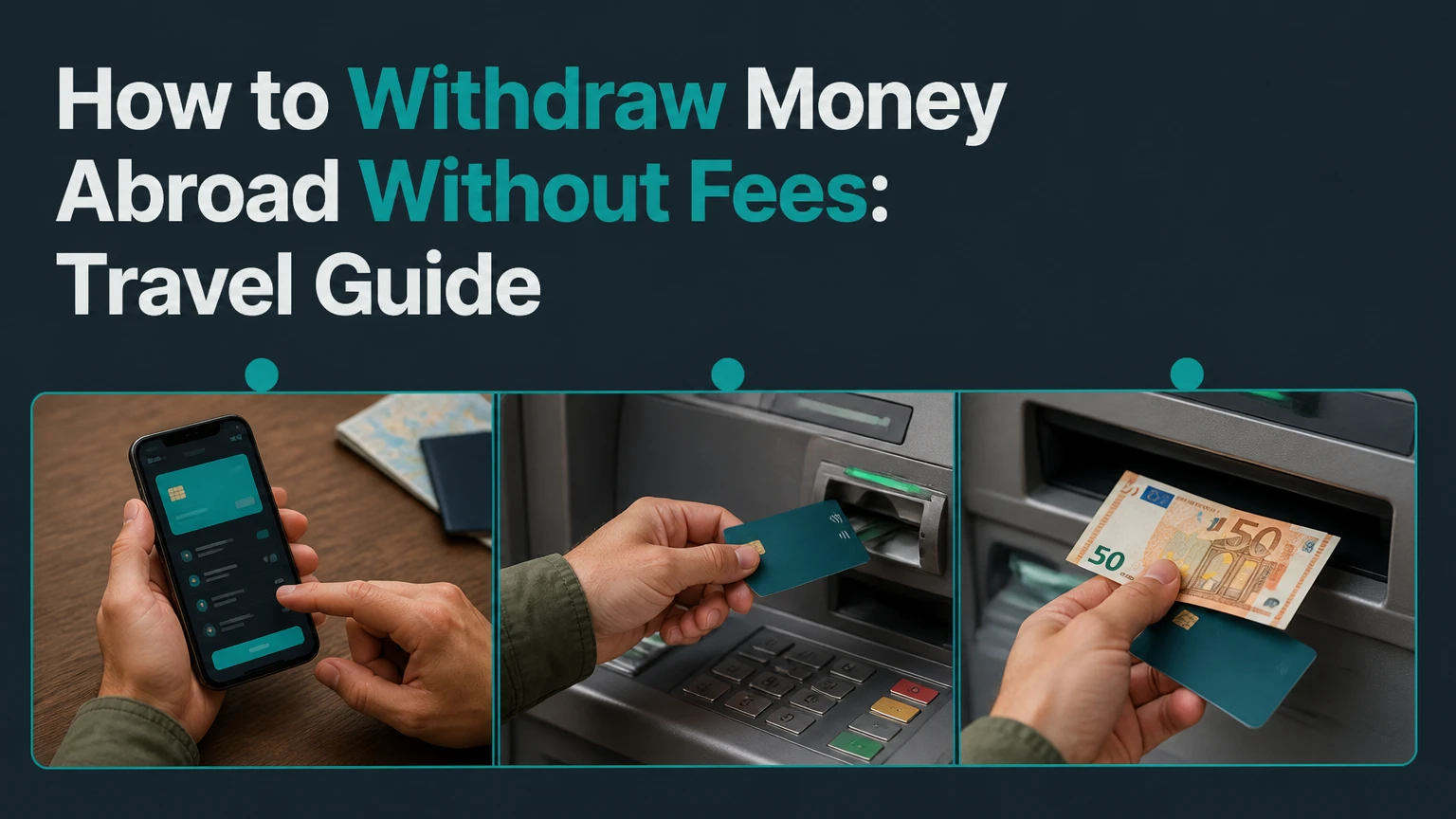
How to withdraw money abroad without fees means using a debit account that charges no foreign transaction fee, avoids or reimburses the foreign ATM surcharge, and converts at a competitive network or mid-market rate. The practical method is to use a suitable debit card, select local currency, choose a bank-operated ATM, and stay within the account’s withdrawal limits.
Key Facts / Quick Answer
A foreign cash withdrawal can involve an issuer fee, an ATM operator fee, a foreign transaction fee, and an exchange-rate markup.
Select the destination country’s local currency at the ATM. Decline conversion into US dollars or another home currency.
Bank-operated ATMs usually provide clearer fee disclosures and lower risk than independent machines in tourist areas.
Charles Schwab’s Investor Checking account is known for worldwide ATM-fee reimbursement for eligible US customers, subject to current account terms.
Wise and Revolut can use competitive exchange rates, but their free cash limits and overage charges vary by plan and country.
A genuine zero-cost withdrawal requires both no unreimbursed fee and no material exchange-rate markup.
What Does Fee-Free International Cash Withdrawal Mean?
Fee-free international cash withdrawal is a transaction in which the traveler receives local banknotes without an issuer charge, ATM operator surcharge, foreign transaction fee, or avoidable currency-conversion markup. A card can be advertised as having no foreign transaction fee while the foreign ATM still charges a local access fee.
The cost has four separate components:
| Cost component | Typical amount | Who charges it | How to reduce it |
|---|---|---|---|
| Home-bank foreign transaction fee | 0%-3% | Card issuer | Use an account with a 0% foreign transaction fee |
| Out-of-network withdrawal fee | USD 0-5 | Home bank or debit network | Use an in-network or reimbursing account |
| Foreign ATM surcharge | USD 0-8 typical | Local ATM operator | Choose a bank ATM or obtain reimbursement |
| Exchange-rate markup | 0%-10% typical | Issuer, ATM, or intermediary | Decline DCC and compare the posted rate |
The exchange rate matters even when every visible fee says USD 0. A provider can recover revenue through a retail exchange rate that is 1%-3% worse than the card-network rate. Review the final debit in your account rather than judging the transaction solely by the ATM receipt.
What a zero-cost transaction requires
A practical zero-cost withdrawal needs four conditions:
- The debit card has no foreign transaction fee.
- The account does not charge an out-of-network withdrawal fee.
- The ATM operator fee is absent or reimbursed.
- The conversion uses a competitive rate without dynamic currency conversion.
No account meets those conditions in every country and every situation. Local ATM limits, unavailable partner networks, weekend pricing, and plan restrictions can change the result.
How Does an Overseas ATM Transaction Work?
An overseas ATM transaction begins when the machine verifies the card and requests authorization through the local banking network, Visa or Mastercard, and the card issuer. The issuer then approves the local-currency amount, places an authorization hold, and completes settlement after the withdrawal is reported.
The transaction normally follows this path:
| Stage | Typical timeframe | Primary participant | What happens |
|---|---|---|---|
| Card read and PIN verification | 5-30 seconds | Foreign ATM | Card credentials and PIN are checked |
| Authorization request | 1-15 seconds | Visa or Mastercard | The requested local-currency amount reaches the issuer |
| Cash dispensing | 10-60 seconds | ATM operator | Notes are counted and delivered |
| Account hold | Immediate | Home bank or fintech | Available balance is reduced temporarily |
| Final settlement | 1-3 business days | Issuer and card network | Amount and conversion are finalized |
If the account already holds the destination currency, the provider may deduct that balance directly. If the account holds US dollars, the card network or provider converts the transaction according to its applicable rate and terms.
The ATM may offer to convert the amount into US dollars. That is dynamic currency conversion, or DCC. The ATM operator, rather than your card issuer or card network, sets the conversion rate. Mastercard’s consumer guidance tells travelers to “always pay in the local currency” when given a choice, because DCC can include a markup.
A pending amount can differ from the final debit. Offline processing, tips are not relevant to cash withdrawals, but network adjustments, partial reversals, and delayed operator fees can change the posted transaction. Keep the receipt until the transaction settles.
Which Account Types Reduce International ATM Costs?
The most useful account type depends on whether you need predictable reimbursement, a multi-currency balance, or access to a specific partner ATM. A reimbursement account often gives the most predictable cash cost, while a fintech account can provide better control over currency conversion and spending limits.
Debit accounts with ATM-fee reimbursement
Some accounts refund fees charged by foreign ATM operators after the transaction posts. Charles Schwab Bank’s Investor Checking account is a prominent example for eligible US customers, although account availability and current terms must be verified before opening or relying on it.
Reimbursement is different from prevention. The ATM may display and collect a surcharge immediately, then the bank credits the amount later. A reimbursement account may also exclude fees that the issuer itself classifies as a currency conversion charge, balance inquiry, or cash advance.
Multi-currency fintech accounts
Wise and Revolut commonly let customers hold or convert multiple currencies before withdrawal. Their attraction is transparent in-app pricing and exchange-rate visibility, but free cash withdrawals usually have monthly limits based on residence, plan, and account terms.
Typical structures include a free allowance measured by both a dollar amount and a number of withdrawals. After the allowance, the provider may apply a percentage charge, a fixed fee, or both. Weekend exchange pricing can also apply to some Revolut plans and currencies.
Bank ATM alliances
The Global ATM Alliance links selected institutions, including some Bank of America, Barclays, BNP Paribas, Deutsche Bank, and Westpac cards and ATMs. The benefit depends on the exact issuing bank, card product, destination, and machine. Alliance membership does not mean every ATM in that bank’s country is free.
A bank may waive its own international ATM fee while the local machine still applies a separate operator surcharge. Check the issuer’s alliance directory and the ATM screen before confirming.
Premium international banking
HSBC Premier and similar premium products may reduce international access fees, but eligibility often depends on residence, salary deposits, investments, or a minimum relationship balance. A premium account is not automatically cheaper than a no-fee travel account if the qualification cost is high.
| Account approach | Typical free allowance | Main benefit | Main limitation |
|---|---|---|---|
| Reimbursement checking | Unlimited or account-defined | Refunds eligible ATM fees | Usually limited by residency and product terms |
| Wise personal account | Provider-defined monthly allowance | Transparent conversion and multi-currency balances | Fees apply after allowance |
| Revolut Standard | Provider-defined monthly allowance | App controls and currency exchange | Plan, weekend, and fair-use restrictions |
| ATM alliance card | Partner ATM access | Can avoid selected access fees | Only participating issuers and machines qualify |
| Premium bank account | Product-defined or unlimited | Broader service and support | Balance or relationship requirements may apply |
How to Withdraw Money Abroad Without Fees Step by Step
The lowest-cost process is to confirm the card terms, identify a bank ATM, request local currency, reject DCC, and reconcile the completed transaction. Completing those checks before inserting the card prevents most avoidable charges.
- Check the account terms before departure. Confirm the foreign transaction fee, international ATM fee, reimbursement policy, free monthly allowance, exchange-rate policy, and daily withdrawal limit.
- Enable travel access if the issuer uses travel controls. Many modern banks do not require a formal travel notice, but they still need accurate contact details and fraud-alert access.
- Carry two cards from different networks. A Visa debit card paired with a Mastercard debit card provides a fallback if a local ATM rejects one network.
- Find a bank-operated machine. Use the destination bank’s official locator, airport banking area, or a clearly branded branch ATM. Avoid machines in bars, currency shops, convenience stores, and isolated tourist locations.
- Inspect the machine. Look for a loose card slot, unusual overlays, damaged keypad, or a camera aimed directly at the PIN pad. Cancel if the machine appears altered.
- Select the local currency. If the ATM asks whether to charge in US dollars or local currency, choose local currency. Choose “without conversion” or a similar wording when shown.
- Read every fee screen. The machine should disclose its own surcharge before confirmation. Cancel if the fee is unexpected or your account does not reimburse it.
- Withdraw an efficient amount. A larger legitimate withdrawal can reduce repeated fixed charges, but stay below local limits and avoid carrying more cash than needed.
- Take the card, cash, and receipt. Some machines return the card before dispensing cash. Verify the receipt shows the local amount and any disclosed fee.
- Reconcile after settlement. Compare the local amount, US-dollar debit, provider fee, and any reimbursement. Save evidence if the final amount differs from the confirmed screen.
The most common operational mistake is accepting the first ATM’s conversion prompt. The second is making several small withdrawals when the issuer charges a fixed fee per transaction.
Which Option Is Cheapest for Different Travelers?
The cheapest option depends on total cost, not the label “fee-free.” Compare the account fee, required balance, withdrawal allowance, local surcharge, conversion spread, and convenience for your destination.
| Traveler situation | Usually suitable option | Typical direct cost | Key condition |
|---|---|---|---|
| Frequent US-based traveler needing cash | Reimbursement checking | USD 0 after eligible reimbursement | Account must be available and active |
| Occasional traveler under a fintech allowance | Wise or Revolut | USD 0 provider fee within allowance | Stay under monthly limit |
| Traveler visiting partner-bank countries | ATM alliance card | USD 0-5 typical | Use a qualifying partner ATM |
| Traveler spending mainly by card | No-fee debit card plus small cash reserve | USD 0-8 ATM surcharge | Use fewer, larger withdrawals |
| Traveler requiring emergency backup | Two debit cards and emergency cash | USD 20-100 reserve | Store separately from wallet |
A simple break-even calculation helps. Suppose a premium account costs USD 15 per month and your existing card would incur USD 6 per withdrawal. The premium account becomes cheaper only after roughly three reimbursable withdrawals, unless it provides other benefits that justify the recurring cost.
Why cash advances are usually a poor substitute
Credit-card cash advances usually begin accruing interest immediately and may include a transaction fee. A typical cash-advance fee is 3%-5% or a minimum fixed amount, while the annual percentage rate can exceed 25%. The card issuer may also apply a foreign transaction fee.
A debit card draws from existing funds. A credit-card cash advance creates borrowing costs before the traveler leaves the ATM. Use a credit card for purchases when its terms are favorable, not as the default international cash vehicle.
Why currency exchange booths often cost more
Airport and tourist-area exchange booths may advertise zero commission while embedding the cost in the exchange rate. A typical spread can reach 8%-15%, particularly for less liquid currencies or small transactions.
The comparison should use the amount of local currency received for the same USD amount. A commission-free quote can still be more expensive than an ATM withdrawal with a visible USD 5 surcharge.
How Should You Choose an ATM and Destination Strategy?
Choose a bank-operated ATM connected to a major card network, preferably inside or beside a staffed branch. Destination conditions matter because local withdrawal caps, ATM density, operator fees, and card acceptance differ substantially between countries and cities.
| ATM decision factor | Favorable sign | Risk indicator | Traveler action |
|---|---|---|---|
| Location | Bank branch or secure retail site | Tourist strip or isolated kiosk | Use a branch ATM |
| Fee disclosure | Fee shown before approval | Vague conversion language | Cancel and try another bank |
| Network support | Visa or Mastercard logo | Unsupported or damaged screen | Use a different machine |
| Withdrawal limit | Local limit near USD 200-500 equivalent | Very low limit under USD 100 | Plan a second bank |
| Security | Good lighting and intact slot | Skimming signs or hidden camera | Do not insert the card |
Local ATM caps can force multiple transactions. If the issuer charges a fixed out-of-network fee, withdrawing the maximum permitted amount can reduce the cost per dollar. This rule does not override personal safety, cash-carrying limits, or account security.
In countries with heavy card acceptance, carry a small reserve rather than optimizing for a large cash withdrawal. In cash-oriented destinations, identify two or three bank networks before arrival and withdraw during business hours.
What changes on weekends?
Weekend withdrawals can cost more when a fintech provider adds a weekend foreign-exchange markup or uses a different fair-use rule. The ATM itself can also apply the same local surcharge regardless of day, so changing the day does not eliminate operator fees.
If your account converts at withdrawal time, exchanging or pre-funding the destination currency on a weekday may improve predictability. This is not universal: card networks and banks use different pricing schedules, and a weekday withdrawal is not automatically cheaper.
What Problems Can Happen During a Withdrawal?
International ATM problems include a retained card, cash not dispensed, partial cash, duplicate pending entries, and a fee that appears after the transaction. The correct response depends on whether the ATM completed authorization, dispensed cash, and returned the card.
| Problem | Immediate action | Typical resolution time | Evidence to keep |
|---|---|---|---|
| Card retained | Contact the bank and issuer immediately | Same day to 5 business days | ATM address and machine number |
| No cash, account debited | Photograph machine and contact issuer | 5-30 business days | Receipt, timestamp, alert |
| Partial cash | Report exact amount received | 5-30 business days | Receipt and cash count |
| Unexpected DCC charge | Dispute with issuer and operator | 10-60 days | Screen choice and receipt |
| Duplicate pending debit | Wait for reversal, then contact issuer | 1-7 business days | App screenshots |
| ATM surcharge not reimbursed | Review policy and submit claim | 1-2 statement cycles | ATM receipt and account terms |
Do not repeatedly enter a PIN after a decline. Multiple attempts can trigger a fraud lock or retain the card. Contact the issuer through its official app or the phone number printed on the card, not a number posted on an unfamiliar ATM.
An ATM dispute may require the local operator’s machine identifier. Record the bank name, street address, date, time, requested amount, dispensed amount, and transaction reference before leaving.
What if the ATM keeps your card?
If a foreign ATM retains a card, freeze the card in the banking app and call the issuer immediately. Ask whether the issuer wants the card canceled permanently. Do not assume the local bank can safely return it, especially when the machine is unattended or the bank is closed.
Keep a second card separate from the primary wallet. A backup card is more useful than a photograph of the first card because some issuers cannot provide an instant replacement abroad.
What Should You Carry Besides a Debit Card?
A reliable cash plan uses a primary debit card, a separate backup card, digital access to the issuer, and a small emergency reserve. No fee policy protects a traveler from a network outage, card seizure, account lock, or local ATM failure.
Use this checklist:
- Primary debit card with a 0% foreign transaction fee
- Backup card on a different network
- Stored issuer phone numbers and secure app access
- Emergency cash stored separately
- Account balance sufficient for deposits or authorization holds
- Copies of card details stored securely, never in an exposed wallet
- Knowledge of the destination’s local currency and common bank networks
Do not rely on a credit card for cash unless you have confirmed its cash-advance fee, interest rate, and available limit. Do not keep every payment instrument in one passport wallet.
An important limitation is residency. Wise, Revolut, Charles Schwab, HSBC Premier, and other products do not have identical availability, protections, fees, or features in every country. A recommendation made for a US resident may be unavailable to a resident of Canada, Australia, the United Kingdom, or the European Union.
Frequently Asked Questions About how to withdraw money abroad without fees
Can I use my normal debit card overseas?
You can use a normal debit card overseas if the issuer permits international transactions, but the card may charge a foreign transaction fee, out-of-network fee, or both. Check the fee schedule before departure and test the card’s app login, PIN, and fraud-alert contact method.
Is it better to withdraw local currency or US dollars?
Withdraw local currency from the ATM and let your card issuer or network handle conversion. Choosing US dollars at the machine usually activates dynamic currency conversion, allowing the ATM operator to set the exchange rate and potentially add a markup.
How much cash should I withdraw at one time?
Withdraw enough for roughly one or two days of expected cash spending, subject to the destination’s safety conditions and ATM limits. A larger transaction can reduce fixed fees, but carrying excessive cash increases loss risk and can complicate replacement if the wallet disappears.
Can I avoid every ATM fee with a prepaid travel card?
A prepaid travel card may avoid some foreign transaction fees, but it cannot guarantee that the local ATM operator will waive its surcharge. Confirm the card’s withdrawal allowance, reload fee, exchange spread, inactivity terms, and reimbursement policy before treating it as free.
What should I do if I accepted dynamic currency conversion?
Keep the receipt and contact the card issuer after the transaction posts. Some issuers can investigate a DCC complaint, although reversal is not guaranteed when the ATM disclosed the conversion and the traveler approved it. Future withdrawals should use the local-currency option.
Are international ATM withdrawals reported for tax purposes?
A normal personal cash withdrawal is generally not taxable income. However, large cross-border movements of physical cash can trigger customs declarations or reporting requirements, and business funds may require accounting records. Check the rules of both the departure and destination countries before carrying substantial cash.
The dependable formula for how to withdraw money abroad without fees is simple: use a debit account with transparent international pricing, select a bank-operated ATM, decline DCC, stay within free limits, and keep a second payment method. Verify the current account terms and destination restrictions before relying on any provider, because “fee-free” usually describes only part of the transaction.
