

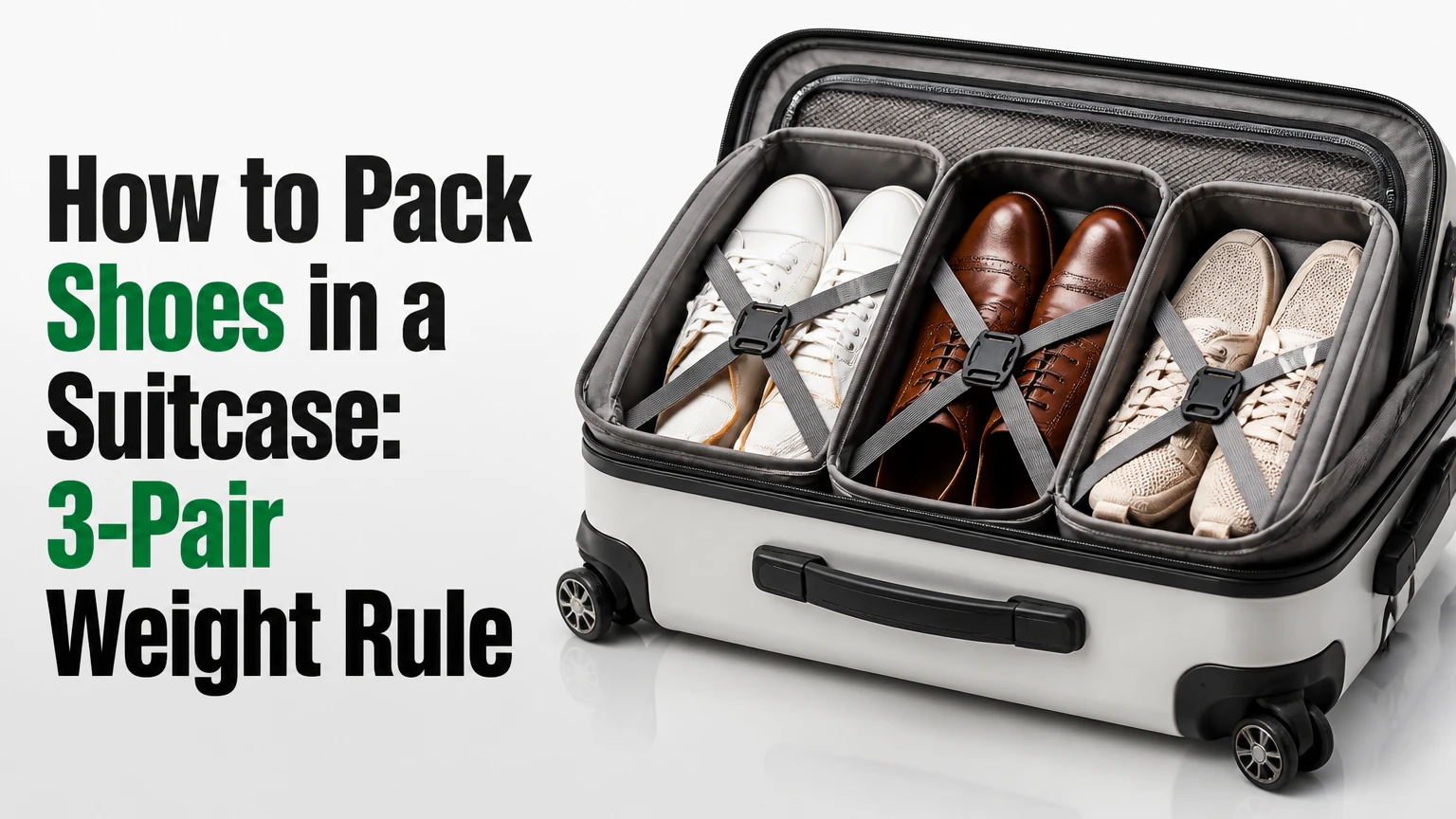
How to pack shoes in a suitcase is a method of cleaning, protecting, and positioning footwear so it uses less space without transferring dirt or losing its shape. The best system limits pairs, wears the heaviest shoes, places packed footwear near the wheels, and fills each interior with dry soft items.
Key Facts
Most travelers can cover a typical trip with one worn pair plus one casual or athletic pair and one occasion-specific pair.
Pack heavy footwear near the suitcase wheels, with soles facing the case wall or another sole.
Clean and completely dry shoes before enclosing them; damp interiors can develop mildew and persistent odor.
Stuff toe boxes with socks or other dry, soft items, but avoid overfilling structured leather or delicate heels.
Individual shoe bags offer the best separation, while shower caps provide a cheap barrier for short trips.
A typical pair takes 3-5 minutes to prepare and 2-3 minutes to place in an organized suitcase.
Why Shoe Placement Matters
Shoe placement controls three things: suitcase balance, clothing cleanliness, and footwear compression. Shoes are often the densest objects in a suitcase, so placing them at the wheel end lowers the center of gravity and reduces shifting when a rolling case is tilted.
The wheel end means the bottom of an upright suitcase, not necessarily the side nearest the handle. In a spinner suitcase, identify the reinforced base where the wheels are mounted. Put boots and substantial trainers there, then place clothing between the footwear and fragile items.
A packed shoe also creates a dirty, rigid surface. A barrier prevents tread debris from reaching shirts, underwear, or hotel bedding. The barrier does not need to be expensive, but it must cover the sole and remain closed during handling.
The basic placement rules
- Put the heaviest pair closest to the wheels.
- Keep soles against the suitcase perimeter, a shoe bag, or another sole.
- Place structured shoes where clothing cannot bend their uppers.
- Keep delicate garments away from laces, buckles, abrasive tread, and wet surfaces.
- Use the central cavity for flat clothing, rather than allowing shoes to occupy the widest middle area.
The common mistake is treating every pair as identical. A pair of lightweight mesh running shoes can sit above folded clothing, while leather boots should form part of the suitcase’s lower perimeter.
How Do You Prepare Shoes Before Packing?
Preparing shoes takes about 3-5 minutes per pair in typical conditions. Remove visible grit, wipe the soles, empty the interiors, and allow any sweat or moisture to evaporate before using a closed bag or cube.
Preparation is a hygiene step and a shape-preservation step. Small stones lodged in a tread can mark clothing or scratch polished leather. A damp insole enclosed for several hours creates a warmer, less ventilated environment where odor becomes harder to remove.
A practical preparation sequence
- Remove debris outdoors. Tap rubber soles together or use a stiff brush on dry mud. Do not scrape delicate suede with an aggressive brush.
- Wipe the outsole. Use a lightly damp cloth on rubber and synthetic soles. Avoid soaking stitched leather or unfinished materials.
- Dry the footwear. Leave shoes open until the lining, tongue, and insoles feel dry. Wet-weather footwear may need several hours, not several minutes.
- Remove loose inserts if appropriate. Removable insoles can air separately, but do not remove molded inserts that are difficult to reinstall.
- Tie or secure the pair. Loose laces catch on clothing and suitcase zippers. Use a loose loop rather than tightening the upper.
- Add an odor absorber. Use a dry tea bag, unused dryer sheet, or baking soda inside a small sachet, never loose baking soda directly on fabric.
- Cover each shoe. Individual bags prevent one shoe from rubbing against its partner and make unpacking cleaner.
Leather conditioner should not be applied immediately before travel because freshly treated surfaces can transfer oil to fabric. Suede should remain dry, and waterproofing sprays need the manufacturer’s stated curing time before enclosure.
| Preparation Task | Typical Time | Suitable Tool | Main Risk if Skipped |
|---|---|---|---|
| Brush dry mud from soles | 30-60 seconds | Shoe brush or old toothbrush | Grit transfers to clothing |
| Wipe rubber outsoles | 30-90 seconds | Damp microfiber cloth | Street residue reaches garments |
| Air out worn shoes | 30 minutes to overnight | Open room or ventilated porch | Odor becomes trapped |
| Insert odor absorber | 15 seconds per shoe | Dry tea bag or sachet | Lining retains sweat smell |
| Cover footwear | 30-60 seconds per pair | Shoe bags or shower caps | Soles contaminate luggage contents |
How Many Pairs Should You Pack?
The right number of pairs depends on trip length, activities, weather, and dress requirements, but a three-pair maximum is a useful starting point. Wear the bulkiest pair during transit, then pack only footwear that performs a distinct function.
A typical traveler can use this rotation:
- Travel pair: comfortable walking shoes or boots worn during transit.
- Activity pair: sneakers, sandals, hiking shoes, or water shoes required at the destination.
- Occasion pair: dress shoes, flats, or formal footwear needed for a specific event.
Trip duration alone does not justify extra pairs. A seven-day city trip may need fewer shoes than a three-day trip involving a wedding, a hike, and a beach. The decisive question is whether a pair handles a different surface, dress code, or weather condition.
William Morris’s organizing principle, “Have nothing in your houses that you do not know to be useful, or believe to be beautiful,” applies well to luggage selection. For shoes, “useful” means a distinct planned role, not a slightly different color.
| Trip Scenario | Worn During Transit | Packed Pair 1 | Packed Pair 2 | Typical Total |
|---|---|---|---|---|
| 3-day city break | Walking sneakers | Lightweight flats | None | 2 pairs |
| 5-day business trip | Comfortable loafers | Formal dress shoes | Gym shoes | 3 pairs |
| 7-day beach holiday | Casual sneakers | Sandals | Water shoes | 3 pairs |
| Hiking weekend | Hiking boots | Camp sandals | None | 2 pairs |
| Wedding and sightseeing | Walking trainers | Formal shoes | Compact flats | 3 pairs |
Which Shoe Barrier Should You Use?
Individual shoe bags provide the cleanest separation, dedicated shoe cubes organize bulky footwear, and shower caps offer the cheapest practical sole barrier. Plastic grocery bags work in emergencies, but they trap moisture and can tear around tread.
A breathable nylon or mesh pouch suits dry sneakers and dress shoes. A washable, water-resistant bag is better for muddy boots or wet-weather footwear, provided the shoe is already dry before storage. Ventilated packing cubes can compress soft shoes, but compression can damage rigid uppers and decorative details.
The best barrier depends on the shoe’s surface, the expected dirt level, and whether the footwear will be packed for hours or days. No barrier fixes wet footwear or an unclean sole.
| Barrier Method | Typical Cost | Preparation Time | Best Use | Main Limitation |
|---|---|---|---|---|
| Reusable nylon shoe bag | USD 5-25 per multipack | 30-60 seconds | Dress shoes and everyday footwear | Limited compression |
| Dedicated shoe cube | USD 15-45 each | 45-90 seconds | Sneakers and soft flats | Can crush structured uppers |
| Disposable shower cap | USD 0.10-1 each | 15-30 seconds | Sandals and clean casual shoes | Weak side protection |
| Reusable silicone cover | USD 8-20 per pair | 30-60 seconds | Damp or dirty outsoles | Adds bulk |
| Grocery or produce bag | Usually free | 15-30 seconds | Last-minute packing | Tears and retains moisture |
When should you use a shoe cube?
Use a shoe cube when several soft pairs need to stay together or when suitcase compartments are limited. Do not place hard boots, rigid high heels, or polished leather oxfords in a tightly compressed cube unless the cube leaves enough room to prevent bending.
A cube is especially useful in a soft-sided suitcase because it creates a removable block. It is less useful when the case is already full, since the cube’s fabric and zipper consume some capacity.
What Is the Most Efficient Packing Order?
The most efficient order is heavy footwear first, protective clothing layers second, and delicate or easily wrinkled garments last. Pair shoes heel-to-toe, cover them, fill their interiors, and place them along the suitcase perimeter before building the clothing layers.
This arrangement creates a stable base. It also leaves the suitcase center available for flat garments, packing cubes, or a toiletry kit. If the case has a hard divider, keep soles on the protected side and use the divider to prevent tread contact with clothing.
The complete suitcase method
- Select the pairs. Remove duplicate-purpose footwear before opening the suitcase.
- Wear the heaviest pair. Boots and substantial trainers save the most weight when worn, although airport security or comfort may make this impractical.
- Clean and dry packed shoes. Inspect tread, insoles, tongues, and interior lining.
- Fill the toe boxes. Use rolled socks, underwear, swimwear, or a soft belt. Keep liquids and hard objects out.
- Pair heel-to-toe. Turn the soles outward so the cleanest surfaces contact the barrier rather than garments.
- Cover each shoe separately. Separate bags reduce scuffing and let you use irregular spaces.
- Place footwear at the wheel end. Set boots and dense shoes along the base or side wall.
- Fill gaps with soft clothing. Put a thin layer between footwear and the suitcase shell.
- Add the remaining garments. Keep fragile fabric away from buckles and abrasive tread.
- Check closure and weight. Close the case without forcing the zipper, then weigh it with a luggage scale.
For a carry-on spinner, place the shoes at the wheel end and toward the corners, where their shape matches the case. For a soft duffel, place shoes at the bottom and protect them with a clothing layer because the bag has less structural support.
| Suitcase Type | Shoe Position | Recommended Pair Count | Protection Priority | Typical Packing Time |
|---|---|---|---|---|
| Carry-on spinner | Wheel end and corners | 1-2 packed pairs | Space and balance | 5-8 minutes |
| Large checked spinner | Wheel end, perimeter | 2-3 packed pairs | Compression and separation | 8-12 minutes |
| Soft-sided suitcase | Bottom and reinforced edge | 1-3 packed pairs | Shape and abrasion | 8-12 minutes |
| Duffel bag | Base, separated by clothing | 1-2 packed pairs | Crush resistance | 5-10 minutes |
| Garment case | Lower compartment | 1 formal pair | Crease and sole protection | 4-7 minutes |
How Should Different Shoe Types Be Packed?
Different footwear needs different protection because a hiking boot, suede loafer, and thin sandal do not respond to pressure in the same way. Flexible shoes tolerate careful nesting, while structured footwear needs space, shape support, and protection from direct compression.
Sneakers and running shoes
Clean the tread, remove loose insoles only if convenient, and stuff the toe boxes lightly with socks. Mesh uppers can go in breathable bags, while heavily worn gym shoes should be aired for at least 30 minutes before enclosure.
Avoid placing a heavy boot on top of mesh footwear. The sole edge can permanently crease or flatten the upper.
Leather dress shoes and loafers
Use socks or soft tissue to support the toe, but do not overstuff the vamp. Place each shoe in a separate bag with the polished sides facing inward or protected by soft fabric.
Wooden shoe trees preserve shape well at home, but full-size trees are usually too heavy for luggage. Lightweight plastic or inflatable shoe trees provide shape support with less weight.
High heels and formal footwear
Wrap each heel separately and protect narrow heel tips from impact. Place heels along the suitcase edge with the sole facing outward, then use clothing to prevent them from moving.
Never force a heel diagonally into a space that bends the upper. A single rigid shoe can puncture a thin garment or crack a decorative finish when the suitcase is dropped.
Boots and hiking footwear
Brush off soil before packing, remove damp insoles where possible, and use a breathable bag. Boots should go near the wheels or at the bottom of a duffel, with socks filling the shaft only when they are completely dry.
Boots are poor candidates for compression cubes. Their rigid shafts consume volume, and compression can distort ankle support or crease leather.
Sandals and flip-flops
Clean sandals, fasten straps, and nest them sole-to-sole. Shower caps work well when the tread is clean and the trip is short.
Thin sandals can fit beside a suitcase frame, between packing cubes, or inside a larger shoe, but keep buckles away from delicate fabric.
| Shoe Type | Interior Filler | Barrier | Best Location | Avoid |
|---|---|---|---|---|
| Mesh running shoes | Socks, 2-4 items | Breathable nylon bag | Perimeter or above clothing | Heavy compression |
| Leather oxfords | Soft socks or shoe tree | Separate shoe bags | Structured lower layer | Damp packing |
| High heels | Tissue or thin socks | Individual padded bags | Protected perimeter | Tight diagonal placement |
| Hiking boots | Dry socks, loose fill | Breathable water-resistant bag | Wheel end or duffel base | Compression cube |
| Sandals | One rolled garment | Shower cap or mesh bag | Gaps and side walls | Loose straps |
What Can You Put Inside Packed Shoes?
The safest fillers are clean, dry, soft items that match the shoe’s shape. Socks, underwear, swimwear, thin shirts, and scarves use the toe cavity without adding hard pressure or contamination.
Shoe interiors are useful storage volume, but they are not suitable for everything. Do not place toiletries, jewelry, chargers, pens, or unsealed food inside footwear because leaks, pressure, and odor can damage both the shoe and the item.
A sock rolled tightly can preserve a round toe, while a loosely folded shirt creates broader support. Fill only until the shoe holds its shape. A bulging upper means the interior has been overpacked.
| Interior Item | Space Used | Shape Support | Leak Risk | Appropriate Shoe Types |
|---|---|---|---|---|
| Rolled socks | 100-250 milliliters per pair | High for toe boxes | None | Sneakers, loafers, boots |
| Underwear | 150-300 milliliters | Medium | None | Casual shoes and sandals |
| Thin T-shirt | 300-600 milliliters | Medium | None | Large sneakers and boots |
| Swimsuit | 100-250 milliliters | Medium | Low when dry | Sandals and trainers |
| Toiletry bottle | 50-150 milliliters | Low | High | Not recommended |
How Do You Prevent Odor, Moisture, and Dirt?
Odor prevention begins with drying, not fragrance. Air out worn shoes, keep odor absorbers dry, and use breathable bags whenever the footwear may retain sweat.
Baking soda can reduce odor when contained in a sachet, but loose powder may collect in seams and darken some materials. Dry tea bags offer a low-mess alternative. Dryer sheets mask smell and can transfer fragrance or residue, so they should not touch delicate suede or unfinished leather.
A plastic bag is acceptable for a clean, fully dry sole during a short trip. It is a poor choice for damp gym shoes packed overnight. In that situation, use a breathable bag and keep the footwear away from clean clothing until it has dried.
Expert insight: The sole barrier and the odor barrier solve different problems. A shower cap protects clothing from tread dirt, but it does little for moisture inside the shoe. A dry sachet manages smell, but it does not make a dirty outsole safe.
Which Packing Mistakes Cause the Most Damage?
The most damaging mistakes are packing damp footwear, placing dense shoes above fragile garments, and using excessive filler or compression. Each error creates a different failure: mildew, crushing, creasing, or contamination.
Mistakes to avoid
- Packing dirty soles directly against garments: Tread grooves hold grit, oils, and organic debris that transfer under pressure.
- Sealing wet shoes in plastic: Trapped moisture encourages mildew and makes odor harder to remove.
- Leaving structured shoes unsupported: Empty toe boxes collapse under adjacent clothing and luggage pressure.
- Overstuffing interiors: Excess filler stretches leather and distorts synthetic uppers.
- Packing more than the trip requires: Extra footwear consumes both volume and weight without improving the itinerary.
- Putting boots at the suitcase top: Dense footwear shifts downward and compresses the contents during handling.
- Using one large bag for mismatched shoes: Buckles and tread can rub against polished surfaces.
- Ignoring airport screening access: Shoes placed under dense layers may slow inspection if a security officer requests removal.
- Packing a new, untested pair: Blisters can make a theoretically versatile shoe unusable on the trip.
Weight is often the hidden constraint. A typical adult pair may weigh 0.5-1.2 kilograms for casual shoes, 0.8-1.8 kilograms for boots, and 0.3-0.8 kilograms for sandals. Manufacturer specifications vary, so weigh unusual footwear rather than relying on estimates.
Carry-On, Checked Bag, and No-Bag Methods
Carry-on packing prioritizes weight, access, and compact shape, while checked luggage prioritizes impact protection and separation from the rest of the contents. Travelers without shoe bags can still pack safely by combining clean soles with washable barriers and clothing placement.
For carry-on travel, wear the heaviest comfortable pair and pack one flexible pair inside the case. Keep the packed shoes accessible if the route, airline, or security process may require footwear removal.
For checked bags, protect structured shoes from compression and use the suitcase perimeter. Avoid leaving a large empty cavity inside boots because the shaft may collapse when other luggage is stacked on top.
For a no-cost solution, use clean shower caps, produce bags, or two layers of clean plastic bags. Replace a torn barrier immediately and do not reuse a bag that contains mud or moisture.
Expert insight: Separating each shoe usually gives better space efficiency than keeping a pair together. Two individual shoes can occupy opposite corners, while a paired block may leave unusable triangular gaps around its heel and toe.
Frequently Asked Questions About how to pack shoes in a suitcase
Should shoes go at the bottom or top of a suitcase?
Shoes should usually go at the bottom, meaning the wheel end of a rolling suitcase. Dense footwear placed there lowers the center of gravity and reduces shifting. Put a thin clothing layer around the shoes, then keep delicate garments above them rather than underneath concentrated weight.
Can I put socks inside my shoes when traveling?
You can put clean, dry socks inside shoes to support the toe box and use otherwise empty space. Roll socks loosely enough to avoid stretching the upper, and do not use them as filler if the footwear is damp, muddy, or strongly odorous.
How do I pack shoes without shoe bags?
Clean the soles, let the shoes dry, and cover each one with a shower cap, produce bag, or clean grocery bag. Place the covered shoes along the suitcase wall and keep buckles, tread edges, and wet surfaces away from clothing.
How do I pack shoes for a business trip?
Wear comfortable walking shoes during transit, then pack one formal pair and one activity pair only if the schedule requires both. Protect dress shoes individually, support the toe lightly, and reserve a structured perimeter position for polished leather or delicate finishes.
Can shoes damage clothes inside luggage?
Shoes can damage clothes through dirt transfer, abrasion, dye transfer, or hard edges. Individual barriers and a thin clothing layer prevent most contact problems, while keeping shoes dry prevents odor from spreading through enclosed fabric.
How do I pack shoes for a long flight?
Choose the heaviest comfortable pair for the flight, wear moisture-managing socks, and pack a lighter change of footwear in a breathable bag. If shoes swell your feet during travel, prioritize a roomy pair rather than saving weight with tight footwear.
Conclusion
How to pack shoes in a suitcase effectively requires selective packing, clean and dry footwear, separate sole protection, and weight-aware placement. Wear the bulkiest pair, limit packed footwear to distinct uses, fill toe boxes with dry soft items, and position dense shoes near the wheels. This method protects clothing while preserving suitcase capacity and shoe shape.
