

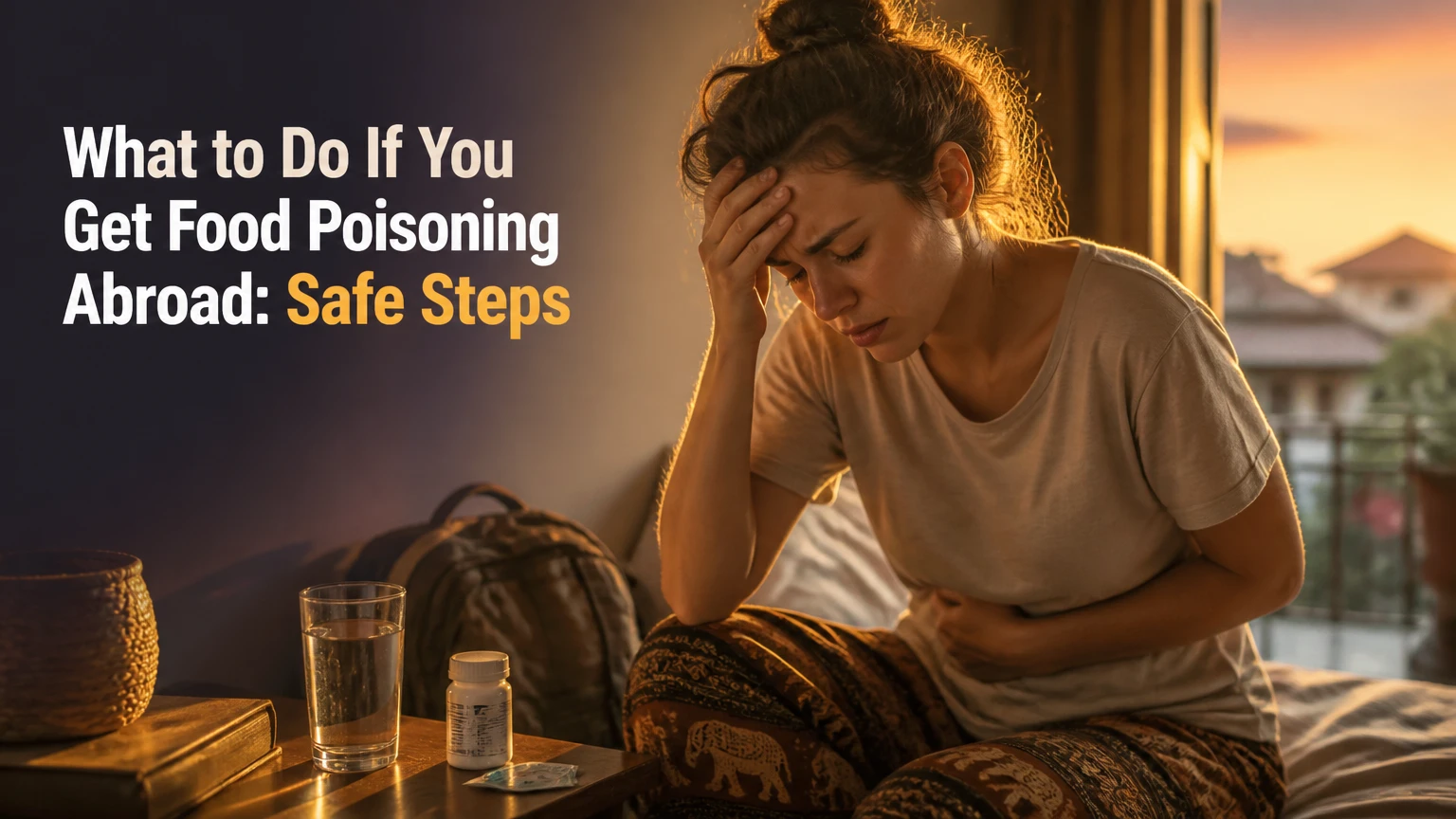
Food poisoning abroad is an acute gastrointestinal illness caused by contaminated food, water, toxins, or chemicals that can trigger vomiting, diarrhea, cramps, and fever. The safest response is to assess danger signs first, replace lost fluid and salts with correctly mixed oral rehydration solution, avoid risky medicines, and arrange medical care when symptoms exceed home treatment.
Key Facts / Quick Answer
Use oral rehydration solution, or ORS, mixed exactly with safe water. Take small, frequent sips rather than large drinks.
Seek urgent medical care for confusion, fainting, severe dehydration, bloody diarrhea, severe abdominal pain, or inability to keep fluids down.
Do not use loperamide when stool contains blood or mucus, or when you have a significant fever, unless a clinician advises it.
Most uncomplicated cases improve within 1-3 days, but bacterial and parasitic infections can last a week or longer.
Contact your travel insurer early, but do not delay emergency treatment while waiting for authorization.
Food poisoning cannot always be traced to the last meal. Incubation may range from 30 minutes to 14 days.
What Food Poisoning Abroad Means
Food poisoning is illness after ingesting a biological toxin, infectious organism, parasite, or harmful chemical. The same symptom pattern can result from norovirus, traveler’s diarrhea, contaminated water, shellfish toxins, medication effects, heat illness, or a surgical emergency, so the trigger cannot be confirmed from symptoms alone.
The illness begins when an agent survives stomach defenses or its preformed toxin reaches the intestine. Some organisms attach to intestinal cells and cause inflammation; others alter fluid transport, while toxins can provoke vomiting before the organism establishes an infection. This explains why a meal eaten one hour earlier may cause symptoms, while another exposure may take several days.
The Centers for Disease Control and Prevention states that “Most people with food poisoning get better without medical treatment.” That general rule applies to otherwise healthy people with mild illness who can drink and urinate normally. It does not apply safely to severe dehydration, invasive infection, vulnerable travelers, or possible poisoning by chemicals or toxins.
Common causes and exposure routes
- Undercooked poultry, meat, eggs, and seafood
- Unpasteurized milk, cheese, juice, or untreated water
- Raw produce washed with contaminated water
- Ice made from unsafe water
- Buffet food held at unsafe temperatures
- Shared surfaces and hands contaminated with norovirus
- Recreational water containing Giardia or Cryptosporidium
- Pesticides, cleaning chemicals, or naturally poisonous plants and seafood
How Long Does Travel-Related Gastroenteritis Last?
The onset and duration of foodborne illness depend on the agent, dose, host health, and whether treatment is needed. Symptoms beginning within hours often indicate a preformed toxin, whereas diarrhea beginning several days after exposure may involve bacterial infection or a parasite.
| Possible cause | Typical onset after exposure | Typical course | Common clues |
|---|---|---|---|
| Staphylococcus aureus toxin | 30 minutes-8 hours | About 24 hours | Sudden vomiting, food held warm, little fever |
| Norovirus | 12-48 hours | 1-3 days | Vomiting, watery diarrhea, sick companions |
| Salmonella | 6 hours-6 days | 4-7 days | Fever, cramps, poultry, eggs, reptiles |
| Campylobacter | 2-5 days | About 7 days | Fever, abdominal pain, poultry or raw milk |
| Shiga toxin-producing E. coli | 1-10 days | 5-10 days | Severe cramps, sometimes bloody diarrhea |
| Giardia | 1-2 weeks | 2-6 weeks untreated | Gas, greasy stools, fatigue, prolonged symptoms |
Incubation tables cannot prove liability. A hotel buffet may be the source, but travelers eat many foods and encounter multiple water sources over several days. A delayed onset can also mean that the suspected restaurant was unrelated.
Food poisoning versus similar illnesses
Norovirus often spreads through people and surfaces, not only food. Heat exhaustion can cause nausea but usually accompanies heavy sweating, weakness, headache, or a hot environment. Malaria can begin with fever, chills, headache, and gastrointestinal symptoms after travel to a risk area. Appendicitis, bowel obstruction, gallbladder disease, and pancreatitis can mimic food poisoning but require examination.
Get medical advice for fever after travel through a malaria-risk region, even when diarrhea is present. Report possible chemical exposure, poisonous mushrooms, or unusual neurological symptoms immediately to emergency services or a poison center.
What Should You Do in the First Six Hours?
The first priority is triage, followed by controlled fluid replacement. Food poisoning becomes dangerous when vomiting and diarrhea remove water, sodium, chloride, potassium, and bicarbonate faster than the body can replace them.
- Check for emergency symptoms. Look for fainting, confusion, blood in stool, severe constant pain, blue or gray skin, minimal urine, or breathing difficulty.
- Stop alcohol and strenuous activity. Move to a cool room and ask a companion to check on you.
- Prepare ORS correctly. Use a sealed commercial packet with the exact volume of safe water stated on its label.
- Sip continuously. After vomiting, wait about 5-10 minutes, then restart with 5-10 mL every 1-2 minutes.
- Track urine and stool. Record the time of urination, vomiting episodes, diarrhea, temperature, and fluid intake.
- Arrange advice early. Call a local clinic, telemedicine service, insurer hotline, or pharmacist who can communicate in a language you understand.
A traveler who is alert, urinating, and retaining small amounts of ORS can often monitor at the hotel initially. A traveler who cannot retain fluid, becomes dizzy on standing, or deteriorates needs clinical assessment rather than repeated home remedies.
A practical fluid schedule
| Situation | Amount and timing | Suitable option | Escalation point |
|---|---|---|---|
| No active vomiting | 100-240 mL after each loose stool | ORS, broth, safe water | Urine becomes scant or dark |
| Vomiting just occurred | 5-10 mL every 1-2 minutes | Chilled ORS by spoon | Repeated vomiting prevents intake |
| Child with diarrhea | 10 mL/kg over 4 hours, guided clinically | Pediatric ORS | Lethargy, no tears, fewer wet diapers |
| Adult with heavy diarrhea | 200-250 mL after each episode, as tolerated | ORS plus normal light food | Dizziness, weakness, or reduced urine |
| Suspected severe dehydration | Do not force large drinks | Immediate medical evaluation | Fainting, confusion, shock symptoms |
These are practical starting amounts, not a substitute for medical assessment. Infants, frail older adults, people with kidney or heart disease, and anyone with restricted fluid intake need individualized advice.
How Do You Mix and Use Oral Rehydration Solution?
Commercial ORS works because its glucose and sodium concentrations promote absorption in the small intestine. Use the packet’s stated water volume, often 200 mL, 500 mL, or 1 liter, and do not add extra sugar, salt, juice, soda, or milk.
Use boiled and cooled water, sealed bottled water, or water treated according to local public-health guidance. Check the bottle seal, because counterfeit or refilled bottles are a risk in some destinations. Discard prepared ORS after 24 hours, or sooner if the packet label specifies a shorter period.
If no commercial ORS is available, the World Health Organization’s widely used home formula is 6 level teaspoons of sugar and 1/2 level teaspoon of salt in 1 liter of safe water. Measurement errors can create a dangerous solution, so commercial packets are preferable when available.
| Hydration choice | Main benefit | Main limitation | Practical rule |
|---|---|---|---|
| Commercial ORS | Balanced sodium and glucose | Requires correct water volume | Best first choice |
| Plain bottled water | Replaces some water | Replaces few electrolytes | Use alongside ORS, not instead |
| Broth or soup | Supplies fluid and sodium | May contain excess fat or spice | Use small portions |
| Sports drink | Provides fluid and sugar | Usually too little sodium, too much sugar | Backup only, dilute only if advised |
| Alcohol or energy drink | No reliable rehydration benefit | Can worsen dehydration or palpitations | Avoid during illness |
Expert insight: The common mistake is drinking a full glass after vomiting. Gastric distension can trigger another vomit, while teaspoon-sized doses often succeed because they deliver fluid without rapidly stretching the stomach.
When Is Food Poisoning an Emergency?
Severe food poisoning requires urgent medical evaluation when dehydration, invasive infection, toxic exposure, or another abdominal disease is possible. Blood in stool, altered mental status, severe pain, or an inability to drink carries more weight than the exact number of diarrhea episodes.
| Warning sign | Why it matters | Action |
|---|---|---|
| Fainting, confusion, extreme weakness | Possible severe dehydration or shock | Call local emergency services |
| No urination for about 8 hours, or very dark urine | Reduced kidney perfusion | Same-day urgent evaluation |
| Blood, maroon stool, or black tarry stool | Possible intestinal bleeding or invasive infection | Urgent medical care |
| Fever around 39°C, or 102.2°F, especially with diarrhea | Greater concern for invasive infection | Contact a clinician promptly |
| Severe, localized, or worsening abdominal pain | Possible appendicitis or another surgical problem | Emergency assessment |
| Repeated vomiting with no retained fluids | Oral replacement is failing | Clinic or emergency department |
| Swollen abdomen, inability to pass stool or gas | Possible obstruction or severe inflammation | Emergency assessment |
| Facial swelling, wheezing, or trouble breathing | Possible food allergy | Emergency services immediately |
The 101°F threshold sometimes used in travel advice is not a universal admission rule. Fever severity, age, blood in stool, pain, dehydration, and local disease risks matter together.
Higher-risk travelers
Pregnant travelers, children under five, adults over 65, and people with diabetes, kidney disease, inflammatory bowel disease, cancer, HIV, or immune-suppressing treatment should seek advice earlier. Dehydration can progress quickly, and some infections carry added pregnancy or fetal risks.
Do not give children anti-diarrheal medicines without pediatric advice. Infants with fewer wet diapers, a dry mouth, no tears, unusual sleepiness, or poor feeding need prompt medical evaluation.
Which Medicines Are Safe to Consider?
Medicine choice depends on stool appearance, fever, age, pregnancy, underlying disease, and the suspected cause. No over-the-counter product reliably treats every form of foodborne illness, and antibiotics can harm people with some infections.
| Option | Possible use | Avoid or seek advice first | Key limitation |
|---|---|---|---|
| ORS | Dehydration prevention and treatment | Fluid restrictions or severe illness | Does not eliminate the cause |
| Loperamide | Short-term watery diarrhea in selected adults | Blood, high fever, suspected dysentery, pregnancy, children | Can worsen some invasive infections |
| Bismuth subsalicylate | Some adults with uncomplicated diarrhea | Aspirin allergy, anticoagulants, ulcers, pregnancy, children with viral illness | Can darken tongue or stool |
| Antibiotics | Selected diagnosed or high-risk bacterial illness | Self-prescribing from a local pharmacy | Wrong drug may fail or cause harm |
| Antiemetic | Vomiting that prevents hydration | Interactions, pregnancy, heart-rhythm risks | Requires local clinical advice |
Loperamide should not be used for bloody diarrhea or diarrhea accompanied by significant fever unless a clinician specifically recommends it. Avoid it in young children without professional guidance. Bismuth products can interact with anticoagulants and may be unsuitable for people allergic to aspirin.
A clinician may prescribe antibiotics for selected cases of severe traveler’s diarrhea, cholera, or another confirmed or strongly suspected bacterial infection. Antibiotics are ineffective against norovirus and parasites require different treatment. Shiga toxin-producing E. coli is one reason self-treatment is unsafe, because antibiotics may increase the risk of complications in some patients.
Expert insight: A pharmacy counter is not a diagnostic service. A sealed medicine with a familiar brand name may contain a different active ingredient or strength, so check the generic name, dose, expiry date, and contraindications with a clinician or qualified pharmacist.
What Can You Eat and Drink While Recovering?
Eat when vomiting has settled and appetite returns; prolonged fasting is unnecessary for most uncomplicated diarrhea. Start with small portions of familiar, low-fat foods and continue breastfeeding or usual infant feeds unless a clinician gives different instructions.
Suitable first foods include rice, potatoes, bread, bananas, soup, oatmeal, crackers, yogurt if tolerated, eggs, and lean protein. The traditional BRAT diet, consisting of bananas, rice, applesauce, and toast, is too limited for prolonged recovery because it may provide inadequate protein and micronutrients.
For 24-48 hours after improvement, many people tolerate smaller meals better than large restaurant portions. Alcohol, very fatty dishes, heavy spice, and large amounts of caffeine can worsen nausea or stool frequency. Temporary lactose intolerance can follow intestinal infection, so pause milk if it increases bloating or diarrhea.
Do not prepare food for other people while symptomatic. Norovirus can remain contagious after symptoms stop, and hand sanitizer does not reliably replace soap and water for removing norovirus from hands.
Where and How Should You Get Medical Care?
Local care is appropriate when symptoms are moderate, persistent, or difficult to manage, even without an ambulance-level emergency. Use the country’s emergency number, hotel medical desk, embassy or consulate information, a reputable private clinic, or a public hospital, depending on urgency and location.
| Care route | Best use | Typical time or cost issue | What to bring |
|---|---|---|---|
| Emergency department | Shock, bleeding, severe pain, confusion | Highest urgency and variable billing | Passport, medication list, insurance details |
| Public hospital | Serious illness and lower-cost local care | Waits and language barriers may occur | Identification and exposure timeline |
| Reputable private clinic | Moderate illness, examination, prescriptions | Typical consultation may range from $30-$250 | Payment card and insurer contact |
| Hotel doctor | Initial assessment and local referral | Convenience fee may be high | Symptom log and policy number |
| Telemedicine service | Mild or stable illness, prescription guidance | Often $20-$100, policy dependent | Temperature, medicines, location |
Prices vary widely by country, facility, tests, and admission length. Reported travel-insurance claim examples have cited average gastrointestinal treatment costs around $5,500 globally and roughly $16,000 in the United States, but these are claim datasets, not universal prices. An intensive-care admission can cost thousands of dollars per day.
The UK Post Office advises travelers to contact their insurer when medical treatment is needed abroad, while insurers commonly require use of an assistance hotline for non-emergency referrals. That requirement does not justify delaying emergency care. Ask the clinic to provide an itemized invoice and ask the insurer whether it can issue a payment guarantee.
Information to tell the clinician
Provide the date and location of every meal, untreated water or ice exposure, swimming exposure, animal contact, medication taken, fever reading, stool appearance, urine changes, and travel through malaria or cholera risk areas. Mention pregnancy, immune conditions, recent antibiotics, and allergies.
Stool testing is more likely when diarrhea is severe, bloody, persistent, associated with fever, or part of an outbreak. A normal early test does not prove that food was safe, because sampling timing and the chosen test affect results.
What Should You Do About Flights and Insurance?
Contact the travel insurer as soon as the situation is stable, but never wait for an authorization code before obtaining emergency treatment. Coverage depends on the policy, pre-existing conditions, exclusions, deductible, medical necessity, and whether the insurer required prior contact.
Ask the treating clinician for a dated diagnosis or clinical summary, treatment record, prescription receipts, laboratory results, and a written statement if you are medically unfit to fly. Airlines and insurers may require specific wording, dates, or forms, so obtain those requirements before changing a ticket.
Keep these records:
- Itemized clinic and hospital bills
- Pharmacy receipts and prescription labels
- Transport invoices, including taxi or ambulance charges
- Boarding passes, booking confirmations, and changed-ticket receipts
- A symptom and exposure timeline
- Names and contact details of treating clinicians
- Written insurer claim numbers and call dates
Travel insurance does not automatically pay a hotel bill, missed excursion, or flight change simply because diarrhea occurred. A clinician’s record connecting the illness to medical inability to travel is usually stronger evidence than photographs of a buffet.
Can You Prove a Hotel Caused the Illness?
A traveler can document a suspected outbreak, but proving that a particular hotel or meal caused food poisoning is medically and legally difficult. The strongest evidence combines compatible incubation, laboratory findings, multiple affected guests, receipts, and an official public-health investigation.
Record what you ate during the previous 14 days, not only the last meal. Save receipts, photograph food labels or menus where lawful, and note the room, restaurant, buffet date, and onset time. Ask other ill travelers for contact details only with their consent.
Do not handle suspicious food or confront staff while ill. Report serious hygiene failures to the hotel, tour operator, local health authority, or relevant national food-safety agency. Preserve original files with dates and avoid editing photographs.
Expert insight: The last meal is often blamed because it is memorable, but the incubation table can point elsewhere. Norovirus may spread through a sick food handler, while Giardia may emerge more than a week after contaminated water exposure.
How Can You Avoid Another Episode?
Food and water precautions reduce risk but cannot make travel risk zero. CDC guidance commonly emphasizes choosing food that is cooked and served hot, avoiding unsafe water and ice, and washing hands with soap before eating.
Use these practical rules:
- Drink sealed, factory-bottled water or reliably treated water.
- Use safe water for brushing teeth in high-risk settings.
- Avoid raw salads, cut fruit, unpasteurized products, and undercooked eggs.
- Choose food cooked thoroughly and served steaming hot.
- Wash hands with soap after using the toilet and before eating.
- Carry ORS, a thermometer, routine medicines, and a written allergy list.
- Check whether destination-specific vaccines, such as hepatitis A, are recommended.
- Avoid swimming when diarrhea is active and follow local pool guidance.
A reusable bottle is useful only when filled from a verified safe source. Filtering, boiling, and chemical disinfection remove different hazards, so select a method suited to bacteria, viruses, and parasites rather than assuming every filter provides equal protection.
Frequently Asked Questions About what to do if you get food poisoning abroad
Can I drink tap water after food poisoning?
Drink tap water only when the local public-health authority considers it safe or when you have treated it effectively. During recovery, sealed bottled water or correctly boiled water reduces uncertainty. Use the same safe source for ORS, ice, brushing teeth, and medicines if local water safety is questionable.
Should I make myself vomit after a suspicious meal?
Do not induce vomiting after suspected food poisoning, chemical exposure, or poisonous food unless a poison center or clinician instructs you. Vomiting can increase dehydration and may injure the throat. Chemical poisoning requires urgent specialist advice, because the safest treatment differs from ordinary infectious diarrhea.
How do I know whether I need stool tests?
A clinician may recommend stool testing for bloody diarrhea, high fever, severe illness, symptoms lasting more than several days, immune suppression, suspected outbreak exposure, or recent antibiotic use. Testing is also useful when treatment decisions depend on distinguishing bacteria, parasites, and noninfectious causes.
Can I swim or go on an excursion after diarrhea stops?
Avoid swimming while diarrhea continues and follow local pool rules, because norovirus and some parasites can spread through contaminated water. Resume excursions only when you can drink, eat, urinate normally, and walk without dizziness. Delay strenuous activity for at least a day after significant dehydration.
What if there is no pharmacy or clinic nearby?
Start frequent ORS sips, stop alcohol and exertion, keep a companion informed, and contact local emergency services, an insurer assistance line, a hotel manager, or a telemedicine provider. Arrange transport before dehydration becomes severe. Do not rely on antibiotics, antidiarrheals, or unverified water-treatment advice from strangers.
Does travel insurance cover food poisoning abroad?
Travel insurance may cover medically necessary treatment, transport, missed travel, or accommodation changes, but policy terms differ. Contact the assistance line promptly, follow referral rules when safe, and keep itemized bills and medical certificates. Emergency treatment should take priority over obtaining insurer approval.
Conclusion
If you are deciding what to do if you get food poisoning abroad, check danger signs first, then use correctly prepared ORS in frequent small sips and monitor urination. Avoid loperamide for bloody or febrile diarrhea, do not self-prescribe antibiotics, and seek local care when hydration fails. Notify your insurer after urgent needs are addressed and preserve every medical and travel record.
