

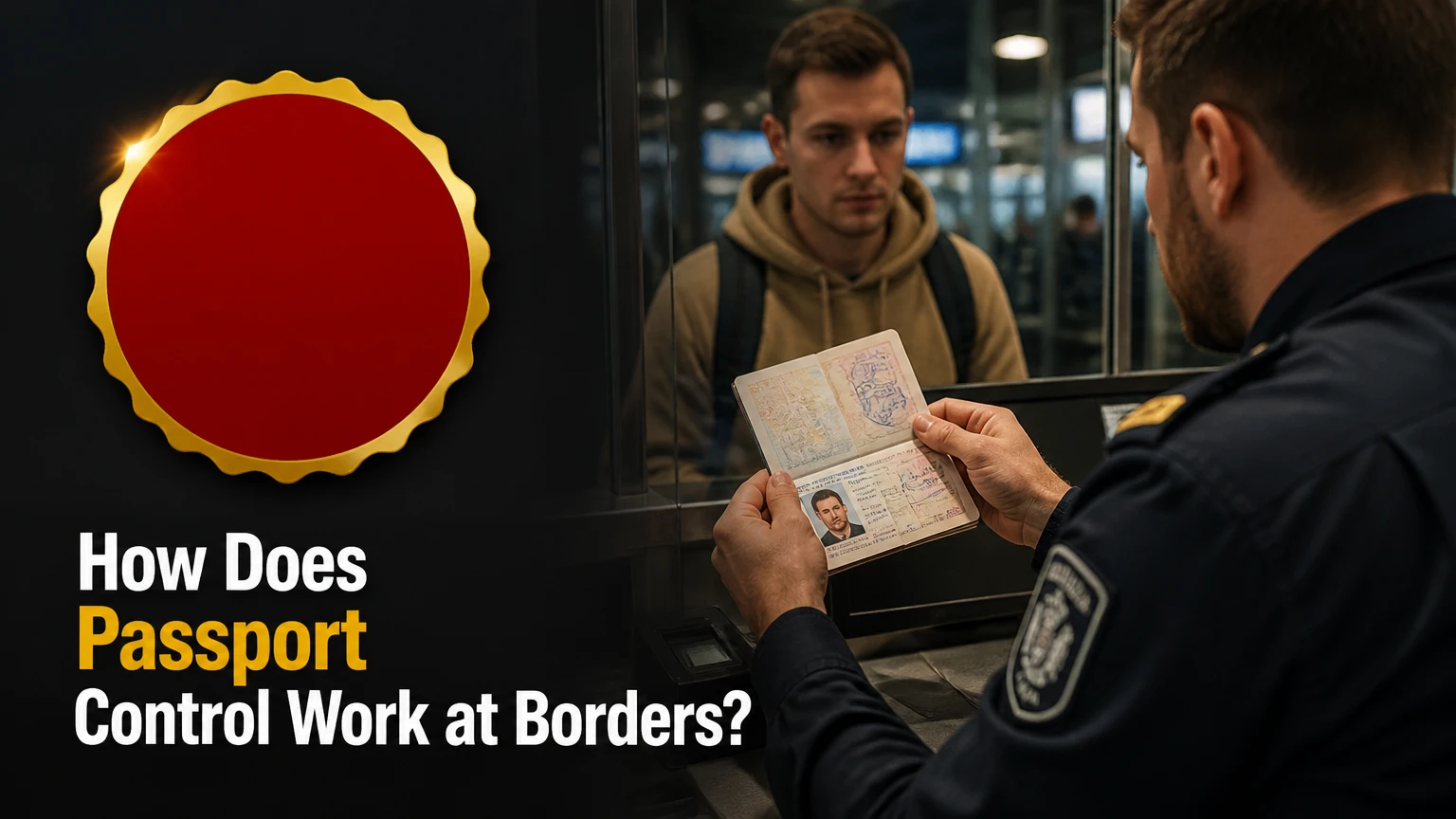
Passport control is the border process in which an authorized officer or automated system verifies a traveler’s identity, travel document, nationality, and permission to enter or leave a country. The process can include document scans, biometric comparison, database checks, questions, and a decision to admit, refer, or refuse the traveler.
Key Facts About Passport Control
- Passport control examines the person and immigration status; customs examines goods, baggage, food, cash, and other property.
- An officer normally reads the passport’s machine-readable zone and may inspect its electronic chip, visa, entry authorization, and travel history.
- A visa or electronic travel authorization permits travel to a border, but it does not guarantee admission.
- Manual questioning often takes 1-3 minutes when documents and answers are straightforward. Queues commonly take 15-45 minutes, with longer waits during peak periods or technical failures.
- E-gates usually require an eligible biometric passport, a qualifying nationality and age, and a face that can be matched under the system’s rules.
- Passport validity requirements are country-specific. The widely repeated six-month rule applies in many destinations, but not every country or itinerary.
What Is Passport Control Checking?
Passport control checks whether the traveler is the document holder and whether the traveler meets the destination’s legal entry conditions. Border authorities may also assess security alerts, previous immigration violations, visa conditions, and the stated purpose of the trip.
The legal power behind border decisions is extensive. In Fong Yue Ting v. United States (1893), the U.S. Supreme Court described exclusion and expulsion as “an inherent and inalienable right of sovereignty.” Modern systems apply that power through legislation, treaties, immigration databases, and administrative procedures.
Passport control is therefore more than a passport authenticity check. An officer may need to determine whether a visitor is a genuine tourist, whether a work activity requires a permit, or whether a resident has the right to return. The same passport can produce different outcomes depending on nationality, visa category, route, previous stays, and supporting evidence.
What Passport Control Is Not
Passport control does not decide every border issue. Airport security screens passengers and cabin baggage for weapons and explosives, while customs enforces rules for imported goods. Public-health, agricultural, and immigration authorities may perform separate checks.
| Border function | Main subject examined | Typical questions or checks | Usual location |
|---|---|---|---|
| Passport control | Person and immigration permission | Who are you, why are you entering, may you enter? | Arrivals or departures hall |
| Airport security | Person and carry-on items | Are prohibited weapons or liquids present? | Before the departure lounge |
| Customs | Goods and baggage | What are you importing, and is it taxable or prohibited? | Baggage reclaim or exit |
| Agriculture or biosecurity | Food, plants, animals, soil | Could the item introduce pests or disease? | Arrival inspection area |
How Does Passport Control Work Step by Step?
Passport control normally follows a sequence of queue selection, document reading, identity verification, questioning, database checks, and an admission or departure decision. The order changes by country, airport, nationality, and technology, but the legal questions remain substantially similar.
- Choose the correct lane. Follow signs such as Citizens, Residents, European Union, Visa Holders, All Passports, or Foreign Nationals. A family lane may have separate age requirements.
- Present the travel document. Give the officer the passport used for the journey, plus a visa, residence permit, or entry authorization when required.
- Let the system read the document. The camera or scanner reads the machine-readable zone, and an electronic reader may access the chip in an e-passport.
- Complete identity verification. The officer compares the traveler with the passport photograph. An e-gate may capture a live facial image, and some systems also use fingerprints.
- Answer targeted questions. Typical subjects include destination address, trip length, purpose, onward travel, employment, and host details.
- Receive the decision. The authority admits the traveler, grants a limited stay, sends the traveler to secondary inspection, records departure, or refuses entry under applicable law.
- Collect the document and follow the next control. Arrival travelers usually proceed to baggage and customs. Departing travelers continue to security or the gate unless preclearance changes the sequence.
The machine-readable zone contains standardized identity fields, including the document number, nationality code, date of birth, sex marker, and expiry date. The electronic chip can provide stronger evidence that the document was issued by the legitimate authority, but the chip does not itself grant immigration permission.
What Questions Do Officers Ask?
Border officers ask questions designed to test consistency between the traveler’s documents, itinerary, and legal status. A short answer is usually sufficient when it directly explains the trip.
Common questions include:
- What is the purpose of your visit?
- How long will you stay?
- Where will you stay tonight?
- Who paid for the trip?
- What work do you do at home?
- Have you visited this country before?
- Do you have an onward or return ticket?
- Are you carrying restricted goods or cash above the declaration threshold?
Officers can ask for evidence such as a hotel reservation, invitation letter, school enrollment, work permit, proof of funds, or onward ticket. Requirements vary by destination and visa category, so travelers should check the official immigration authority rather than assume that every visitor receives the same examination.
What Happens During Secondary Inspection?
Secondary inspection is a further review away from the primary booth when an officer needs more time, documents, biometric checks, or clarification. A referral does not automatically mean wrongdoing; random quality-control referrals, name similarities, language issues, and database alerts can all cause delays.
The traveler may be asked to repeat answers, provide contact details, unlock or submit devices where local law permits, or explain travel history. Officers may verify accommodation, immigration records, criminal-history information, or the authenticity of a document.
Do not leave the inspection area without permission. Ask calmly whether additional documents are needed, and request an interpreter if communication is inadequate. The practical outcome can be admission, a shorter authorized stay, voluntary withdrawal of an application, detention, or a formal refusal.
Which Passport Control Systems Are Used?
Countries combine human booths, automated border control gates, airline checks, and preclearance arrangements. Technology speeds routine cases, but it does not eliminate officer discretion or the possibility of manual inspection.
- Manual inspection: An officer reads documents, asks questions, and makes the decision.
- Automated border control: An e-gate reads an e-passport and compares the live face with the document’s biometric image.
- Preclearance: The destination country completes immigration and sometimes customs checks before departure.
- Mobile or remote processing: Some jurisdictions collect arrival information through an app or online declaration before the traveler reaches the border.
| System | Typical processing time | Eligibility requirement | Main limitation | Example |
|---|---|---|---|---|
| Manual booth | 1-3 minutes per traveler | Valid travel document and any required permission | Queue length and officer referral | International arrivals worldwide |
| E-gate | 15-30 seconds when successful | Eligible e-passport, nationality, age, and biometric match | Failure sends traveler to an officer | UK, Singapore, Australia |
| U.S. preclearance | 20-90 minutes at busy facilities | Travel through a participating location | Must clear earlier at departure | Canada, Ireland, Aruba |
| Trusted traveler lane | Often under 10 minutes after queue entry | Approved background screening and program membership | Enrollment limits and inspection authority remain | Global Entry, NEXUS |
How Do E-Gates and Biometrics Work?
An e-gate verifies that the document is genuine enough for the system, reads the traveler’s identity data, and compares a live biometric capture with the passport photograph or an approved immigration record. A facial match is one part of the decision, not proof that the traveler is entitled to enter.
E-gates can fail when a traveler wears sunglasses, a mask, or a hat, when lighting is poor, or when the passport chip is damaged. A changed appearance, glare on glasses, incorrect positioning, or a child below the system’s age threshold can also trigger manual processing.
Fingerprint use is not universal. Some countries collect fingerprints at enrollment or arrival, while others use only facial comparison for a particular nationality or route. The passport chip generally stores a facial image and document data under International Civil Aviation Organization specifications; it does not normally store a complete immigration history.
When Does Passport Control Happen?
Passport control usually occurs on arrival when entering a country and on departure when a government records that a traveler has left. The exact arrangement depends on the border agreement, airport design, and whether a country has exit controls.
At departure, passengers may encounter passport control before security, after security, or through an electronic exit record created at the gate. Some countries do not operate a visible exit booth for every traveler, but airlines and border systems still transmit departure information.
At arrival, the traveler usually clears immigration before collecting checked baggage. Preclearance reverses the normal geography: a U.S.-bound passenger may complete U.S. inspection in Canada, Ireland, or another participating location, then land in the United States without repeating routine immigration control.
| Travel situation | Where immigration control occurs | What changes for the traveler | Practical planning point |
|---|---|---|---|
| Ordinary international arrival | Destination airport | Entry decision occurs after landing | Keep documents accessible until baggage claim |
| International departure with exit control | Origin airport | Departure may be logged or stamped | Arrive early enough for check-in, security, and immigration |
| U.S. preclearance | Departure airport abroad | Arrival in the United States resembles a domestic arrival | Follow the earlier facility’s opening hours |
| International transit | Transit airport or final destination | Transit visa rules may apply even without entry | Check whether changing terminals requires border control |
| Land crossing | Road, rail, or pedestrian checkpoint | Vehicle, occupants, and goods may be examined | Keep vehicle papers and entry documents ready |
What Happens in a Schengen Border Crossing?
The Schengen Area normally removes routine passport checks between its participating internal borders, while retaining controls at the external perimeter. A traveler flying from France to Italy generally does not pass ordinary immigration control, but a traveler flying from the United States to France does.
Internal checks can return temporarily for public-order or security reasons. Police may still conduct identity checks, and customs rules can apply even where passport control does not. The European Union’s Entry/Exit System is designed to record many non-EU short-stay travelers at the external border, although rollout timing and operational details require confirmation from current EU and national sources.
How Much Does Passport Control Cost and How Long Does It Take?
Routine passport inspection is usually included in the border service and has no separate payment at the booth. Travelers can still pay for a visa, electronic travel authorization, reciprocity fee, arrival levy, residence permit, or expedited airport service.
There is no global passport-control fee, universal queue time, or reliable worldwide refusal percentage. A destination may charge USD 10-100 for an entry authorization or visitor levy, while another includes border-related taxes in the airline ticket. Confirm the amount on the official government website because commercial visa sites often add service charges.
| Item | Typical amount or time | When it applies | What determines the result |
|---|---|---|---|
| Routine immigration inspection | USD 0, 1-3 minutes | Most ordinary crossings | Country policy and traveler circumstances |
| Arrival queue | 15-45 minutes | Typical airport periods | Flight banks, staffing, season, and system status |
| Peak immigration queue | 60-120+ minutes | Busy holidays or outages | Passenger volume and manual fallback |
| Electronic authorization | USD 0-100 | Visa-exempt or simplified entry routes | Nationality, destination, and trip purpose |
| Visitor visa | USD 20-200+ | Visa-required travel | Consular fee, visa class, and nationality |
| Trusted traveler membership | USD 50-120 for several years | Approved frequent travelers | Program and application category |
The safest airport rule is to allow at least three hours before an international departure when the airport is unfamiliar, checked baggage is involved, or exit control and security are both required. A traveler with no checked bag at a small airport may need less time, but the airline’s check-in cutoff still controls.
Can Passport Control Refuse Entry?
Passport control can refuse entry when a traveler lacks the required visa or authorization, fails an admissibility condition, presents an invalid document, gives contradictory answers, or triggers a legal security or immigration concern. A refusal can occur even when the passport is genuine and the traveler obtained a visa.
A visa is permission to travel to a border and request admission. It is not an unconditional promise of entry. Border authorities may determine that the traveler’s purpose does not match the visa, that the person intends unauthorized work, or that required funds and accommodation have not been demonstrated.
Possible outcomes include:
- Admission for the requested or a shorter period
- Admission with conditions, such as no employment
- Referral to secondary inspection
- Permission to withdraw the application and depart
- Formal refusal and return on a carrier
- Detention while identity, security, or removal arrangements are resolved
The officer normally records the legal basis and decision under domestic procedure. Appeal rights, review timing, and access to legal assistance differ sharply by country, so a refused traveler should ask for written documentation and contact the relevant consulate or qualified immigration lawyer.
What Documents and Passport Conditions Matter?
Travelers should carry the original passport, required visa or electronic authorization, and evidence that supports the declared purpose of travel. A border officer may not request every item, but missing evidence can make an otherwise lawful trip difficult to explain.
| Document or condition | Typical rule or threshold | Why officers may need it | Common failure |
|---|---|---|---|
| Passport validity | Often 3-6 months beyond entry or departure | Confirms the document remains valid during stay | Assuming six months applies everywhere |
| Blank pages | Often 1-2 visa or stamp pages | Provides space for endorsements | Full passport or detached pages |
| Electronic authorization | Approval before travel where required | Confirms visa-waiver eligibility | Using a third-party imitation website |
| Proof of accommodation | First-night address or host details | Tests itinerary and contact location | Giving an address that cannot be verified |
| Onward travel | Return or onward reservation where required | Supports temporary-visit claim | Open-ended itinerary with no explanation |
| Financial evidence | Destination-specific amount or method | Shows ability to support the stay | Relying only on an inaccessible banking app |
Severe water damage, a torn biodata page, a detached cover, missing pages, or an unreadable photograph can cause a carrier or officer to reject the document. A passport that is technically unexpired may still be unusable if its identity page or security features are damaged.
Children create additional document issues. Some countries request parental consent letters, birth certificates, custody orders, or proof of the accompanying adult’s relationship. A child traveling with one parent should check both the destination’s rules and the airline’s document policy.
How Can Travelers Avoid Border Delays?
The most effective preparation is consistency. The passport, visa application, booking, spoken explanation, and supporting evidence should describe the same trip.
Use this practical checklist:
- Check entry rules for the passport nationality, not only the departure country.
- Confirm whether the trip involves transit through a third country.
- Verify passport validity and physical condition.
- Save the official visa, authorization, hotel, ticket, and insurance records offline.
- Know the first accommodation address and the planned length of stay.
- Use the correct immigration lane.
- Remove sunglasses, hats, masks, and headphones at facial-recognition gates.
- Do not photograph or record in an immigration hall where local rules prohibit it.
- Answer accurately and briefly. Do not guess dates or joke about weapons, drugs, illegal work, or overstaying.
- Declare cash, food, plants, medicines, and restricted goods when required by customs rules.
Expert insight: The most common avoidable delay is not a sophisticated fraud alert. It is a mismatch between the traveler’s answer and the itinerary, such as saying “holiday” while carrying employment documents or stating a hotel name that differs from the booking.
Expert insight: Do not volunteer a thick folder at the booth. Keep evidence organized and produce the specific document requested, because excessive unsolicited material can obscure the simple answer the officer needs.
Expert insight: A return ticket is evidence of an intended departure, not a guarantee of admission. Immigration officers can still examine funds, employment, accommodation, prior compliance, and the purpose of the proposed stay.
How Does Passport Control Compare With Other Border Checks?
Passport control determines whether a person may cross an immigration boundary. Customs determines whether goods may cross it, while security screening determines whether a person or item presents an immediate transport-security risk.
| Check | Person or property | Typical authority or system | Usual decision |
|---|---|---|---|
| Immigration control | Traveler’s identity and status | Border Force, CBP, national immigration service | Admit, limit, refer, or refuse |
| Customs inspection | Baggage, merchandise, cash | Customs authority and declaration system | Release, tax, seize, or penalize |
| Aviation security | Body and cabin baggage | Airport security agency or contractor | Clear, search, or prohibit item |
| Health or agriculture | Food, plants, animals, medical risks | Biosecurity or public-health agency | Declare, inspect, destroy, or quarantine |
A traveler can pass immigration and still be stopped by customs. Conversely, a person can have legally permitted goods but be refused entry because the immigration requirements are not met.
Frequently Asked Questions About how does passport control work
Do I need to show my passport during an international connection?
You may need to show a passport during a connection if you enter the transit country, change airports or terminals, collect baggage, or pass through a country without sterile transit. Some routes require a transit visa even when the traveler does not leave the airport. Check the transit airport and destination rules for the passport nationality.
Can passport control see my previous travel history?
Border authorities may access travel history held in national immigration, visa, airline passenger, entry-exit, or law-enforcement systems, subject to local law and data-sharing arrangements. The passport chip itself usually does not contain a complete travel history. Previous overstays or inconsistent applications can therefore matter even when the current passport is new.
Is passport control before or after baggage collection?
At many international airports, arriving passengers complete immigration before collecting checked baggage, then pass customs after baggage reclaim. Airport layouts differ, and preclearance changes the sequence. Follow the signs and do not leave the controlled route to collect bags before immigration unless airport staff direct you.
Can I use an expired passport to return home?
Many countries allow their own citizens to return, but airlines may require an emergency travel document or confirmation from a consulate before boarding. A foreign resident or visitor generally cannot rely on a passport that expired during the trip. Contact the issuing government and airline before traveling.
Why was my passport stamped, but no date was written?
Some countries have replaced routine stamps with electronic entry records, while others use stamps that refer to a visa, admission class, or separate digital record. Keep the entry receipt or download the official admission record when available, because the authorized stay may not be obvious from the passport page.
Can a border officer search my phone?
Search powers differ by country and location. Some border laws provide broader authority at ports of entry than in the interior, while privacy safeguards and refusal consequences vary. Do not assume that a device search is universally permitted or prohibited. Check the destination’s official rules and obtain legal advice for a serious concern.
Conclusion
Passport control is a legal identity and admissibility decision, not simply a passport stamp. The process usually combines a document scan, identity or biometric verification, questions, database checks, and an entry or exit record, while e-gates and preclearance change the location and speed of those steps. Prepare the correct passport, visa or authorization, itinerary, and supporting evidence, then distinguish how does passport control work from customs and airport security.
