

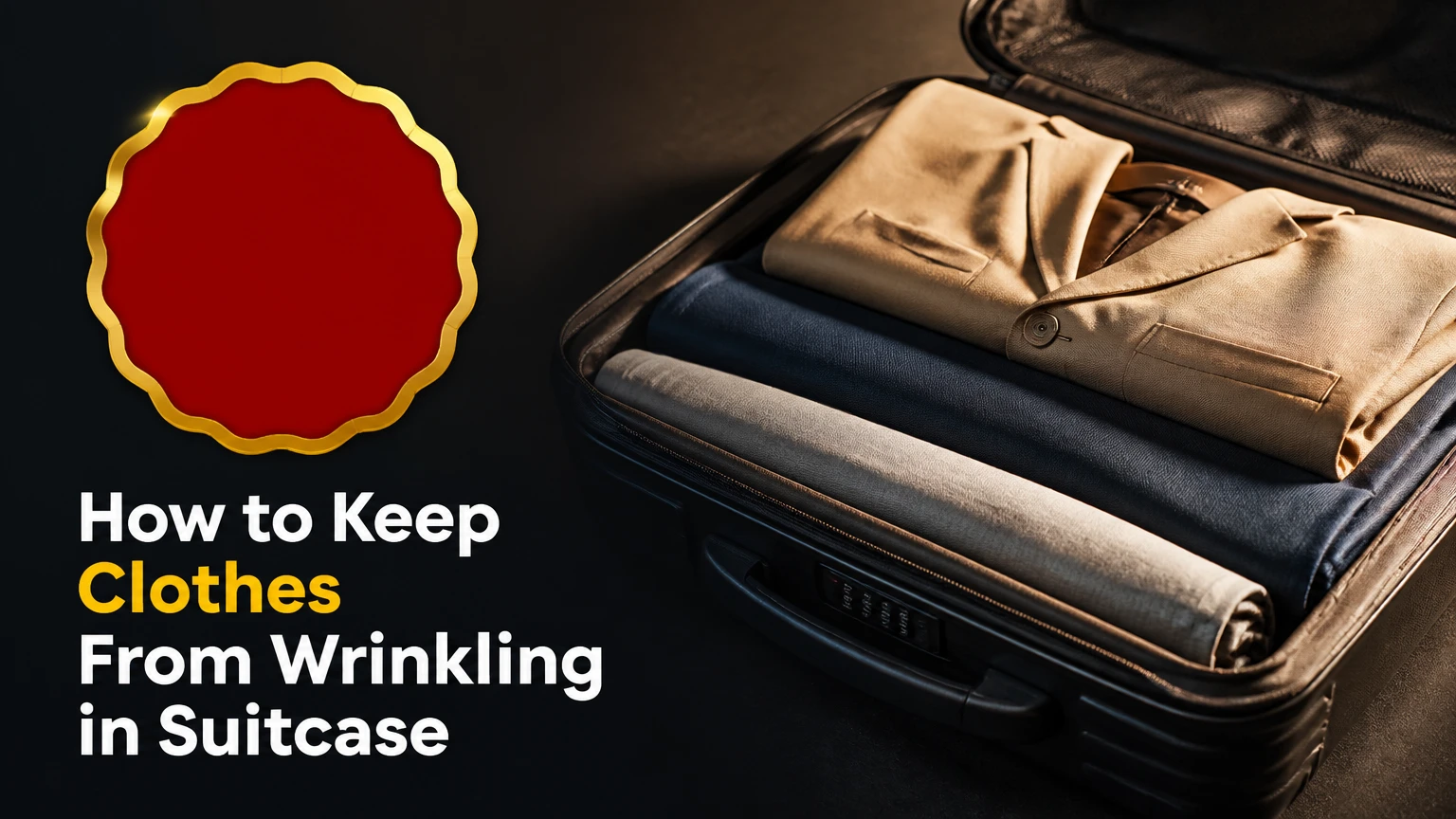
How to keep clothes from wrinkling in suitcase packing is a process of reducing friction, sharp folds, moisture, and sustained pressure. The most reliable approach combines rolling soft casual garments, folding structured pieces around a soft core, using a friction barrier, and unpacking within 10 minutes of arrival.
Key Facts for Wrinkle-Free Packing
- Pack clean, completely dry clothing because moisture makes fibers more likely to hold compressed creases.
- Roll T-shirts, athletic wear, pajamas, knitwear, and jeans, but fold tailored jackets and dress shirts.
- Use tissue paper or a thin plastic garment bag between formal garments to reduce fabric-to-fabric drag.
- Fill roughly 75-85% of the suitcase. A completely full case creates pressure, while a half-empty case allows shifting.
- Put shoes, toiletries, and dense denim near the wheels or bottom, with delicate garments above them.
- Hang clothing immediately after arrival, then use a steamer, wrinkle-release spray, or controlled bathroom steam for remaining lines.
Why Does Fabric Wrinkle in Transit?
Fabric wrinkles when fibers are bent, compressed, rubbed, or exposed to moisture while held in a distorted position. A suitcase creates all four conditions: clothing is folded into a small volume, pressed by neighboring items, shaken during movement, and sometimes packed before residual laundry moisture has evaporated.
Friction makes fabric bunch rather than slide smoothly. Pressure then fixes the bunched fabric into creases. Sharp folds create stronger lines than broad curves because the same area receives force along one narrow axis.
Fiber type changes the result. Cotton and linen absorb moisture and develop visible fold memory, while polyester blends and wool often recover better after hanging. Heat and humidity can relax some fibers, but excessive heat can damage elastane, silk, coatings, and synthetics.
In practice, the deepest wrinkles usually come from one of two mistakes: a suitcase packed beyond its closing capacity or a garment folded with a hard edge against a rigid suitcase wall. Removing either source often improves results more than buying a specialized organizer.
What Makes a Crease Permanent?
A travel crease becomes harder to remove when a garment remains compressed for many hours, especially in warm or humid conditions. The wrinkle is not permanent in the chemical sense, but cotton, linen, rayon, and viscose can retain the shape until moisture, steam, or pressing resets the fibers.
Pack garments only after they have cooled from ironing or drying. Warm clothing placed immediately into a tightly closed case can retain heat and humidity, which increases the chance of set-in folds.
Which Packing Method Fits Each Garment?
The best suitcase technique depends on structure, fiber, thickness, and the garment’s visible surfaces. Rolling reduces long fold lines in flexible clothing, while folding protects collars, lapels, pleats, and shoulder shaping that can deform inside a tight roll.
| Garment or fabric | Preferred method | Typical fold or roll size | Main wrinkle risk |
|---|---|---|---|
| Cotton T-shirt | Smooth roll | 3-4 inches diameter | Edge compression |
| Jeans or denim | Loose fold or roll | 4-6 inches diameter | Thick seam pressure |
| Merino knitwear | Loose roll | 5-7 inches diameter | Stretch and pilling |
| Silk blouse | Flat fold with tissue | 8-12 inches wide | Sharp creases and abrasion |
| Linen shirt | Flat fold with tissue | 10-14 inches wide | High fold memory |
| Wool blazer | Bundle wrap | 12-16 inches across | Lapel and shoulder distortion |
| Dress trousers | Long flat fold | One or two folds | Center-leg crease |
| Polyester athletic wear | Smooth roll | 3-5 inches diameter | Low, but possible, compression shine |
When Should You Roll Clothes?
Roll flexible garments that have few rigid features and can tolerate gentle compression. A smooth roll works particularly well for T-shirts, underwear, socks, leggings, casual shorts, pajamas, and most jersey garments because the curved surface avoids one dominant fold line.
Lay the garment face down, close buttons and zippers, fold sleeves inward, and smooth the fabric before rolling from the hem. Roll firmly enough to prevent loose bunching, but do not twist the garment or compress it into a hard cylinder.
Jeans can be rolled, although their thick waistbands and seams may press lines into thinner items. Place denim low in the suitcase or use it as a perimeter layer rather than putting it on top of shirts.
When Is Folding Better Than Rolling?
Fold garments with collars, lapels, structured shoulders, pleats, boning, or delicate surface finishes. Folding also works better for clothing that must arrive presentation-ready, because a tight roll can distort a shirt collar or create a spiral crease across a blazer.
Place tissue paper across the garment before each major fold. The paper gives adjacent surfaces a low-friction sliding layer and slightly increases the fold radius. Fold along existing construction lines, such as a trouser crease or shirt side seams, instead of making new diagonal folds.
How to Arrange a Suitcase
Suitcase organization prevents crushing by separating dense objects from vulnerable garments and by stopping clothing from migrating during handling. The correct arrangement places hard, heavy items low and toward the wheel end, while formal and delicate pieces remain near the top with minimal pressure above them.
Use this sequence:
- Put shoes in bags along the wheel end and outer edges. Fill each shoe with socks, a belt, or underwear to use the cavity without pressing the sole against clothing.
- Add toiletry bags, denim, coats, and other dense items in the bottom zone. Keep liquids sealed separately.
- Place rolled casual clothing in the middle, filling broad spaces without forcing rolls into corners.
- Fold shirts, dresses, trousers, and lightweight blouses flat near the top.
- Lay a blazer or suit jacket flat, then place a thin tissue sheet or garment bag over it.
- Fill small gaps with soft items so clothing cannot slide, but stop when the case requires force to close.
- Close the suitcase gently and check whether the contents can shift more than about 1 inch when the case is moved.
| Suitcase zone | Recommended contents | Protection method | Typical pressure level |
|---|---|---|---|
| Wheel-side base | Shoes, denim, toiletry kit | Shoe bags and sealed liquids | High |
| Center layer | T-shirts, knitwear, pajamas | Rolls or loose cubes | Medium |
| Perimeter gaps | Socks, belts, swimwear | Soft gap filling | Low |
| Upper layer | Shirts, blouses, trousers | Flat fold and tissue | Low |
| Final surface | Blazer, dress, delicate item | Garment bag or tissue | Lowest |
How Full Should a Suitcase Be?
A suitcase should usually be filled to approximately 75-85% of its usable volume. That range creates enough support to limit movement without applying the continuous compression produced by an overstuffed case.
The percentage is a practical packing target, not a luggage-industry standard. The better test is mechanical: the contents should remain arranged when the suitcase is tilted, and the lid should close without someone sitting on it or pulling the zipper against resistance.
An underfilled case needs soft perimeter packing, not more dense clothing. An overfilled case needs fewer items, not stronger compression cubes. Compression solves volume problems by increasing pressure, which is exactly the condition that formal garments tolerate poorly.
Expert insight: Compression bags save space by removing air from thick garments, but they do not remove fabric mass. A compressed sweater still presses against everything around it, so the space gain can increase crease depth in nearby shirts.
How to Pack Suits, Dress Shirts, and Dresses
Structured clothing needs surface support, broad folds, and protection from abrasion. A bundle method works well because the garments wrap around a soft center instead of bending repeatedly along one narrow line.
Packing a Blazer or Suit Jacket
Button the jacket, turn one shoulder inside out, and place the other shoulder into that pocket so the jacket lies with its lining outward and its shoulder shape supported. Fold the jacket lengthwise, then place it flat across the suitcase or wrap it around a soft bundle of underwear and T-shirts.
Do not pack shoes, chargers, or toiletry containers inside the jacket’s chest area. Hard objects create localized pressure marks that steaming may not fully remove. Keep the lapels aligned and avoid placing a wheel-side corner directly under the shoulder.
For a two-piece suit, fold trousers along their existing crease and lay them across the jacket rather than stacking them tightly on top. This distributes pressure and reduces a second sharp crease.
Packing Dress Shirts
Close the top button and at least one middle button, then place the shirt face down. Fold each sleeve across the back at a shallow angle, smooth the cuffs, and fold the sides inward before making one broad horizontal fold below the collar.
Collars should face upward or remain supported by the shirt body. Stuffing socks into a collar can stretch it, while placing a rigid belt inside can leave a pressure mark.
A thin tissue sheet between shirts reduces rubbing. A plastic dry-cleaning bag provides more slip, but clothing must be fully dry because sealed plastic can retain moisture and odor.
Packing Dresses and Skirts
Fasten zippers and hooks, smooth the dress on a bed, and fold it along the least visible construction lines. Leave a section of the hem extending beyond the suitcase edge while packing the bodice, then fold the hem over the top after the case is nearly full.
This technique protects the most visible lower section from repeated folds. It works better for long dresses than forcing the garment into several compact rectangles.
Do Packing Cubes and Compression Bags Prevent Wrinkles?
Standard packing cubes reduce movement and preserve organization, but they do not automatically prevent wrinkles. Compression cubes and vacuum bags reduce volume by applying additional force, so they are useful for bulky casual garments and risky for linen, silk, tailored wool, and pressed cotton.
| Packing aid | Typical USD cost | Best contents | Wrinkle effect |
|---|---|---|---|
| Standard packing cube | $10-$35 per set | T-shirts, underwear, knitwear | Low to moderate risk |
| Compression cube | $20-$50 per set | Sweaters, fleece, coats | Moderate to high risk |
| Tissue paper pack | $5-$15 | Silk, linen, dress shirts | Lowers friction |
| Plastic garment bag | $0-$10 | Suits, dresses, jackets | Lowers abrasion, retains moisture |
| Shoe bag | $5-$15 | Footwear and belts | Prevents sole contact |
| Travel steamer | $25-$80 | Mixed fabrics after arrival | Removes recovery wrinkles |
Use one cube for rolled casual wear and leave it slightly loose. A cube that must be forced shut transfers pressure to every garment inside. Keep formalwear outside compression systems, preferably in the suitcase’s garment compartment or upper layer.
Does Tissue Paper Really Help?
Tissue paper helps by allowing adjacent fabric surfaces to slide instead of grabbing each other during movement and compression. It cannot prevent a wrinkle caused by overpacking, but it often reduces the number of sharp secondary creases in silk, linen, rayon, and dress shirts.
Use acid-free tissue when possible, especially for light-colored or delicate garments. Avoid newspaper because ink can transfer, and avoid thick paper that creates its own ridges. One sheet inside the garment and one between stacked garments is usually sufficient.
How Fabric Choice Changes Travel Results
Fabric performance depends on fiber composition, weave, finish, and garment construction. A shirt labeled “wrinkle resistant” may recover faster than untreated cotton, but that label does not mean the shirt can be compressed indefinitely without creasing.
| Fabric category | Recovery after hanging | Moisture sensitivity | Best travel treatment |
|---|---|---|---|
| Merino wool | Good within 1-3 hours | Moderate | Loose roll or broad fold |
| Polyester blend | Very good within 30-90 minutes | Low | Roll or light cube |
| Cotton poplin | Fair within 2-6 hours | High | Fold with tissue |
| Linen | Poor to fair within 4-12 hours | High | Broad fold, then steam |
| Silk | Fair within 2-6 hours | Sensitive to water and heat | Tissue barrier, no tight compression |
| Rayon or viscose | Poor within 4-12 hours | High, especially when wet | Flat fold, minimal pressure |
| Elastane blend | Good within 1-3 hours | Low to moderate | Smooth roll, avoid high heat |
Merino wool, polyester blends, nylon, and jersey knits usually recover more readily than pure linen or untreated cotton. A small amount of elastane can improve recovery, but the fiber percentage alone does not guarantee wrinkle resistance because weave and finish also matter.
The American Cleaning Institute recommends following the garment care label because fiber blends and finishes can require different water and heat limits. That advice matters after travel: a high-heat hotel iron can flatten shine into polyester or damage elastane even when the garment appears sturdy.
Expert insight: The visible wrinkle often comes from construction, not the fabric label. A cotton shirt with a broad, relaxed weave may recover better than a tightly tailored polyester shirt whose seams and placket force pressure into fixed lines.
What Is the Best Method for a Business Trip?
A business trip calls for a hybrid system: carry the suit jacket and other high-value formalwear when possible, fold the remaining structured garments with tissue, and roll only flexible base layers. This approach protects appearance while reserving suitcase space for casual items.
For a two-day trip, a typical compact kit includes one suit, two dress shirts, one pair of trousers, two undershirts, two pairs of socks, underwear for each day plus one spare, and one casual outfit. Place the suit above all dense items and use a garment folder rather than a compression cube.
If the airline allows a personal item, keep the jacket, one shirt, and essential presentation clothing in the cabin. Checked luggage can be delayed or exposed to rough handling, and no packing method guarantees a pressed jacket after several hours under other bags.
What to Do After Arrival
Immediate unpacking limits the time clothing remains compressed and lets gravity restore broad shapes. Hang shirts, trousers, dresses, and jackets within about 10 minutes of reaching the room, then smooth seams and pull the fabric gently rather than stretching it.
| Recovery method | Typical time | Suitable fabrics | Main limitation |
|---|---|---|---|
| Hanging and hand smoothing | 30 minutes-3 hours | Wool, polyester, knits | Does little for sharp cotton lines |
| Wrinkle-release spray | 5-15 minutes | Cotton blends, synthetics | Test dark or delicate fabric first |
| Bathroom steam | 10-20 minutes | Cotton, linen, wool | Humidity is uneven and slow |
| Handheld steamer | 3-10 minutes per garment | Most steam-safe fabrics | Needs water and an outlet |
| Hotel iron | 2-8 minutes per garment | Iron-safe cotton and linen | High heat can scorch or shine fabric |
Bathroom steam can relax light wrinkles, but the often-repeated idea that exactly eight minutes is sufficient has no dependable universal basis. Room size, shower temperature, ventilation, and fabric weight change the result, so use 10-20 minutes and keep garments away from direct water.
For a handheld steamer, hang the garment vertically, pull the lower edge gently, and move the steam head continuously. Check the care label first. Do not use high heat on silk, coated fabrics, or garments marked “dry clean only.”
Do not spray a wool or cashmere garment with a homemade vinegar mixture unless the care label and a hidden-fabric test support it. Vinegar can affect dyes, finishes, and odor perception, while controlled steam or professional pressing is safer for expensive fibers.
Common Packing Problems and Their Fixes
The most frequent failure is treating every garment as if it responds identically to rolling, compression, and heat. A packing system should match the garment’s structure and recovery behavior.
- Deep horizontal lines: Reduce the number of folds and add tissue at the fold surface.
- Shiny patches: Keep irons and hard objects away from synthetic fabric.
- Musty smell: Repack only when garments are fully dry and use breathable storage.
- Shirt collars crushed: Keep collars supported by the shirt body, never packed under shoes.
- Clothes scattered inside the case: Add soft gap fillers or a lightly packed cube.
- Wrinkles around zippers and seams: Close fasteners and fold along construction lines.
- Damp clothing after swimming: Use a separate waterproof bag until the clothing can dry fully.
- Dirty and clean items mixed together: Reserve one washable bag for worn clothing.
Expert insight: A garment bag inside a fully packed suitcase can increase wrinkles if it creates a stiff, oversized bundle. The bag works best when the garment has room to lie flat, not when it is folded into a rigid package under maximum pressure.
A Low-Cost Packing Setup
Most travelers do not need a vacuum system or a specialized garment folder. A practical low-cost setup uses ordinary household items that reduce movement and contact without compressing clothing excessively.
| Item | Typical USD cost | Quantity for one trip | Function |
|---|---|---|---|
| Acid-free tissue paper | $5-$15 | 5-10 sheets | Reduces friction |
| Reusable shoe bags | $5-$15 | 1-2 bags | Isolates soles |
| Standard packing cube | $10-$20 | 1-2 cubes | Controls casual clothing |
| Thin plastic garment bag | $0-$10 | 1-2 bags | Protects formalwear |
| Travel wrinkle spray | $8-$15 | 2-3 ounces | Eases minor creases |
| Handheld steamer | $25-$80 | 1 device | Faster destination recovery |
For a typical trip, spend about $20-$50 on tissue, shoe bags, one cube, and a small spray. Add a steamer only if you travel frequently, wear formal clothing, or regularly stay where irons are unavailable.
Frequently Asked Questions About how to keep clothes from wrinkling in suitcase
Should I Iron Clothes Before Packing?
Iron or steam clothing before packing, then let each piece cool and dry completely for at least 15-30 minutes. Packing warm fabric can trap moisture and heat, which encourages creases. Fold along the garment’s existing seams and add tissue to reduce friction during transit.
Can I Pack Clothes Straight From the Dryer?
Pack clothes only after they are fully dry and cool. Residual heat or moisture can make cotton, linen, rayon, and viscose hold compressed shapes more strongly. If a garment feels cool and dry at the collar, waistband, and seams, it is generally ready for the suitcase.
Are Plastic Bags Safe for Delicate Clothes?
Thin plastic garment bags reduce abrasion and help fabric slide, but they can trap humidity. Use them for completely dry suits, dresses, and shirts, and avoid sealing damp clothing inside. Acid-free tissue is preferable for long storage because it permits more air exchange.
How Do I Pack Clothes Without a Suitcase?
A duffel or backpack needs the same principles: roll flexible clothes, fold structured garments broadly, isolate shoes, and fill gaps without compression. Place formalwear against the back panel, use a thin garment bag, and avoid packing dense objects directly against collars or shoulders.
Should I Use a Packing Cube for Linen?
Use a standard, lightly packed cube for linen rather than a compression cube. Fold linen with tissue, keep the cube below its maximum capacity, and expect some creasing because linen has high fold memory. Plan to steam or hang linen for several hours after arrival.
What Is the Fastest Way to Remove Wrinkles at a Hotel?
A handheld steamer is usually the fastest controlled option, taking about 3-10 minutes per garment. If one is unavailable, hang the item during a 10-20-minute hot shower, then smooth seams by hand. Use a hotel iron only after checking the garment’s care label and heat tolerance.
Conclusion: The Reliable Suitcase Formula
How to keep clothes from wrinkling in suitcase travel comes down to controlling pressure, friction, moisture, and fold shape. Roll flexible clothing, fold formal pieces with tissue, keep the case at roughly 75-85% capacity, place heavy items below delicate garments, and hang everything within 10 minutes of arrival. No method eliminates every crease, but this combination produces the most reliable results without overcompressing the load.
