
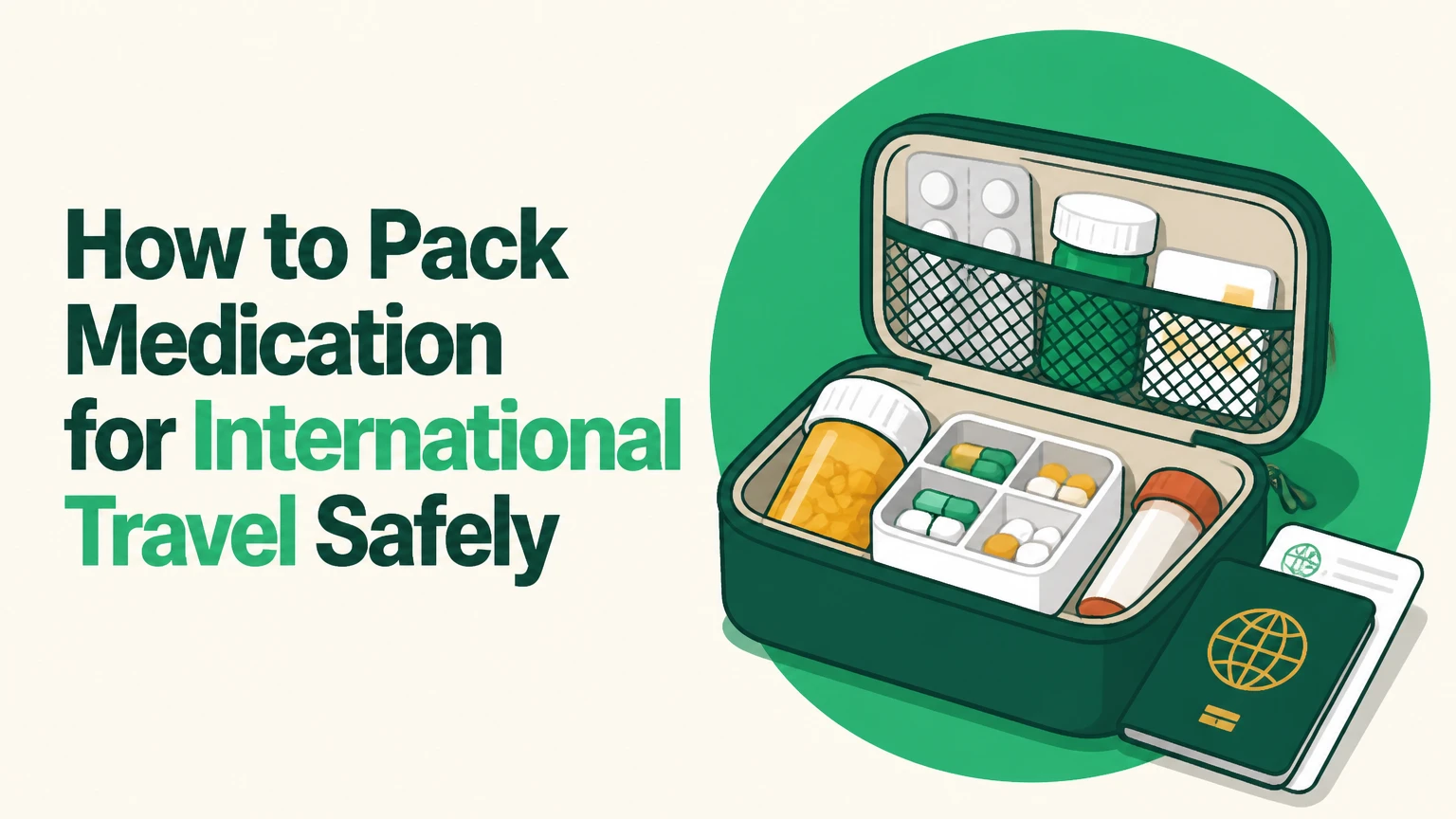
How to pack medication for international travel is a risk-management process that combines destination-law checks, original labeled packaging, medical documentation, and temperature protection. Keep the full working supply in your carry-on, verify every active ingredient with the destination and transit authorities, and prepare a replacement plan before departure.
Key Facts / Quick Answer
Check the destination country’s rules for each active ingredient 4-8 weeks before departure, especially controlled medicines, stimulants, sedatives, opioids, codeine, and pseudoephedrine.
Keep prescription and essential OTC medication in original pharmacy packaging with your name, drug name, strength, directions, and quantity visible.
Carry enough for the trip plus a typical 3-7-day delay reserve, subject to the destination’s personal-import limit.
Medically necessary liquids can receive an aviation-security exception to the standard 100 ml limit, but passengers should declare them for inspection.
Store insulin, biologics, and other temperature-sensitive products according to the manufacturer’s temperature range, not a generic cooler setting.
Carry a signed clinician letter, printed prescription, medicine list, and copies of permits in both paper and offline digital form.
What Must Be Checked Before Departure?
International medication packing works only when three separate systems agree: the medicine must be legal in the destination, physically stable during transit, and accessible if travel plans change. Airline screening rules govern the flight, while customs and pharmaceutical laws govern importation after landing.
A medicine legal in the United States can require a permit, quantity restriction, or advance approval elsewhere. Japan, Singapore, the United Arab Emirates, Indonesia, and some European countries impose special controls on particular stimulants, sedatives, opioids, decongestants, or cannabis-derived products. A connection can also create a second legal checkpoint.
The U.S. Department of State advises travelers to check foreign medication restrictions with the destination embassy. The International Narcotics Control Board, or INCB, publishes country-specific information for some controlled medicines, but embassy instructions remain the controlling source because rules and application procedures change.
The Four-Source Verification Method
Use these sources in order, and save the answers in writing:
- Destination embassy or consulate: Confirm whether the active ingredient is permitted, restricted, or prohibited.
- Transit-country authority: Check every country where you leave the international transit area or pass through customs.
- Airline: Ask about medical devices, dry ice, refrigerated containers, and cabin storage limits.
- Airport security authority: Review screening procedures for liquids, needles, pumps, oxygen, and cooling packs.
Do not rely on a brand name alone. Search the generic name, active ingredient, salt form, concentration, and delivery system. “Adderall,” for example, identifies a brand, while amphetamine salts determine how many authorities classify the medicine.
How Should Medication Be Organized?
Prescription medication should remain in the pharmacy-dispensed container whenever possible. The label should connect the medicine to the traveler through a matching name and identify the drug, strength, directions, prescriber, and dispensing quantity.
A weekly pill organizer can help with daily use after customs, but it is poor evidence of lawful ownership at a border. A customs officer cannot reliably identify loose tablets by appearance, and different manufacturers may produce similar-looking pills.
The Centers for Disease Control and Prevention advises travelers to “keep medicines in their original, labeled containers.” That instruction protects against identification problems, dosing confusion, and questions about whether a medicine was transferred or altered.
Carry-On, Backup, and Daily-Use Zones
Use separate zones rather than scattering bottles through luggage. The primary supply and documents stay together, while a small day-use pouch can make dosing easier after security.
| Zone | Contents | Typical quantity | Location | Main reason |
|---|---|---|---|---|
| Immediate-use pouch | Next flight doses, inhaler, rescue medicine | 24 hours | Personal item | Access during boarding and delays |
| Primary medical pouch | Prescription and essential OTC medicines | Trip supply plus 3-7 days | Carry-on | Prevents loss and cargo temperature exposure |
| Document sleeve | Letter, prescription, permits, medicine list | 2 paper sets | Carry-on | Fast security and customs presentation |
| Recovery reserve | Replacement doses where lawful | 3-7 days | Separate carry-on compartment | Protects against delay or theft |
| Nonessential duplicate | Vitamins, low-risk remedies | 1 trip supply | Carry-on or checked bag | Reduces crowding in the medical pouch |
Keep medicines together but do not conceal them. Clear packing lets security staff inspect the contents quickly and reduces the chance that a rushed search separates a bottle from its documents.
Original Containers Compared With Space-Saving Options
| Packing method | Identification quality | Typical cost | Best use | Main weakness |
|---|---|---|---|---|
| Pharmacy bottle or box | Highest | $0-$10 | Prescriptions and controlled drugs | Bulky for long trips |
| Manufacturer blister pack | High | $0-$15 | Tablets supplied in sealed strips | Label may be on outer carton |
| Pharmacy vacation fill | Highest | Normal copay plus $5-$30 | Long trips and delay reserve | Requires advance pharmacy approval |
| Weekly pill organizer | Low at customs | $5-$25 | Daily use after inspection | Weak proof of contents |
| Zip bag with loose pills | Very low | $1-$5 | Not recommended for prescriptions | Pills cannot be verified |
| Compact medical pouch | Depends on containers | $15-$60 | Organizing labeled packages | Does not replace original labels |
A pharmacy may be able to print smaller auxiliary labels or dispense a travel quantity. Never remove the identifying label to save space. For liquids, preserve the manufacturer carton when it identifies concentration, storage conditions, or an attached measuring device.
Which Documents Should You Carry?
A medication travel file should prove identity, medical need, lawful possession, and prescribed use. Carry the original paper documents in your personal item, then store scanned copies offline on an encrypted device or secure cloud account.
A clinician letter is especially useful for controlled medicines, injectable supplies, syringes, medical devices, and quantities exceeding a short trip. The letter should use the traveler’s passport name and list:
- Diagnosis or medical indication, without unnecessary private detail
- Generic and brand names
- Strength, dose, frequency, and route of administration
- Total quantity and treatment duration
- Need for syringes, needles, lancets, pumps, or cooling
- Clinician’s name, license details, contact information, signature, and date
- Statement that the medicine is for the named traveler’s personal treatment
A printed prescription supports the letter but does not replace an import permit. Some countries require an application several weeks before arrival, a translated document, a physician registration number, or a specific quantity ceiling.
| Document | Who issues it | Typical preparation time | What it proves | Copy to carry |
|---|---|---|---|---|
| Pharmacy label | Dispensing pharmacy | Same day | Medicine identity and patient link | Original plus photo |
| Printed prescription | Prescriber or pharmacy | 1-5 business days | Prescribed treatment | 2 paper copies |
| Medical letter | Treating clinician | 3-14 days | Medical need and devices | Signed original plus copy |
| Import permit | Destination authority | 2-8 weeks, typical | Legal entry approval | Original plus digital scan |
| Translation | Certified translator if required | 3-10 days | Local-language readability | Original and translation |
| Medicine list | Traveler or clinician | Same day | Complete trip inventory | Paper and offline file |
Avoid including an entire medical record. Customs officials generally need a concise treatment explanation, not unrelated diagnoses or laboratory results. Use a password-protected digital copy because an unlocked phone can expose more health information than necessary.
How Do Controlled and OTC Medicines Change the Plan?
Controlled and apparently ordinary OTC medicines need ingredient-level screening before international travel. Pseudoephedrine, codeine, dextromethorphan, tramadol, methylphenidate, amphetamine, diazepam, lorazepam, zolpidem, testosterone, CBD, and some injectable hormones can trigger additional requirements or restrictions.
The U.S. Food and Drug Administration warns travelers not to assume that a prescription is legal abroad. The U.S. Department of State similarly notes that foreign governments may treat common medicines as controlled substances and may impose severe penalties for possession without authorization.
Do not ship medicine to yourself unless the destination authority explicitly permits that method. Packages can be detained, returned, or treated as commercial imports, and replacement products may have different strengths or ingredients.
Quantity, Refill, and Permit Planning
There is no universal international 90-day rule. A 30-day limit is common in some systems, a 90-day personal-use limit is common in others, and controlled drugs may have a much shorter limit or require a permit regardless of trip duration.
Use the smallest lawful quantity that covers the itinerary and an evidence-based delay reserve. Ask the destination authority whether the reserve counts toward the personal-import maximum.
| Trip situation | Medication quantity to request | Typical lead time | Legal question | Practical action |
|---|---|---|---|---|
| 7-day trip | 7 days plus 3-7 days | 2-4 weeks | Is a short personal supply allowed? | Keep all doses in carry-on |
| 21-day trip | 21 days plus 3-7 days | 2-4 weeks | Does the country cap quantities at 30 days? | Use a pharmacy travel fill |
| 45-day trip | 45 days plus delay reserve | 4-8 weeks | Is a permit required above 30 days? | Obtain written approval |
| 90-day trip | 60-90 days if lawful | 6-10 weeks | Does the medicine have a lower cap? | Confirm quantity before filling |
| Controlled medicine | Authority-approved amount | 6-12 weeks, typical | Is an import permit mandatory? | Apply before booking final travel |
Insurance early-refill rules can prevent a longer supply. Contact the insurer and pharmacy at least 4-6 weeks before departure, and ask whether the prescription can be filled in a single package with a label showing the full quantity.
What Goes in the Carry-On?
All doses needed during travel, plus the full essential supply, belong in a carry-on or personal item. Checked luggage can be delayed, misrouted, or exposed to temperatures that fall outside a medicine’s storage specification.
The FDA’s travel guidance states, “Do not put your medications in your checked luggage.” This is especially important for insulin, seizure medicine, anticoagulants, steroids, rescue inhalers, epinephrine, transplant medicine, and drugs where even one missed dose creates medical risk.
Keep the medical pouch under the seat when possible. An overhead bag may become inaccessible during turbulence, a gate check, or a full flight.
A Practical Carry-On Layout
Place the pouch where it can be removed without unpacking clothing. Put liquid medication and cooling equipment near the top, with the documents in an external sleeve.
| Item | Packing position | Inspection treatment | Delay reserve | Example |
|---|---|---|---|---|
| Tablets and capsules | Labeled pouch in cabin bag | Present bottles if asked | 3-7 days | Blood-pressure medicine |
| Liquid prescription | Separate transparent medical bag | Declare before screening | Full trip supply | Antibiotic suspension |
| Injection device | Protective case beside medicine | Show prescription letter | 3-7 days | Insulin pen |
| Needles and syringes | Original sterile package | Carry documentation | Trip quantity | Diabetes supplies |
| Rescue medicine | Personal-item front pocket | Keep immediately accessible | 1 spare where lawful | Epinephrine auto-injector |
| Backup documents | Document sleeve | Present only when requested | 2 sets | Permit and prescription |
Do not leave medicine in a hot parked vehicle, on a sunny airport windowsill, or against a frozen gel pack. A cooler protects against heat only when the product does not freeze and the container is monitored.
How Are Liquids, Needles, and Devices Packed?
Medically necessary liquids, gels, creams, aerosols, and injectable supplies can usually receive an exception to the standard 100 ml, or 3.4 oz, aviation-security limit, but screening personnel may inspect or test them. The exception applies to security screening, not automatically to destination customs law.
Tell the security officer that the bag contains medically necessary items before the X-ray or CT screening begins. Keep the original container, prescription, and clinician letter available. Airport procedures differ, so check the departure airport and airline rather than assuming the same process for the return flight.
Needles should remain capped or in sterile packaging and travel with the medicine or a medical device. Place used sharps in an approved sharps container after use. Never put loose needles into a toiletry pouch.
Examples that deserve separate preparation include:
- Insulin pens, vials, and glucose sensors
- EpiPens and other auto-injectors
- Asthma inhalers and spacers
- Liquid antibiotics and compounded medicines
- Injectable biologics and prefilled syringes
- CPAP supplies, pumps, and electronic dosing devices
- Glucose meters, lancets, and test strips
Security approval does not guarantee that a border officer will accept an unlabeled product. The label and destination law remain decisive.
How Are Refrigerated Medicines Protected?
Refrigerated medicines must follow the manufacturer’s stated temperature range and excursion time, not a generic “keep cool” assumption. Many biologics require 2-8°C, while some products can tolerate room temperature for a defined period; the package insert controls the decision.
An insulated medical cooler is useful for transit but does not automatically provide refrigeration. A frozen gel pack can freeze insulin or a biologic if it touches the vial, and dry ice may require airline approval because carbon dioxide displaces oxygen in confined spaces.
| Product category | Typical storage target | Transit method | Typical cooler price | Key failure |
|---|---|---|---|---|
| Unopened insulin | 2-8°C | Insulated case, no direct ice contact | $20-$80 | Freezing or overheating |
| Refrigerated biologic | 2-8°C | Validated cooler with thermometer | $40-$150 | Exceeding excursion time |
| Room-temperature biologic | 15-30°C, product-specific | Padded cabin pouch | $15-$60 | Unnecessary chilling |
| Liquid antibiotic | Product-specific | Original bottle in leakproof bag | $5-$40 | Leakage or incorrect discard date |
| Vaccine or specialty drug | Manufacturer range | Validated temperature logger | $60-$200 | Unrecorded temperature excursion |
A typical consumer medical cooler costs $20-$150, but price does not prove performance. Look for a stated hold time, temperature range, pack configuration, and instructions for preventing direct contact between frozen packs and medicine.
Ask the pharmacist what to do after an excursion. Do not discard an expensive medicine automatically, and do not use it automatically after overheating or freezing. The manufacturer or pharmacist may determine whether the product remains usable.
What Happens at Security and Customs?
Security screening checks items for transport safety; customs checks whether goods may enter the country. Passing airport security does not establish permission to import a medicine, and customs approval does not excuse airline restrictions on devices or cooling materials.
At security, declare medically necessary liquids, needles, and cooling packs before inspection. At customs, answer questions directly, present the documents, and declare controlled medicines when the arrival form or officer requires declaration.
The Arrival Sequence
- Keep the medical pouch and document sleeve accessible until leaving the airport.
- Follow the arrival form instructions for prescription drugs, controlled substances, and medical devices.
- Use the designated customs channel when the country requires declaration.
- Show original labels, the prescription, clinician letter, and permit together.
- State the medicine’s generic name, intended personal use, and quantity.
- Ask for a written receipt or incident record if an officer retains anything.
- Contact the embassy, insurer, clinician, or local regulator before seeking a replacement.
Do not argue about a classification at the counter. If an officer questions a medicine, request the applicable procedure and keep a record of the officer’s instructions, time, and location.
Which Packing Method Is Best for Different Trips?
Original pharmacy containers are the safest default, while daily organizers are a convenience tool rather than a border-compliance method. The best setup changes with medicine type, trip length, temperature requirements, and the strictness of destination rules.
| Traveler profile | Recommended setup | Avoid | Typical preparation cost | Why |
|---|---|---|---|---|
| One-week tablet user | Original bottles plus personal pouch | Loose pills | $0-$25 | Simple identification |
| Family with five prescriptions | Labeled bottles in one organizer | Mixing family members’ drugs | $15-$60 | Prevents ownership confusion |
| Insulin user | Cabin cooler, thermometer, letter | Frozen packs touching insulin | $30-$150 | Maintains product range |
| Controlled-medicine user | Original package, permit, letter | Extra unapproved reserve | $10-$100 plus permit fees | Quantity and legality matter |
| Long-term traveler | Pharmacy travel fill, scanned records | Mailing medication without approval | $20-$150 | Supports replenishment planning |
| Traveler with liquid medicine | Medical liquids bag, original bottles | Decanting into travel bottles | $5-$40 | Preserves concentration and labels |
A small organizer can be placed inside the carry-on after arrival, but transferring all tablets before the border crossing creates avoidable uncertainty. The space saved rarely compensates for the risk of delay or confiscation.
What Are the Most Common Failure Points?
The most frequent problems occur before the airport, when travelers confuse airline security permission with foreign import permission. A medicine may pass screening and still be seized at customs because the active ingredient is restricted.
Expert insight: The label matters more than the container’s appearance. A branded travel case does not establish identity, while a plain pharmacy bottle with a complete label often answers the first customs question immediately.
Expert insight: A delay reserve is not automatically lawful. If the destination allows 30 days, carrying 37 days can create a quantity problem even when the extra week is medically sensible. Confirm the cap before adding reserve doses.
Expert insight: Cooling is often more dangerous than moderate warmth. Direct contact with frozen packs can damage insulin and biologics, so separation, insulation, and a temperature indicator matter more than buying the largest cooler.
Avoid these specific mistakes:
- Packing the only supply in checked baggage
- Removing labels to reduce weight
- Using a brand name without checking the generic ingredient
- Assuming an OTC product is legal because it needs no prescription at home
- Carrying CBD oil, cannabis products, or hemp extracts without country-specific approval
- Bringing a letter that uses a nickname instead of the passport name
- Storing every document only in an internet-dependent phone app
- Replacing a medication locally without checking strength, formulation, and counterfeit risk
- Leaving medicine in a hotel safe when a dose is due during an excursion
- Failing to check return-country rules separately from departure-country rules
How Should You Plan Long Trips and Time-Zone Doses?
Long trips require a replenishment strategy, not simply a larger suitcase supply. Ask the destination regulator whether local refills, imports by mail, or a second personal entry are permitted, then identify a licensed clinic or pharmacy before departure.
Time-zone changes can alter dose intervals, especially for insulin, anticoagulants, seizure medicine, steroids, hormones, and medicines with narrow dosing windows. Ask the prescriber for a written adjustment plan that names the departure time zone, destination time zone, and daylight-saving changes.
Keep a medicine schedule in both local time and the original time zone until the adjustment is complete. Phone alarms should name the medicine and dose, not merely display a generic reminder.
If medication is lost, contact the treating clinician and insurer first. A foreign clinician may need to prescribe the locally available equivalent, and a pharmacist may need to verify the original package, prescription, or diagnosis before dispensing.
What Should the Final Packing Checklist Include?
Complete the checklist 4-8 weeks before departure, then perform a second physical check 24 hours before leaving. The later check catches expired supplies, changed flights, missing permits, and medicines accidentally placed in checked luggage.
| Checkpoint | Action | Completion target | Evidence to save |
|---|---|---|---|
| 8 weeks before | Verify ingredients and permits | 56 days before | Embassy email or permit |
| 6 weeks before | Request letter and travel refill | 42 days before | Signed letter and pharmacy receipt |
| 4 weeks before | Confirm airline and airport rules | 28 days before | Policy page and call notes |
| 1 week before | Photograph labels and documents | 7 days before | Offline encrypted files |
| 24 hours before | Count doses and inspect expiry dates | 1 day before | Final inventory |
| At departure | Declare medical liquids and devices | Security checkpoint | Inspection instructions |
| At arrival | Follow customs declaration rules | Border crossing | Receipt or record if needed |
Put the following in one accessible personal item:
- Full labeled medicine supply
- Three to seven days of additional medicine, if lawful
- Clinician letter and printed prescription
- Import permit and certified translation, if required
- Medicine list with generic names and strengths
- Syringes, needles, or device documentation
- Leakproof bags for liquids
- Temperature case and thermometer when indicated
- Pharmacy and clinician contact details
- Offline photos of every label and document
Frequently Asked Questions About how to pack medication for international travel
Can I bring vitamins and supplements across an international border?
Vitamins and supplements still fall under destination import rules, particularly when they contain CBD, hormones, stimulants, animal products, or high-dose ingredients. Keep commercial packaging and carry a reasonable personal quantity. Avoid unlabeled powders and loose capsules because customs cannot verify their composition or intended use.
Should I pack medicine in a pill organizer for a flight?
Pack the border-crossing supply in original labeled containers rather than a pill organizer. After customs, a daily organizer can simplify dosing if the original packages remain available. For controlled medicines, loose tablets create the greatest identification and ownership risk, even when the organizer is clearly divided by day.
Can I buy the same prescription medicine overseas?
Do not assume an overseas product is identical to the medicine dispensed at home. The country may use a different strength, formulation, salt, or counterfeit-prone supply chain. Contact your clinician and a licensed local pharmacy, and verify the active ingredient before changing products or doses.
What if my medicine is confiscated at customs?
Request the reason, legal basis, and a written record of the action without attempting to conceal another supply. Contact your destination embassy, treating clinician, insurer, and the local medicines regulator. Do not replace a controlled medicine through an informal seller, and do not take an unfamiliar substitute without professional confirmation.
Do medication rules change for a cruise or multi-country trip?
Cruise passengers must check every country where the vessel docks, not only the embarkation and final destination. A medicine permitted in one port may be restricted in another, while shipboard storage may not meet refrigeration requirements. Carry the full documents and keep the supply in your cabin carry-on.
Does a doctor’s letter guarantee entry with medication?
A doctor’s letter supports medical necessity but does not guarantee import permission. A destination may require an advance permit, a local-language translation, a quantity limit, or a prohibition despite the prescription. Verify the active ingredient and obtain written authorization when the authority requires it.
Conclusion
Safe international medication packing depends on legal verification, original labels, accessible carry-on storage, and product-specific handling. Start 4-8 weeks early, check destination and transit-country rules, prepare a 3-7-day reserve only when lawful, and declare medically necessary liquids or controlled medicines as required. That is how to pack medication for international travel without treating airline screening as a substitute for customs compliance.
