

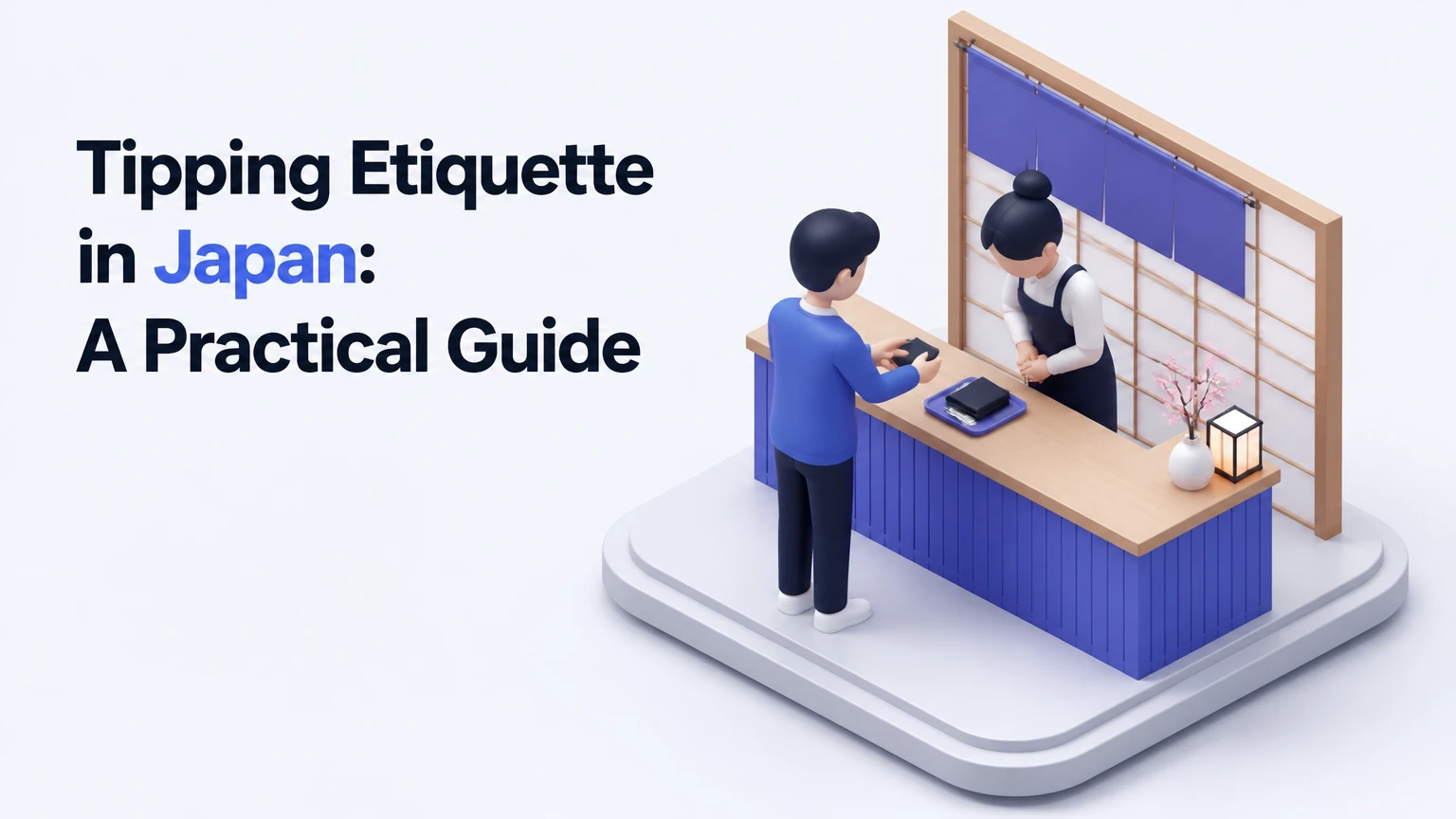
Tipping etiquette in Japan is a no-tip custom in which restaurants, taxis, hotels, and ordinary guides expect payment of the displayed amount, not an added percentage. Japan’s omotenashi hospitality model treats attentive service as part of the agreed price, while a few private, traditional, or luxury settings may accept a discreet gift or wrapped payment.
Key Facts
Standard restaurant, café, taxi, and hotel tipping in Japan is $0.
A mandatory 10% consumption tax usually applies to taxable purchases, while a separate service charge may add 10%-15% at some luxury venues.
Izakaya table charges called otoshi or tsukidashi commonly cost about $2-$7 per person, using a typical exchange rate of ¥150 to $1.
A private guide may accept about $13-$33 for an exceptional, personalized, multi-day service, but no tip is required.
A ryokan gratuity, called kokorozuke, is a rare traditional gesture, not a standard hotel fee. If offered, use a clean envelope and present it before service begins.
A sincere “gochisousama deshita”, a polite bow, or a thoughtful small gift is usually more appropriate than loose cash.
What Does Tipping Etiquette in Japan Mean?
Tipping etiquette in Japan means paying the listed price without adding a gratuity, because ordinary service is already priced into the meal, fare, room, or activity. The rule covers most visitors’ situations, including restaurants, bars, convenience stores, taxis, trains, business hotels, and standard guided tours.
Japan National Tourism Organization states plainly that “tipping is not customary in Japan.” That statement is the safest operational rule for travelers. Some workers may accept appreciation in a carefully handled form, but acceptance does not create an obligation for future visitors.
The custom is connected to omotenashi, a hospitality ideal focused on anticipating a guest’s needs without openly demanding a reward. Omotenashi does not mean every Japanese worker receives a high wage or that every business includes identical labor costs. It means the customer normally does not calculate an optional payment after service.
Why Is a Tip Often Refused?
A Japanese employee may refuse a tip because the business does not have a process for recording or distributing it, because the worker believes the bill is already settled, or because taking personal cash conflicts with workplace rules. Refusal is usually practical and polite rather than a judgment about the visitor’s character.
Cash offered directly can also create a problem for the employee. The worker may need to identify the owner, report the money, or chase a departing customer to return it. That administrative burden explains why leaving a bill on a table can produce an awkward result.
In practice, the mistake most visitors make is interpreting excellent attention as a signal to pay more. At a sushi counter, a taxi, or a family-run inn, careful service is often the normal professional standard rather than an invitation to negotiate compensation.
When Should You Pay More Than the Bill?
You should pay more than the displayed bill only when the amount is a mandatory charge already printed by the business or when a specific individual accepts a traditional, private expression of thanks. A visitor should never add an automatic 15%-20% gratuity merely because that percentage is normal in the United States.
The first step is to inspect the receipt, menu, booking confirmation, or hotel folio. Japanese businesses may show consumption tax, a seating fee, a private-room fee, a service charge, or a meal fee as separate line items.
| Charge or gesture | Typical amount in USD | Where it appears | Visitor action |
|---|---|---|---|
| Consumption tax | 10% | Restaurants, hotels, retail, attractions | Pay if included on the bill |
| Restaurant service charge | 10%-15% | Luxury hotels and fine dining | Do not add another percentage |
| Izakaya otoshi | $2-$7 per person | Pubs and drinking establishments | Accept as a seating or appetizer charge |
| Private-room charge | $7-$67 per room | Restaurants and karaoke venues | Confirm before ordering if unclear |
| Kokorozuke | $13-$33 typical gesture | Some traditional ryokans | Offer only when context supports it |
| Guide appreciation | $13-$33 typical gesture | Private, personalized, multi-day guiding | Offer privately at the final goodbye |
The conversion figures above use a typical planning rate of ¥150 per $1, not a guaranteed exchange rate. Your card issuer, bank, or exchange counter may produce a different dollar amount.
What Is Otoshi or Tsukidashi?
Otoshi, also called tsukidashi in some regions, is a compulsory appetizer or seating charge at many izakayas. The item is not a voluntary tip, and refusing it usually does not remove the charge because the fee is part of the establishment’s pricing system.
A typical charge is ¥300-¥1,000 per person, or about $2-$7 at the planning rate above. The food may arrive before the customer orders a main dish, which leads some visitors to assume it was served by mistake. The receipt normally includes the fee under a name such as otoshi, tsukidashi, or seat charge.
Regional wording varies. An Osaka establishment may use tsukidashi, while a Tokyo establishment may more often use otoshi, but the practical issue is the same: the customer pays the stated charge rather than tipping the server.
How Do Service Charges and Tax Work?
A service charge is a mandatory percentage added by a business, commonly 10%-15% at luxury hotels, Western-style restaurants, private dining rooms, or high-end bars. Japan’s national consumption tax is generally 10% for standard taxable goods and services, although reduced tax treatment applies to some food purchases and takeout situations.
A restaurant can therefore show both a service charge and consumption tax. For example, a menu price of $100 with a 10% service charge and 10% tax may produce a final bill near $121, depending on how the establishment applies tax. The service charge is not a tip that you need to duplicate.
| Example bill | Listed price | Added charge | Approximate final amount |
|---|---|---|---|
| Ordinary restaurant meal | $40 | 10% consumption tax | $44 |
| Luxury dinner | $100 | 15% service charge plus 10% tax | $126.50 |
| Izakaya meal for two | $60 | $10 otoshi plus 10% tax | $77 |
| Hotel room | $200 | 10% tax plus 15% service charge | $253 |
The table uses simplified arithmetic to show cost structure. Actual bills can include accommodation tax, local charges, private-room fees, or different tax treatment.
How Much Should You Tip in Common Situations?
For ordinary travel situations, the correct amount is $0. Pay the final displayed total, collect your change, and leave without placing additional cash on the table or in a vehicle.
| Situation | Normal additional payment | Typical payment method | Appropriate thanks |
|---|---|---|---|
| Casual restaurant | $0 | Cash register or card terminal | “Gochisousama deshita” |
| Fine-dining restaurant with service charge | $0 | Card or cash at the venue | Polite thanks to the staff |
| Taxi ride | $0 | Exact fare or accepted card payment | “Arigatou gozaimasu” |
| Business hotel | $0 | Folio settlement at checkout | Verbal thanks or review |
| Private guide, one-day group tour | $0 | Tour price or booking platform | Positive review |
| Private guide, multi-day custom tour | $13-$33 optional | Wrapped cash or gift at final goodbye | Specific personal thanks |
| Dedicated ryokan attendant | $0 normally | Room and meal price | Small gift or carefully wrapped kokorozuke |
| Hair salon or massage | $0 | Pay the displayed amount | Direct verbal appreciation |
These are customary practices, not legal limits. A company policy, booking platform, or guide’s written instructions can override a general custom.
Do You Tip Taxi Drivers in Japan?
You do not normally tip taxi drivers in Japan. Pay the meter fare, tolls, and any clearly stated surcharge, then take your belongings and thank the driver. Drivers may return an attempted overpayment, including a small amount left as rounding.
Japanese taxis often provide automatic doors, clean interiors, careful driving, and assistance with luggage. Those features are part of the paid service. A visitor who wants to show appreciation can say “arigatou gozaimasu” or bow slightly instead of adding money.
Late-night fares, expressway tolls, reservation fees, and airport transfers are different from gratuity. Check that the extra amount is a transport charge. A receipt can help separate a legitimate surcharge from a mistaken assumption about tipping.
Do You Tip Hotel Staff or a Ryokan Attendant?
You do not tip ordinary hotel staff in Japan, including bell staff, front-desk employees, housekeepers, or concierge staff. A traditional ryokan also does not require a gratuity, even when a nakai-san, or room attendant, provides elaborate meals and personalized assistance.
A rare exception is kokorozuke, a small advance expression of thanks associated with a dedicated attendant or an unusually personalized arrangement. It is more likely to arise at an intimate, high-end ryokan than at a large modern property. Many contemporary ryokans do not expect it.
If you choose to offer it, a typical planning amount is $13-$33 per room or party, not a percentage of the room rate. Give it only when the setting supports the gesture, and do not interpret a refusal as a social failure.
Do You Tip a Private Tour Guide?
A private, multi-day guide may accept $13-$33 as a personal thank-you, but guides do not require a tip for a normal one-day tour or a group excursion. The amount should reflect unusual effort, such as extensive itinerary changes, translation help, accessibility coordination, or sustained private driving assistance.
A small gift from your home country can be easier than cash, especially when the guide works for a company with strict money-handling rules. Avoid expensive gifts that create a tax, workplace, or reciprocity concern.
Offer appreciation at the final goodbye, not after the first greeting. Use a small envelope for cash, or present a modest packaged item with both hands while explaining that it is a thank-you.
How Should You Present a Traditional Cash Gift?
A traditional cash gesture should be enclosed in a clean, simple envelope and presented with both hands at an appropriate private moment. Do not pull wrinkled notes from a wallet and pass them across a crowded counter.
The process is straightforward:
- Prepare crisp, clean notes in advance.
- Place the money in a pochi-bukuro or another small decorative envelope.
- Write a brief name or thank-you message only if you can do so accurately.
- Wait until the end of a private interaction, unless the arrangement specifically calls for advance kokorozuke.
- Present the envelope with both hands and a slight bow.
- Say, “Arigatou gozaimasu”, or explain in simple English that it is a small thank-you.
- If the recipient declines, take it back immediately and thank them.
A plain envelope is safer than an elaborate ceremonial one when you do not know the symbolism. Avoid presenting loose coins, foreign currency that the recipient cannot easily exchange, or visibly worn banknotes.
What Is the Difference Between Kokorozuke and Chadai?
Kokorozuke is a discretionary advance payment or gift associated with a particular service arrangement, while chadai historically refers to money connected with tea, a room, or hospitality expenses. Neither term describes ordinary restaurant tipping in modern Japan.
The terms are culturally specific and not interchangeable in every region or property. Many visitors will never need to use either word. If a ryokan booking agent or host gives explicit instructions, follow that property’s practice rather than relying on a generic internet rule.
| Term | Approximate meaning | Usual timing | Modern traveler relevance |
|---|---|---|---|
| Kokorozuke | Small advance expression of thanks | Before personalized service | Rare and context-dependent |
| Chadai | Historic tea or room-related fee | At the hospitality encounter | Mostly traditional or historical contexts |
| Pochi-bukuro | Small gift envelope | Whenever cash is presented | Useful for discreet cash gifts |
| Nakai-san | Ryokan room attendant | During the stay | May receive thanks, not an expected tip |
The most important distinction is between a named cultural practice and a universal obligation. A term appearing on a travel forum does not mean every ryokan, guide, or restaurant follows it.
Where Does the Rule Change?
The no-tip norm changes most often at businesses designed for international customers, venues using an explicit service charge, private arrangements with a stated gratuity, and establishments staffed under foreign hospitality conventions. The location alone does not determine the rule.
| Setting | Likely tipping expectation | What to inspect | Recommended action |
|---|---|---|---|
| Tokyo luxury hotel | $0 optional tip | Folio service-charge line | Pay listed total |
| Kyoto traditional ryokan | $0 normally | Host’s written instructions | Ask discreetly if arranging special care |
| Osaka izakaya | $0 plus otoshi | Menu or receipt | Pay seating charge |
| Narita or Haneda airport service | $0 | Posted transfer price | Pay fare and stated fees |
| Foreign-owned hotel bar | $0 if service charge appears | Menu and receipt | Do not double-tip |
| Private villa with staff | Contract-specific | Booking agreement | Follow written policy |
International venues may place service charge included or gratuity included on a receipt. If the wording says service charge, the amount is already the establishment’s chosen compensation mechanism. If a venue explicitly says gratuity is excluded, ask whether the business expects an optional payment, rather than guessing from foreign habits.
Do Tokyo, Kyoto, and Osaka Have Different Rules?
Tokyo, Kyoto, and Osaka follow the same broad no-tipping norm. Differences arise from venue type, regional vocabulary, tourism exposure, and the formality of the service, not from a citywide tipping law.
Kyoto’s traditional hospitality businesses may be more likely to encounter kokorozuke questions because of ryokans, tea experiences, and private cultural arrangements. Osaka izakayas may use tsukidashi for a charge that Tokyo visitors often call otoshi. Tokyo’s international hotels may explain service charges in English.
A traveler should therefore identify the business category first. A Michelin-listed restaurant in Tokyo and a neighborhood noodle shop in Kyoto both generally expect no gratuity, while a private multi-day cultural guide in either city may accept a carefully presented thank-you.
What Should You Do If You Leave a Tip?
If you leave cash on a table or in a room, return promptly and explain that you intended it as a gift, because staff may treat the money as forgotten property. The business may place it in lost-and-found or send an employee after you to return it.
If the money is returned, accept it without repeated insistence. Say “sumimasen” if you caused confusion, then offer a verbal thank-you or a review instead.
If you already left the area, contact the restaurant, hotel, or guide through the booking channel. Do not assume the employee kept the money. Workplace policies may require staff to report or surrender unclaimed cash.
Is Tipping Insulting in Japan?
Tipping is not automatically insulting in Japan, but unsolicited loose cash can be confusing, awkward, or inappropriate because it contradicts the expected payment system. A discreet gift offered in a traditional context has a different meaning from adding money to a fast-food receipt.
Intent and context matter. A visitor who offers cash after exceptional service is usually understood as generous, but the recipient may still refuse because accepting personal money is not permitted or customary.
The practical rule is simple: do not label a rejected tip as an insult, and do not force the recipient to accept it. Respectful conduct means allowing the employee to follow local and workplace norms.
What Are Better Alternatives to a Tip?
The best alternatives are specific verbal thanks, a factual review, a small appropriate gift, or a recommendation that helps the business. These forms communicate appreciation without imposing an unfamiliar cash transaction on an employee.
- Say “gochisousama deshita” after a meal.
- Say “arigatou gozaimasu” when leaving a taxi, hotel, shop, or tour.
- Mention a staff member’s helpful action in a review.
- Bring modest packaged sweets or souvenirs from your home country.
- Return rented equipment clean and on time.
- Follow reservation, seating, photography, and payment rules.
- Ask before photographing staff or private spaces.
- Thank a guide for a specific result, such as arranging translation or adapting a route.
A review should name the business accurately and avoid promising that future customers should tip. A small gift should be inexpensive, unopened, and easy to carry. Food containing alcohol, meat, or allergens may not suit every recipient.
What Language Can Travelers Use?
The most useful phrases are short and situational. Pronunciation does not need to be perfect; a calm delivery and a bow or nod communicate the intended respect.
| Situation | Japanese phrase | Practical meaning | When to use |
|---|---|---|---|
| Leaving a restaurant | Gochisousama deshita | Thank you for the meal | After payment |
| General thanks | Arigatou gozaimasu | Thank you very much | Any service setting |
| Apology for confusion | Sumimasen | Excuse me or I am sorry | After a refused tip |
| Asking about a charge | Kore wa nan desu ka? | What is this? | When reading a receipt |
| Offering a gift | Osewa ni narimashita | Thank you for your care | At the end of a stay or tour |
Expert insight: Saying “gochisousama deshita” at a small family restaurant often fits the local interaction better than attempting a cash tip. The phrase acknowledges the food and labor without suggesting that the posted price was inadequate.
How Does Japan Compare With the United States?
Japan uses a more predictable displayed-price model, while the United States commonly expects an additional percentage for table service. The difference affects budgeting, staff interactions, menu interpretation, and the consequences of paying the wrong amount.
| Payment feature | Japan | United States |
|---|---|---|
| Standard restaurant tip | $0 | Typically 15%-25% |
| Taxi gratuity | $0 | Commonly 10%-20% |
| Menu-price expectation | Tax or charges may be separate | Tax and tip often added later |
| Staff response to extra cash | May refuse or return it | Usually accepts it |
| Typical payment location | Register, terminal, or server | Table terminal, app, or server |
| Service-charge meaning | Often mandatory venue fee | May replace or supplement tip |
The comparison is a budgeting tool, not a judgment about either system. Japan’s final amount can still rise through tax, otoshi, accommodation tax, transport tolls, or a service charge.
What Is the Main Financial Trap?
The main financial trap is assuming that “no tip” means “no additional charges.” A traveler can avoid gratuity and still underbudget if a luxury hotel adds a service charge, an izakaya adds otoshi, or a destination adds a local accommodation levy.
Read three places before committing to a high-cost booking:
- The menu or booking page for tax language.
- The reservation confirmation for service and facility charges.
- The receipt for seating fees, private-room costs, or transport surcharges.
For a $200 hotel room, a 15% service charge and 10% consumption tax can produce an approximate $253 total before other charges. For a $60 izakaya meal for two, a $10 combined otoshi charge plus 10% tax produces about $77.
Expert insight: The most reliable budget habit is to reserve a 10%-20% buffer for disclosed charges, not to reserve an American-style gratuity. That distinction prevents both underpayment and unnecessary overpayment.
What Are the Most Common Mistakes?
The most common mistakes involve transferring a familiar tipping system into a country with a different payment workflow. Each mistake is easy to prevent when the traveler identifies whether the extra amount is a charge, a gift, or neither.
| Mistake | Likely consequence | Better response | Recovery time |
|---|---|---|---|
| Leaving cash on a restaurant table | Staff may chase the customer | Pay at the register | Immediately |
| Adding 20% to a taxi fare | Driver may return the excess | Pay the meter amount | At destination |
| Refusing to pay otoshi | Delayed bill or dispute | Ask what the charge covers | Before departure |
| Insisting after a refusal | Employee discomfort | Accept the refusal | Immediately |
| Giving worn or loose notes | Gesture appears careless | Use a clean envelope | Before presentation |
| Tipping every hotel employee | Confusion and repeated refusals | Thank staff verbally | Throughout stay |
A foreign currency note can also be impractical. The recipient may not have a convenient exchange option, and a small denomination from another country may have little value.
Expert insight: Never use a tip to compensate for a language barrier. If a request, allergy, mobility need, or reservation problem matters, communicate it before service begins. Money offered afterward cannot reliably repair an unmet safety or access requirement.
Frequently Asked Questions About tipping etiquette in Japan
Should I tip at a Japanese café or coffee shop?
No. Japanese cafés generally expect payment of the displayed total, including any listed tax or charge. Leave the table, counter, or register without adding cash. Saying “arigatou gozaimasu” when receiving the order or departing is appropriate, especially at a small independent café.
Should I tip a Japanese chef at a sushi counter?
No standard gratuity is expected at a sushi counter. Pay the bill or settle the amount through the restaurant’s stated process. If the chef provided an unusually personal experience, express thanks directly or leave a factual review rather than placing cash beside the plates.
Can I give a gift to a Japanese host?
Yes, a modest, neatly packaged gift is usually more culturally seamless than money. Small sweets or souvenirs from your home country work well when they are easy to carry and do not contain ingredients the recipient may avoid. Present the gift with both hands and explain that it is a thank-you.
Should I tip a hotel housekeeper each day?
No. Daily housekeeping in Japanese hotels is included in the room price, and cash left in the room may be treated as lost property. Thank the staff through the front desk, a written note, or a positive review if the service was especially helpful.
Should I tip for luggage assistance at a train station?
No. Station staff and ordinary porters do not normally expect a gratuity. Pay any clearly posted delivery or storage fee, then thank the employee. If a private luggage-forwarding company lists a delivery price, that price replaces the need for an additional tip.
What if my booking confirmation says gratuity is excluded?
Ask the provider what “gratuity excluded” means in its specific policy. Some international operators use foreign wording without expecting a cash tip, while others may include an optional guide payment in the final checkout process. Follow the written policy and avoid handing loose cash directly to staff.
Final Rule for Tipping Etiquette in Japan
Tipping etiquette in Japan is best handled by paying the displayed total, checking for mandatory tax or service charges, and using words, gifts, or a review to show appreciation. Reserve wrapped cash for a clearly appropriate private arrangement, such as rare kokorozuke or exceptional multi-day guiding, and accept refusal immediately.
